Shadow Tankers, Real Consequences: The Rising Clash On The World’s Oceans
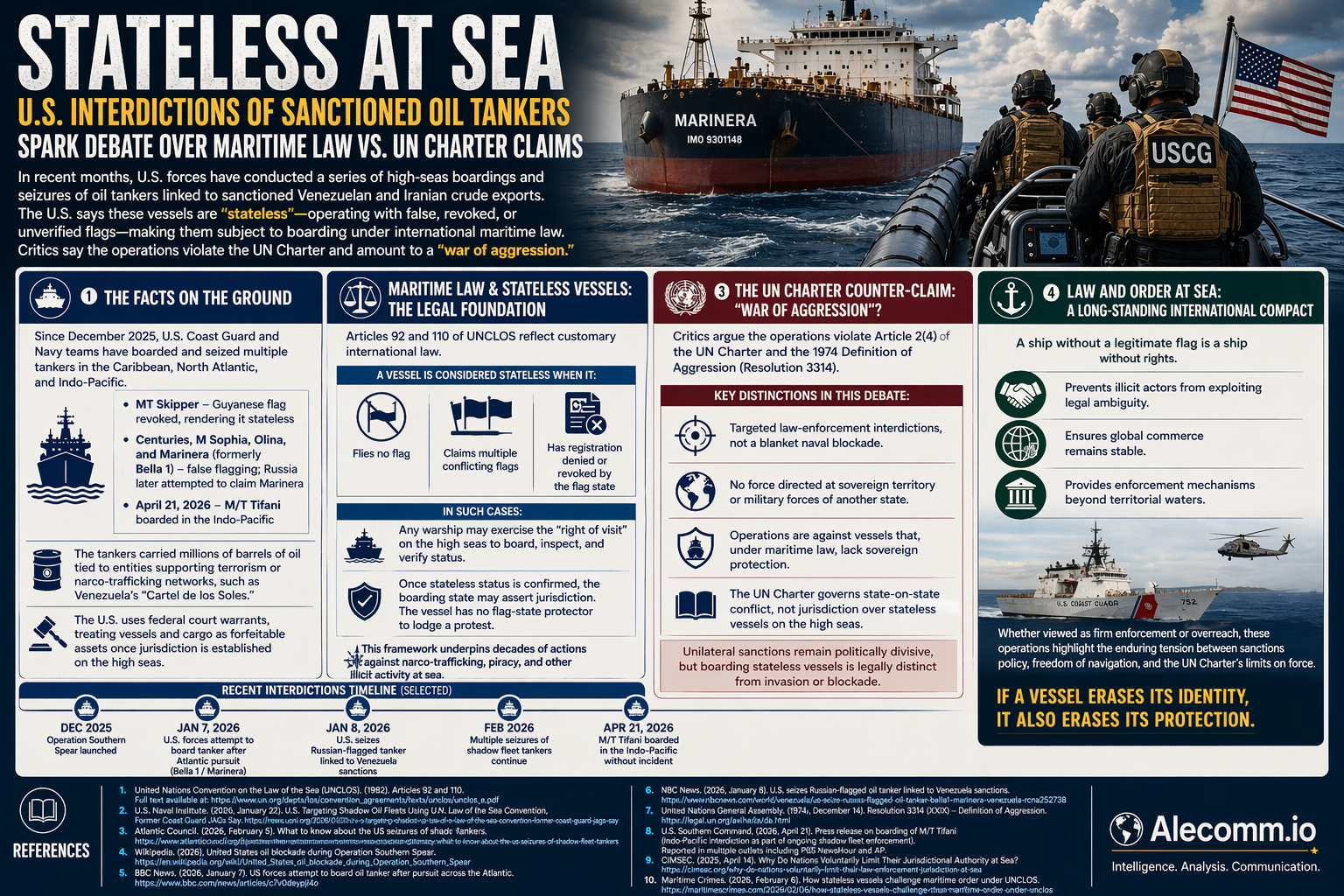
In recent months, U.S. forces have conducted a series of high-seas boardings and seizures of oil tankers linked to sanctioned Venezuelan and Iranian crude exports. Operations under “Operation Southern Spear,” launched in December 2025, have targeted vessels the United States classifies as “stateless”—ships operating with false or unverified flags, revoked registrations, or deliberately concealed identities through AIS spoofing and other deceptive practices.
These actions have fueled international debate, with critics arguing they amount to an illegal “war of aggression” under the UN Charter. The legal framework, however, draws on long-established rules of the sea that predate the modern UN system and were endorsed by many of the same nations now raising objections.
The Facts On The Ground
Since December 2025, U.S. Coast Guard and Navy teams have boarded and seized multiple tankers across the Caribbean, North Atlantic, and Indo-Pacific.
Examples include:
- The MT Skipper, initially registered under a Guyanese flag that Guyana later revoked—rendering the vessel stateless.
- The Centuries, M Sophia, Olina, and the high-profile Marinera (formerly Bella 1), which Russia later attempted to claim after the U.S. classified it as stateless due to false flagging.
- As recently as April 21, 2026, the sanctioned tanker M/T Tifani was boarded without incident in the Indo-Pacific as part of efforts targeting Iranian illicit networks.
These tankers carried millions of barrels of oil tied to entities designated by the U.S. as supporting terrorism or narco-trafficking networks, including Venezuela’s “Cartel de los Soles.”
The United States justifies these seizures through federal court warrants, treating both vessels and cargo as forfeitable assets once jurisdiction is established on the high seas.
Maritime Law And Stateless Vessels: The Legal Foundation
These interdictions rest on core principles of international maritime law, codified in Articles 92 and 110 of the United Nations Convention on the Law of the Sea (UNCLOS). These provisions reflect customary international law, which the United States observes despite not ratifying the full convention.
A vessel must be genuinely registered to a single nation and fly only that flag. When a ship:
- Flies no flag,
- Claims multiple conflicting flags, or
- Has its registration formally denied or revoked by a flag state,
…it is considered stateless.
In such cases:
- Any warship may exercise the “right of visit” on the high seas to board, inspect, and verify status.
- Once statelessness is confirmed, the boarding state may assert jurisdiction, as the vessel has no flag-state protection to lodge a protest.
This framework has underpinned decades of U.S. interdictions of narco-trafficking vessels, piracy operations, and enforcement against illicit maritime activity. It exists precisely to prevent legal black holes at sea.
The UN Charter Counter-Claim: “War Of Aggression”?
Critics—including officials from Venezuela, Russia, and China, along with some UN human-rights observers—argue these operations violate the UN Charter, particularly Article 2(4), which prohibits the threat or use of force against the territorial integrity or political independence of any state.
They also cite the 1974 UN General Assembly Definition of Aggression (Resolution 3314), which includes blockades as a potential form of aggression.
Key distinctions in this debate:
- These are targeted law-enforcement interdictions, not a blanket naval blockade restricting access to ports or coastlines.
- No force has been directed at sovereign territory or another state’s military assets.
- Operations are conducted exclusively against vessels that, under maritime law, lack sovereign protection.
- The UN Charter governs state-on-state conflict, not the separate body of law dealing with stateless vessels on the high seas.
While unilateral sanctions remain politically contentious, the specific act of boarding stateless ships is legally distinct from claims of invasion or blockade.
Law And Order At Sea: A Long-Standing International Compact
The rules governing stateless vessels represent a pragmatic international compromise designed to maintain order on the world’s oceans. Nations have long accepted that a ship without a legitimate flag is, effectively, a ship without rights.
This principle ensures that:
- Illicit actors cannot exploit legal ambiguity,
- Global commerce remains stable, and
- Enforcement mechanisms exist beyond territorial waters.
The broader sanctions regime will continue to spark geopolitical friction. But the mechanics of these interdictions sit within a well-established maritime framework.
Whether viewed as firm enforcement or strategic overreach, these operations expose a deeper tension: the collision between sanctions policy, freedom of navigation, and the UN Charter’s limits on force.
Out on the open ocean, however, one rule still holds firm—
If a vessel erases its identity, it also erases its protection.
**References**
1. United Nations Convention on the Law of the Sea (UNCLOS). (1982). Articles 92 (Status of ships) and 110 (Right of visit). Full text available at: https://www.un.org/depts/los/convention_agreements/texts/unclos/unclos_e.pdf.
2. U.S. Naval Institute. (2026, January 22). U.S. Targeting Shadow Oil Fleets Using U.N. Law of the Sea Convention, Former Coast Guard JAGs Say. https://news.usni.org/2026/01/22/u-s-targeting-shadow-oil-fleets-using-u-n-law-of-the-sea-convention-former-coast-guard-jags-say.
3. Atlantic Council. (2026, February 5). What to know about the US seizures of shadow fleet tankers. https://www.atlanticcouncil.org/dispatches/when-economic-warfare-meets-gunboat-diplomacy-what-to-know-about-the-us-seizures-of-shadow-fleet-tankers/.
4. Wikipedia. (2026). United States oil blockade during Operation Southern Spear. (Timeline of interdictions including MT Skipper, Centuries, M Sophia, Olina, Marinera/Bella 1, and related operations). https://en.wikipedia.org/wiki/United_States_oil_blockade_during_Operation_Southern_Spear.
5. BBC News. (2026, January 7). US forces attempt to board oil tanker after pursuit across the Atlantic. https://www.bbc.com/news/articles/c7v0deypjl4o. (Details on Bella 1/Marinera and stateless vessel claims).
6. NBC News. (2026, January 8). U.S. seizes Russian-flagged oil tanker linked to Venezuela sanctions. https://www.nbcnews.com/world/venezuela/us-seize-russia-flagged-oil-tanker-bella1-marinera-venezuela-rcna252738. (Coverage of Marinera/Bella 1, M Sophia, and stateless designation).
7. United Nations General Assembly. (1974, December 14). Resolution 3314 (XXIX) – Definition of Aggression. https://legal.un.org/avl/ha/da/da.html.
8. U.S. Southern Command. (2026, April 21). Press release on boarding of M/T Tifani (Indo-Pacific interdiction as part of ongoing shadow fleet enforcement). Reported in multiple outlets including PBS NewsHour and AP.
9. CIMSEC. (2025, April 14). Why Do Nations Voluntarily Limit Their Jurisdictional Authority at Sea? (Analysis of UNCLOS Article 110 right of visit and stateless vessels). https://cimsec.org/why-do-nations-voluntarily-limit-their-law-enforcement-jurisdiction-at-sea/.
10. Maritime Crimes. (2026, February 6). How stateless vessels challenge maritime order under UNCLOS. https://maritimescrimes.com/2026/02/06/how-stateless-vessels-challenge-maritime-order-under-unclos/.
These sources provide the factual, operational, and legal foundation for the article’s discussion of U.S. interdictions, stateless vessel status, and the UN Charter debate. They are drawn from official treaties, government statements, and reputable international reporting as of April 2026.
Leave a Reply