Nuclear addendum: the law Blumenthal pretends exists, but doesn’t apply
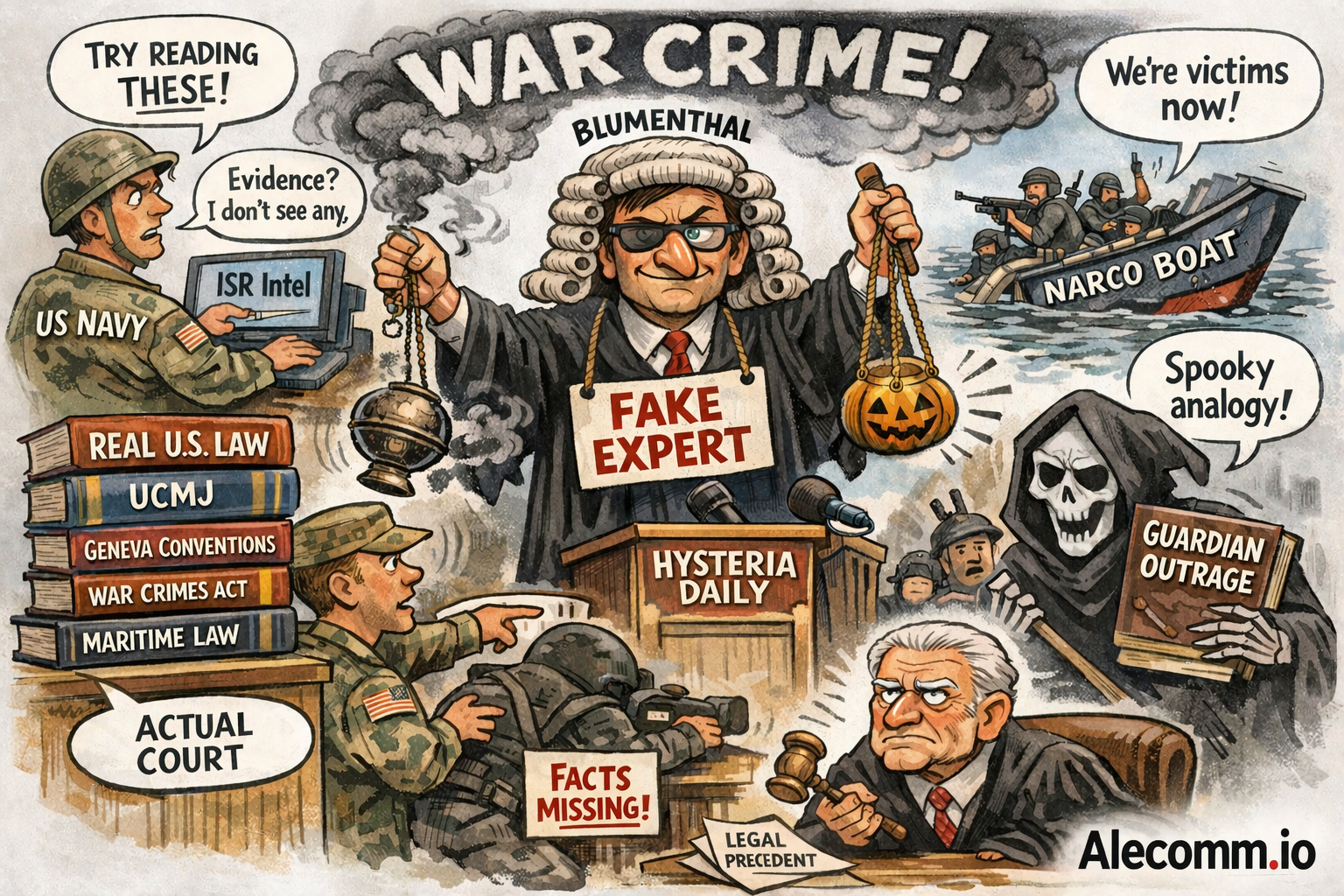
Blumenthal throws around “international law” like it settles the argument by itself, but never actually applies the legal framework that governs US military operations. Here it is without the theatre, and without the fake solemnity.
1. There is no automatic “war crime” without jurisdiction
War crimes are not a mood, a headline, or a dramatic adjective. They require specific legal elements, including:
- an armed conflict, whether international or non-international
- protected persons under the law of armed conflict
- hors de combat status clearly established at the time of engagement
- mens rea, meaning intent or criminal negligence
Blumenthal proves none of that.
2. The governing US law that actually applies
Uniform Code of Military Justice (UCMJ)
- Article 128 covers assault and homicide, and requires unlawful intent
- Article 134 incorporates the law of armed conflict only where it actually applies
- Article 92 applies to illegal orders, not to lawful missions people dislike afterward
A lawful mission carried out under lawful rules of engagement is not automatically a UCMJ violation just because a columnist starts hyperventilating.
War Crimes Act, 18 U.S.C. § 2441
This is the backbone of US war-crimes prosecutions.
To trigger it, you need:
- a grave breach of Geneva
- against protected persons
- during an armed conflict
Narco-terror interdiction operations outside a declared armed conflict do not automatically fall into that category. Blumenthal simply assumes applicability and hopes nobody notices the missing steps.
3. What the Geneva Conventions actually protect
Geneva protects:
- wounded combatants who are hors de combat
- shipwrecked persons who are clearly surrendering or incapacitated
- civilians not directly participating in hostilities
Geneva does not magically protect:
- unidentified hostile actors in an active interdiction zone
- individuals assessed as ongoing threats based on ISR
- narco-terror maritime operations conducted under US statutory authority
Clinging to wreckage is not some enchanted legal force field.
4. Maritime interdiction authority, the bit they keep omitting
Maritime Drug Law Enforcement Act, 46 U.S.C. §§ 70501–70508
This statute:
- grants extraterritorial jurisdiction
- applies on the high seas
- authorizes force against stateless vessels
- recognises transnational narco networks as serious threats
That is black-letter US law. Not spin. Not media cosplay. Actual law.
5. Rules of engagement are not Geneva violations
Rules of engagement are:
- classified
- mission-specific
- approved through civilian authority
- structured to comply with the law of armed conflict
The media does not get to reconstruct classified ROE from emotion, cropped images, and hindsight outrage, then pretend it has conducted a legal analysis.
6. Blumenthal gets command responsibility backwards
Command responsibility requires:
- knowledge of unlawful acts
- failure to prevent or punish them
It does not apply where:
- the mission is lawful
- the ROE are lawful
- the commander is relying on ISR and subordinate assessments made during operations
That is why actual courts demand evidence. Newspaper indignation is not a substitute.
7. The Peleus analogy is legally illiterate
The U-852 / Peleus case involved:
- prisoners already hors de combat
- survivors being machine-gunned after capture
- a declared world war
Trying to paste that precedent onto a modern counter-narco interdiction operation is not serious legal reasoning. It is legal dress-up.
8. What this article really is
This is not law.
It is not evidence.
It is not jurisprudence.
It is political messaging dressed up as legal expertise, designed to:
- chill command authority
- criminalise operational decision-making
- replace lawful ROE with newsroom outrage
Final verdict
Blumenthal does not merely misunderstand the law. He sidesteps it, cherry-picks history, strips out the controlling statutes, and bets the audience will never notice what is missing.
This is not accountability.
It is propaganda wearing a law degree like a Halloween costume.
Leave a Reply