History already wrote this warning — are we ignoring it again?
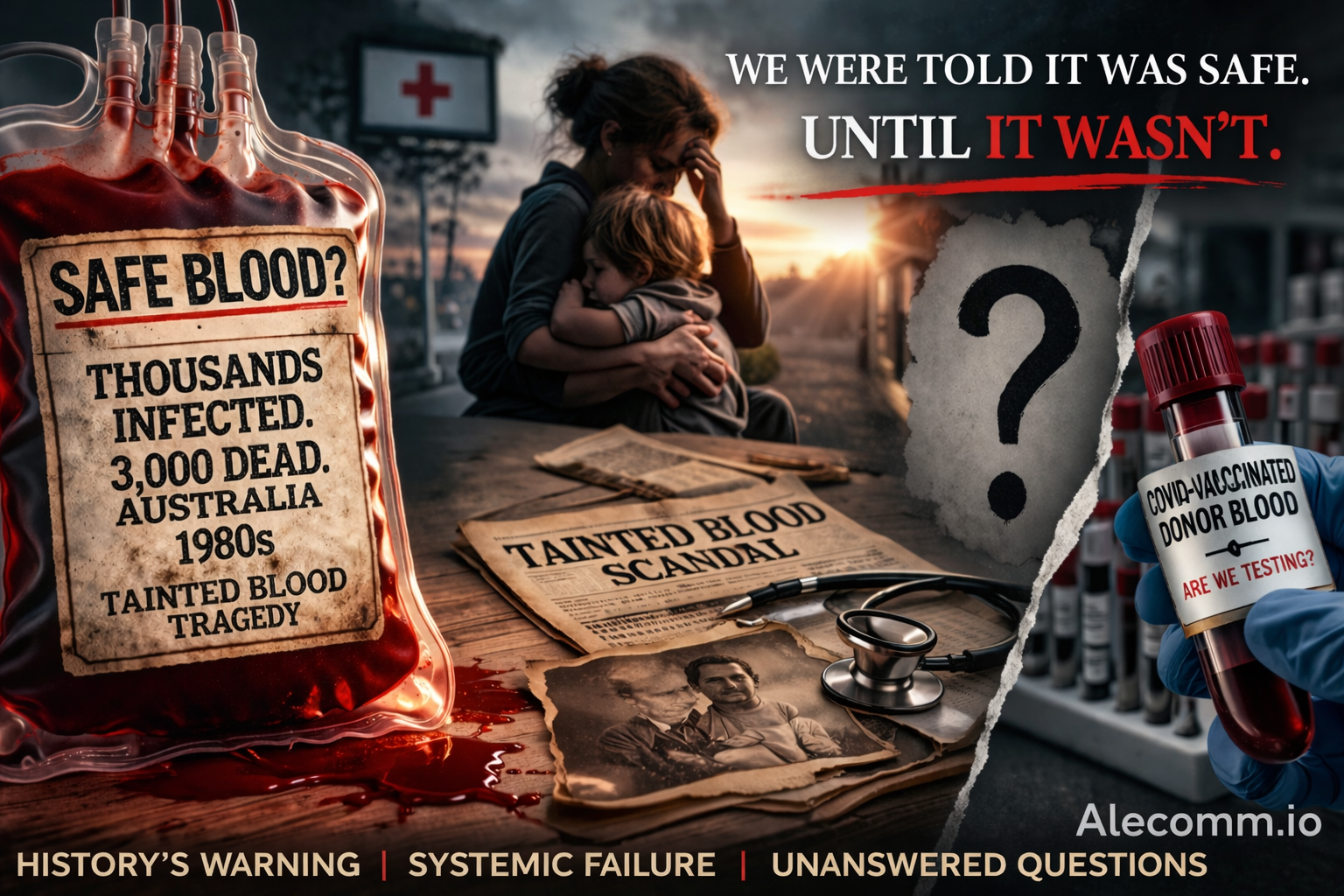
It didn’t start as a scandal. It started as trust — and ended in one of the deadliest failures of modern healthcare.
This wasn’t a “scare.” It was real, and it was catastrophic.
Thousands of Australians were infected through contaminated blood products in the 1980s — and around 3,000 died as a result.
This happened during a period when critical questions about donor risk were not being asked, and screening systems lagged behind a rapidly emerging epidemic.
One of the most powerful personal accounts comes from Bryce Courtenay, who documented the loss of his son Damon Courtenay in April Fool’s Day — a raw, unfiltered account of what this failure actually looked like inside a family.
Other authors who exposed or documented the tainted blood tragedy (not all Australian):
Eric Wright
Personal advocacy and accounts relating to families affected by contaminated blood products.
Mark Fowler
Representative of haemophiliac voices infected via Factor VIII treatments, sharing firsthand lived experience.
Randy Shilts
And the Band Played On
A forensic breakdown of the systemic failures that allowed contaminated blood to circulate on a global scale.
Geoffrey Cowan
Focused on the legal and policy failures surrounding contaminated blood products in the US and UK.
And the lessons still aren’t fully learned.
For decades, experts pushed for broader screening of blood supplies — including for infections like Lyme disease — yet meaningful action took years to gain traction. The pattern is familiar: delay, dismiss, then respond when it’s already too late.
And now, history looks like it’s rhyming again.
Despite everything exposed by the tainted blood crisis, serious questions are being raised about whether the same level of scrutiny is being applied today — including concerns about blood from COVID-vaccinated donors and whether it is being adequately differentiated or studied within the supply. The issue isn’t ideology — it’s whether the system is once again assuming safety instead of rigorously proving it.
Back then, the blood was declared safe — until it wasn’t. Back then, warnings were ignored — until the consequences were irreversible.
So the question now is unavoidable:
Have we actually learned from one of the worst public health failures in modern history… or are we setting the stage to repeat it?
Leave a Reply