
Our Gas, Their Profits
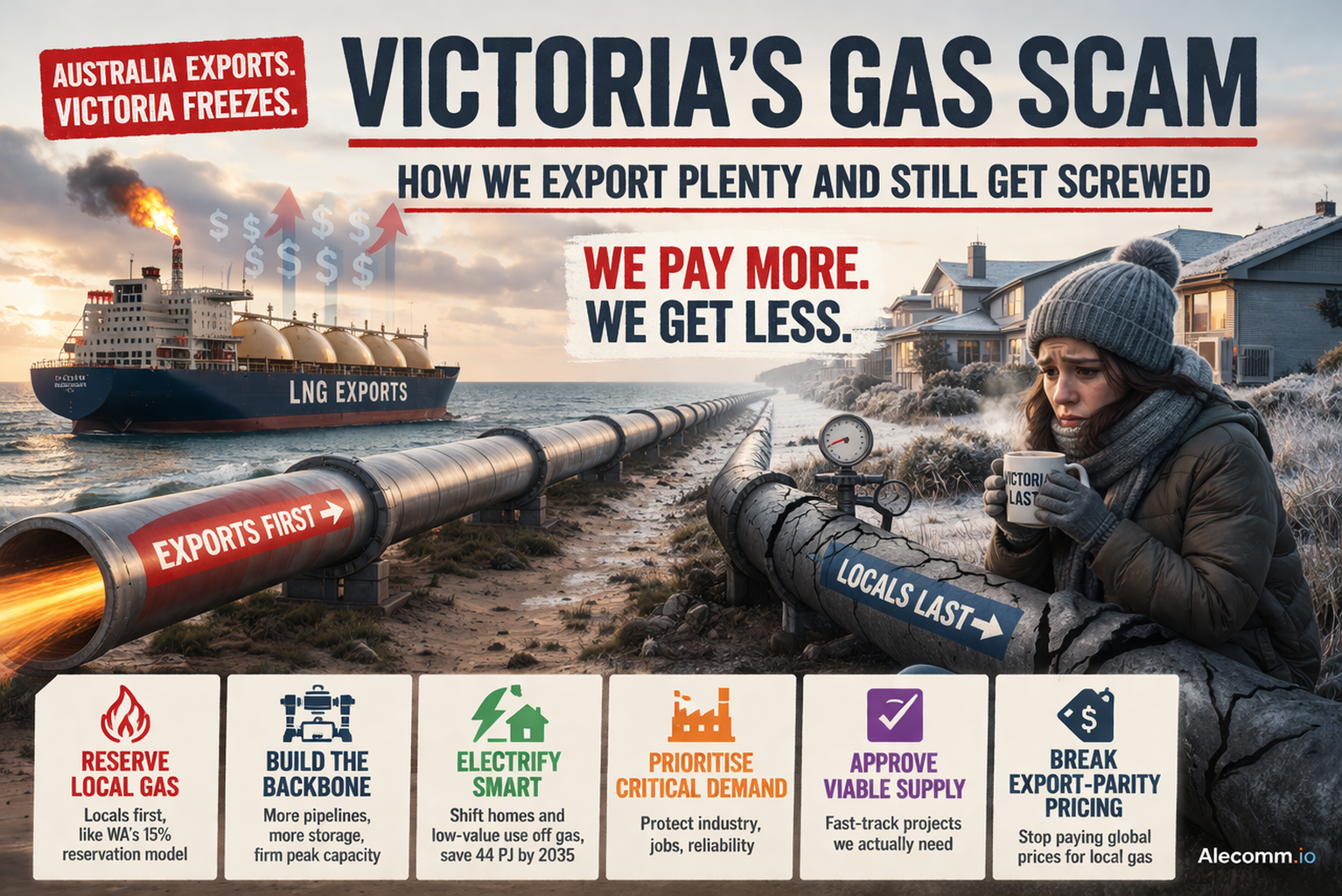
Victoria isn’t short of gas. It’s short of control.
For years, policy failure has left the state exposed—dependent on long-haul supply, hostage to export decisions, and paying inflated prices for its own resources. The result? Households squeezed, industry nervous, and winter supply risks creeping closer.
Fixing it isn’t complicated. It just requires doing what works, cutting what doesn’t, and dropping the fantasy that “the market will sort it out.”
Here’s the real plan.
1. Force Local Supply First — No More Hoping
Western Australia proved something simple: if you want domestic gas, you mandate it.
Their policy requires LNG exporters to reserve gas equivalent to 15% of production for local use, backed by actual delivery infrastructure. No loopholes, no wishful thinking—locals get supply first.
Victoria needs the same on the east coast:
A hard domestic reservation scheme tied to pipeline access, approvals, and market participation.
Because right now, Victoria is effectively last in line—relying on surplus gas drifting down from Queensland exports. When exporters ship more offshore, locals get squeezed. That’s not a market—it’s a design flaw.
2. Build the Missing Backbone — Pipelines, Storage, Peak Capacity
Even if gas exists, it’s useless if it can’t get where it’s needed when it’s needed.
Victoria’s system is fragile:
- Heavy reliance on interstate flows
- Limited storage buffers
- Tight peak-day capacity during winter
Forecasts are already warning:
- Peak-day shortfalls from 2028
- Structural supply gaps from 2029
That’s not a future problem—that’s a countdown.
Fix it with:
- Expanded pipeline capacity into southern markets
- More storage to smooth seasonal demand
- Firm peak-day delivery capability
WA tied reservation to infrastructure. Victoria needs to do the same or stay exposed.
3. Stop Burning Premium Gas Where It’s Not Needed
Using high-value gas for basic household heating is like fuelling a lawnmower with aviation fuel.
Victoria already knows this:
- Electrification + efficiency could save 44 PJ/year by 2035
- That’s roughly 85% of current industrial demand
This isn’t ideology—it’s supply strategy.
Every home shifted to electric heating or hot water:
- Frees up gas
- Reduces peak pressure
- Stabilises the system
Gas should go where it’s hardest to replace—not where it’s easiest.
4. Prioritise Who Actually Gets Gas
In a tight system, pretending all demand is equal is how everything breaks.
Victoria needs gas triage:
- Priority: high-heat industry, manufacturing, grid backup, essential services
- Deprioritise: low-value residential and replaceable uses
This isn’t controversial—it’s already acknowledged in state energy planning.
It just hasn’t been enforced properly.
5. Approve Practical Supply — Or Accept Shortages
You can’t block supply, delay infrastructure, and still expect reliability.
That’s how you manufacture a crisis.
The fix isn’t “approve everything.” It’s:
- Fast-tracking viable, necessary projects
- Supporting transitional supply during electrification
- Aligning approvals with actual system needs
Because without replacement supply, decline becomes collapse.
6. Break Export-Parity Pricing — It’s a Policy Choice, Not Physics
Here’s the quiet scam:
Australians pay global prices for Australian gas.
That only happens because policy allows it.
Reservation alone isn’t enough—you also need a domestic pricing framework for reserved gas.
Otherwise:
- Supply exists
- Locals still get gouged
Western Australia proved governments can intervene. Victoria’s mistake has been pretending it can’t.
The Real Fix — All of It, Not One Piece
Victoria doesn’t need a miracle. It needs coordination.
Reserve local gas.
Build infrastructure.
Electrify what makes sense.
Prioritise critical demand.
Approve viable supply.
Break export-linked pricing.
Do one without the others, and you stay stuck.
Do all of them, and Victoria stops being the last customer on a system designed for exports.
The Bottom Line
Victoria’s gas problem isn’t geological—it’s political and structural.
The state is sitting at the wrong end of a pipeline system designed to serve exporters first and locals second.
Until that flips, nothing changes.
References
Western Australian Government – Domestic Gas Policy
https://www.wa.gov.au/government/wa-domestic-gas-policy
Western Australian Government – Policy Development and Application
https://www.wa.gov.au/organisation/department-of-energy-and-economic-diversification/wa-domestic-gas-policy-development-and-application
Australian Competition and Consumer Commission (ACCC) – East Coast Gas Outlook
https://www.accc.gov.au/media-release/deteriorating-short-term-outlook-for-east-coast-gas-supply
Australian Energy Market Operator (AEMO) – 2025 Gas Statement of Opportunities
https://www.aemo.com.au/-/media/files/gas/national_planning_and_forecasting/gsoo/2025/2025-gas-statement-of-opportunities.pdf
Victorian Government – Gas Substitution Roadmap
https://www.energy.vic.gov.au/renewable-energy/victorias-gas-substitution-roadmap
Victorian Government – Gas Security Statement
https://www.energy.vic.gov.au/__data/assets/pdf_file/0032/755771/Victorian-Gas-Security-Statement.pdf
Leave a Reply