The Outrageous Persecution of Dr Paul Oosterhuis
In any society that claims to value scientific integrity and medical freedom, doctors must be able to question prevailing policies without fearing professional destruction. That principle is supposed to be foundational to medicine itself. Science advances through scrutiny, debate, and the courage to challenge accepted views.
Yet the case of Dr. Paul Oosterhuis reveals just how far some regulatory bodies have drifted from that principle.
Instead of protecting patients and upholding fairness, regulators appear increasingly willing to silence dissent, punish independent thinking, and wield their authority as a blunt instrument against those who refuse to conform.
What happened to Dr. Oosterhuis should alarm anyone who believes medicine must remain grounded in open inquiry rather than institutional obedience.
A Doctor Who Refused to Stay Silent
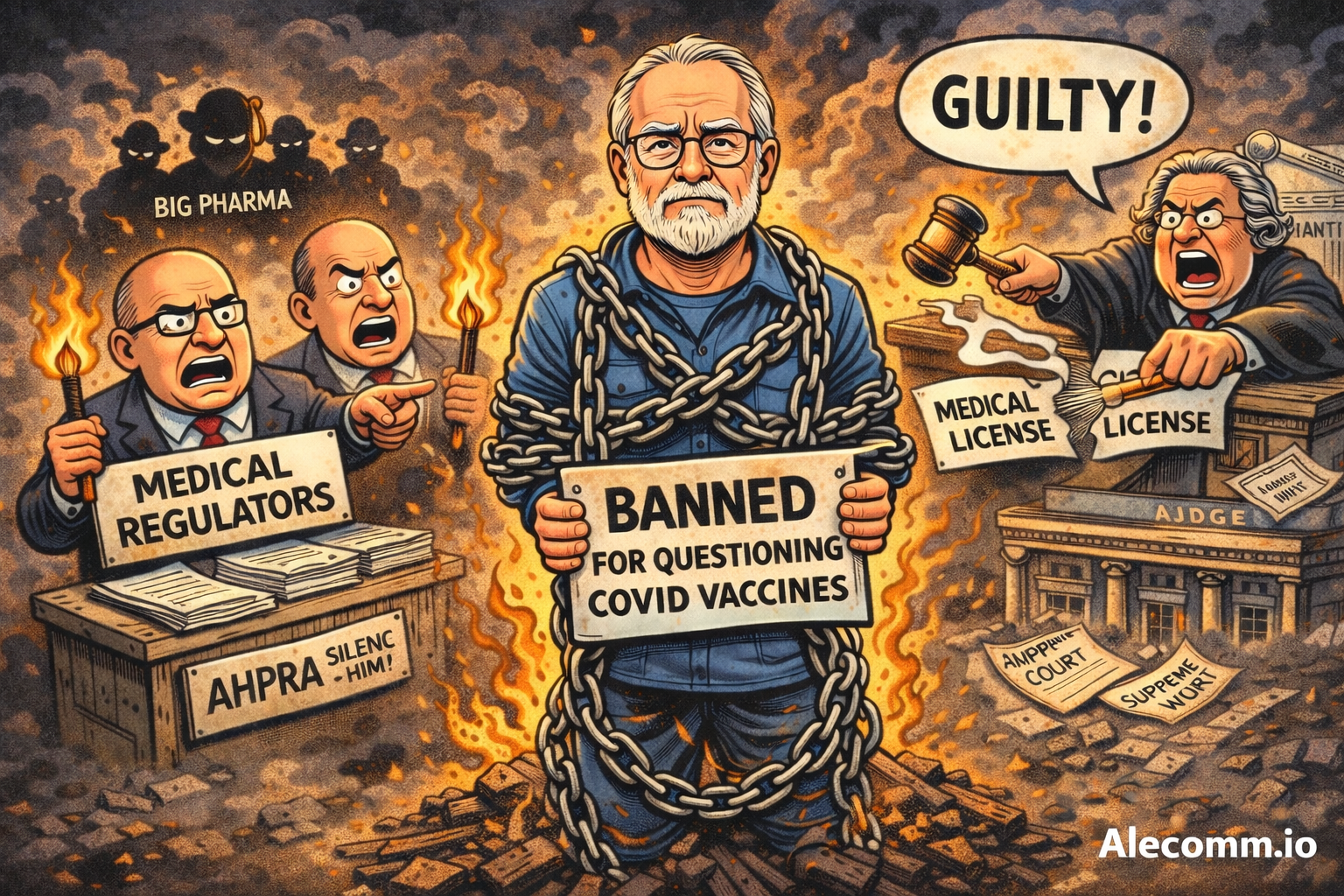
Dr. Paul Oosterhuis, a respected Australian anaesthesiologist, became a target of regulatory action after publicly criticising COVID-19 vaccines and the policies surrounding them.
Rather than remaining quiet and protecting his career, he spoke openly about what he believed were serious safety concerns and troubling aspects of the vaccine rollout. He described the technology as experimental and argued that the public had not been given the full picture about potential risks.
For daring to voice those concerns, he found himself facing the full force of the medical regulatory system.
The Medical Council of New South Wales moved swiftly to suspend his medical registration.
Not because patients had complained.
Not because anyone alleged he harmed a patient.
But because regulators objected to what he was saying.
That distinction cannot be overstated. When a doctor’s licence can be removed without a single patient complaint, the system has crossed a dangerous line.
Regulation designed to protect patients has become regulation used to control speech.
Standing Alone Against the System
Dr. Oosterhuis did not quietly accept the suspension.
Instead, he did what few individuals have the courage to do: he fought back.
Representing himself, he challenged the decision in the Supreme Court of New South Wales, confronting an entrenched regulatory apparatus determined to defend its authority.
The spectacle of a doctor standing alone against a powerful institutional system captured public attention. At one hearing he appeared remotely from home in casual clothing—an image that, for supporters, symbolised something powerful: an individual citizen confronting a bureaucratic machine that had forgotten its proper limits.
The case quickly became about far more than one doctor.
It exposed a growing pattern within modern medicine: regulators increasingly acting not merely as overseers of professional conduct, but as enforcers of ideological conformity.
The Dangerous Precedent
If regulators can suspend doctors for expressing controversial opinions, the consequences for the medical profession are profound.
Doctors are trained to analyse evidence, question assumptions, and apply independent judgment. That intellectual independence is the cornerstone of safe medical practice.
But when regulators begin policing what doctors are allowed to say publicly, that independence is replaced by fear.
Fear of investigation.
Fear of suspension.
Fear of professional destruction.
Once that fear takes hold, the entire profession changes. Doctors stop asking uncomfortable questions. They stop challenging flawed policies. They stop speaking honestly about risks that deserve scrutiny.
Science cannot function under those conditions.
A profession built on evidence becomes a profession governed by compliance.
A System That Has Lost Its Way
Medical regulators were never meant to operate this way.
Their mandate is clear: protect patients from negligent or dangerous practitioners. They exist to investigate misconduct and ensure standards of care are maintained.
They were never meant to act as arbiters of permissible thought.
Yet cases like that of Dr. Oosterhuis suggest that some regulatory bodies have lost sight of that boundary entirely.
Instead of focusing on patient harm, they have turned their attention toward policing speech, disciplining dissent, and preserving institutional narratives.
That shift is deeply troubling.
Because once regulators begin punishing doctors for what they say rather than what they do, the door opens to something profoundly corrosive: the politicisation of medicine.
Why This Matters
The persecution of one doctor might seem like a narrow professional dispute.
It is nothing of the sort.
If a medical licence can be taken away simply because regulators dislike a doctor’s public views, then no doctor is truly free to exercise independent judgment.
And if doctors cannot speak openly about medical evidence, risks, or uncertainties, then patients are the ones who ultimately suffer.
The case of Dr. Paul Oosterhuis therefore raises a stark and unavoidable question.
Have medical regulators forgotten their role?
Because oversight that punishes dissent rather than protecting patients is not oversight at all.
It is institutional intimidation.
And if that trend continues unchecked, the cost will not merely be the careers of doctors willing to speak out.
The cost will be the integrity of medicine itself.
Leave a Reply