
Canberra’s Caravan Delusion
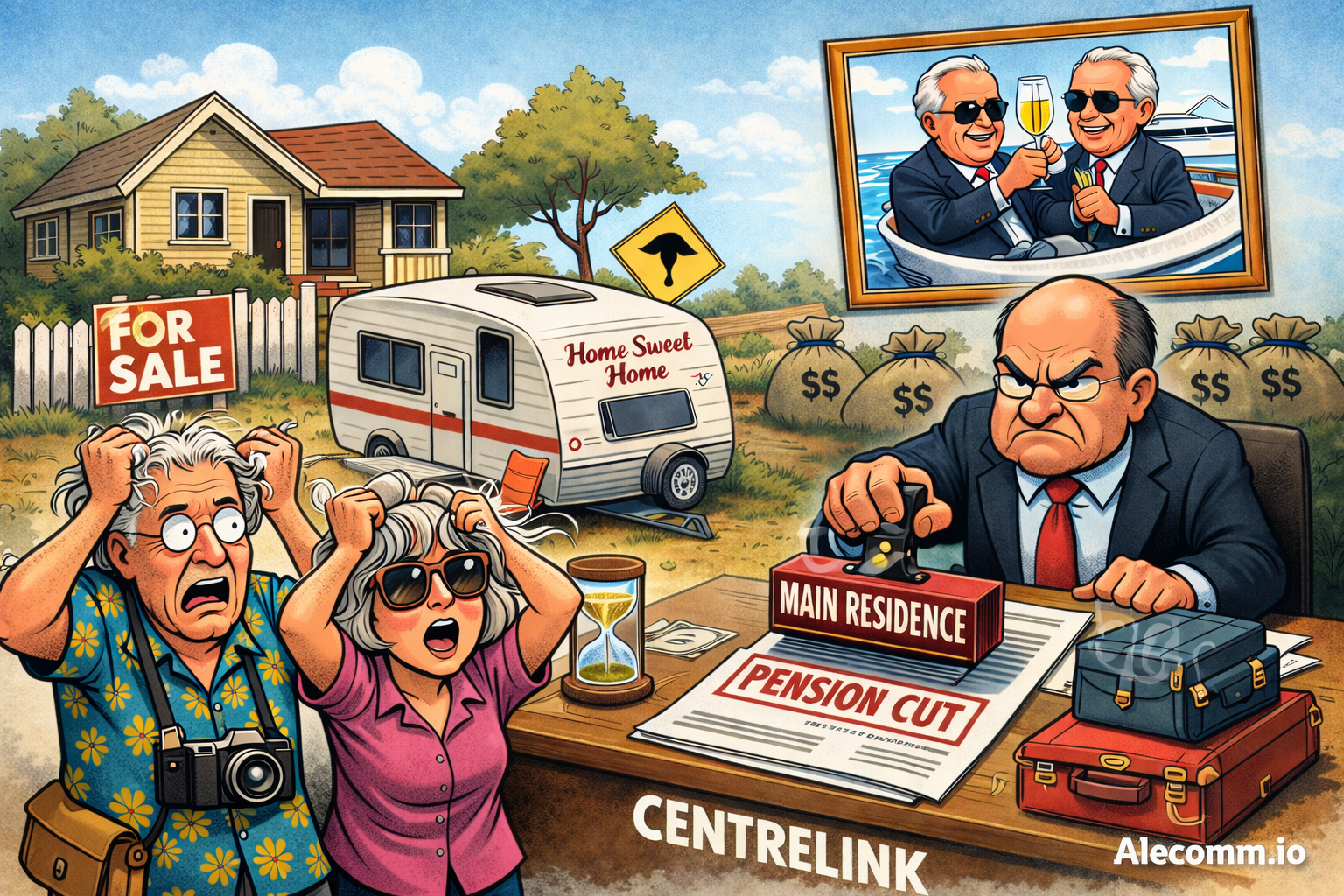
There comes a moment when government policy stops being complicated and starts being plain stupid.
This is one of those moments.
Australia has somehow managed to create a system where a retiree — a person who has worked, paid taxes, contributed for decades, and finally reached the finish line — can be financially punished for doing something outrageously radical:
Driving around their own country in a caravan.
Yes. Really.
And no, this isn’t satire.
The Rule That Defies Common Sense
Under Centrelink rules, a retiree’s principal home is normally exempt from the Age Pension assets test. That makes sense. You need somewhere to live. Government policy historically recognises that your home isn’t spare cash sitting in a bank account.
But here’s where reality detaches from logic.
If retirees leave their house and travel Australia in a caravan:
• For up to 12 months, everything is fine. Their house remains their principal residence and stays exempt.
• After 12 months, Centrelink can decide the caravan is now their main residence.
• The house they worked their entire lives to own? Suddenly becomes an assessable asset.
And that single administrative flip can reduce or cancel their pension entirely if asset thresholds are exceeded.
Let that sink in.
- Nothing about the retiree’s wealth changed.
- Nothing about their contribution changed.
- Nothing about their need for income changed.
Only their postcode changed — to “somewhere near Longreach this week.”
You Didn’t Get Rich — You Just Went Camping Too Long
This is the bureaucratic logic at work:
- You stay home → House exempt → Pension safe.
- You explore Australia for a year → Still fine.
- You enjoy yourself for thirteen months → Congratulations, you’re suddenly asset-rich.
It’s the financial equivalent of Schrödinger’s house: exempt until someone notices you’re having too much freedom.
Centrelink’s framework treats temporary absence from a home as acceptable only for a limited period. Beyond roughly twelve months, the home may be counted as an asset because you’re no longer considered to be living in it.
So the system effectively says:
Retirement travel is allowed — but only in moderation approved by paperwork.
The Grey Nomad Boom Meets Grey Bureaucracy
Australia actively promotes domestic tourism. Caravan sales surged, regional towns rely on travelling retirees, and “doing the lap” is practically a national rite of passage.
Yet the same retirees helping local economies are warned they may jeopardise their pension status if they don’t constantly update Centrelink about where their wheels are parked.
The message is absurdly mixed:
“Please spend money travelling Australia… but don’t enjoy it long enough to trigger a classification change.”
Meanwhile — The Political Class
Here’s the uncomfortable question nobody in Canberra seems eager to ask:
Are retired politicians subjected to lifestyle policing like this?
Former MPs and senior officeholders receive pensions and benefits vastly higher than the Age Pension — structured under entirely different entitlement frameworks.
They can travel indefinitely.
Live overseas.
Maintain multiple residences.
No bureaucrat is reclassifying their family home because they spent too long touring vineyards in Europe.
So ordinary Australians face asset-test gymnastics for owning a modest home while travelling domestically — while political pensions operate in an entirely separate universe.
If equality before the law means anything, it should include retirement rules.
Punishing Behaviour We Claim to Encourage
Think about what this policy actually discourages:
• Active ageing
• Domestic tourism
• Regional spending
• Independent living
• Healthy retirement lifestyles
Instead, retirees are nudged toward staying put — not because they want to, but because policy uncertainty makes mobility financially risky.
That’s not social security.
That’s behavioural control through administrative technicalities.
The Real Problem: Definitions Written for a Different Era
These rules were built when retirement meant:
House → Armchair → Lawn bowls → Done.
They were not designed for modern retirees who are healthier, mobile, and financially cautious enough to travel cheaply around Australia rather than cruise Europe.
The law hasn’t caught up with reality.
A caravan today is not a holiday toy. For many Australians, it’s simply a mobile extension of home.
Yet the system treats mobility as evidence of changed wealth — which is economically nonsensical.
The Fix Is Obvious
The amendment required isn’t complex:
If a retiree retains ownership of their home and intends to return, the home should remain exempt indefinitely — regardless of travel duration within Australia.
Simple. Logical. Fair.
No loopholes. No gaming the system. Just recognition that retirement freedom should not carry a hidden financial trapdoor.
Because Right Now?
We have reached peak administrative absurdity:
A retiree can cross the country thousands of kilometres…
but apparently crosses an invisible bureaucratic line at month thirteen.
And at that point, according to policy logic, they didn’t just travel.
They accidentally became rich.
Which might be the most impressive feat ever achieved with a caravan and a folding chair.
Sources
- https://au.finance.yahoo.com/news/centrelink-payment-warning-to-retired-aussies-as-caravan-travel-booms-update-your-details-180041165.html
- https://www.yourlifechoices.com.au/centrelink/retired-and-travelling-in-a-caravan-here-are-centrelink-changes-you-must-know/
- https://www.wallacepartners.com.au/age-pension-and-cgt-implications-of-caravanning-around-australia-for-12-months/
- https://www.dva.gov.au/access-benefits/pensions-and-payments/what-changes-your-payments/your-property-or-accommodation/how-owning-a-home-can-affect-pensions-and-payments
- https://www.servicesaustralia.gov.au/travelling-site-and-mooring-fees-rent-type-for-rent-assistance?context=22206
Leave a Reply