
Forward Defense: Governance in the Age of Litigation
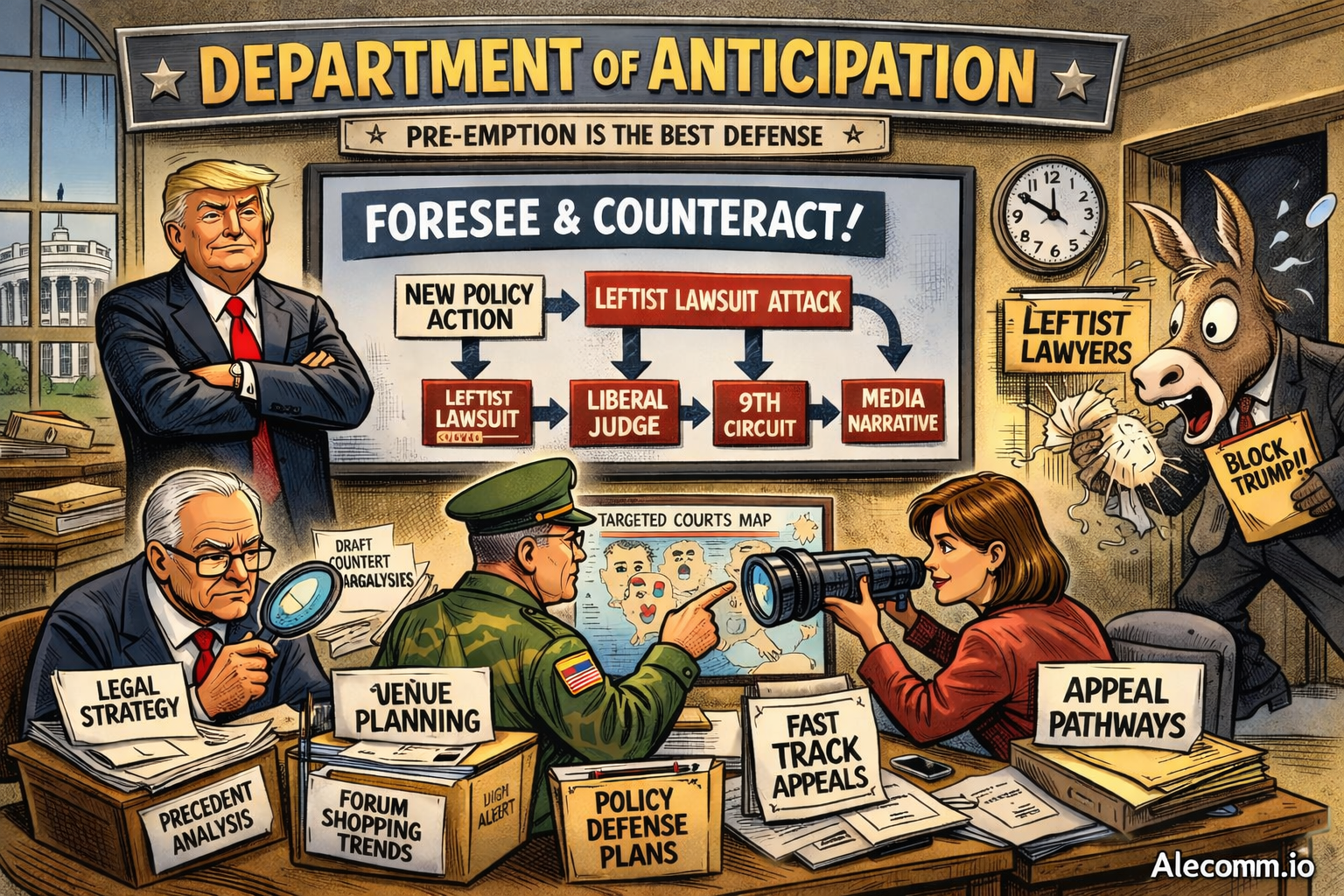
What we need is a Department of Anticipation — not another bloated bureaucracy, but a rapid-response legal and legislative unit built to pre-empt obstruction before it metastasizes. Every executive action, agency reform, border measure, or regulatory rollback should be reviewed through a forward-defense lens: Who will challenge this? On what grounds? In which district? Before which judge? With what media narrative attached? Then have the counterarguments drafted, the jurisdictional strategy mapped, and the appeal pathways pre-planned before the first lawsuit is even filed.
The reality is that modern governance doesn’t end when a policy is announced — it begins there. In an environment where nearly every administrative move is immediately litigated, delay becomes the weapon. So instead of reacting to injunctions and emergency filings after the fact, a standing anticipatory unit would analyze precedent, venue selection trends, judge assignment probabilities, and constitutional fault lines in advance. It would “DOA” weak filings by structuring actions to survive scrutiny from day one.
This isn’t about silencing opposition. It’s about operational competence. If an administration was elected on a defined platform, then implementing that platform efficiently requires legal resilience built into the architecture — not scrambling after every temporary restraining order. Governance in 2026 isn’t just policy execution; it’s strategic litigation forecasting.
Call it anticipation. Call it forward defense. But if you know the playbook being used against you, it’s negligent not to prepare for it.
Leave a Reply