
World-Class University, Third-World Dental Training
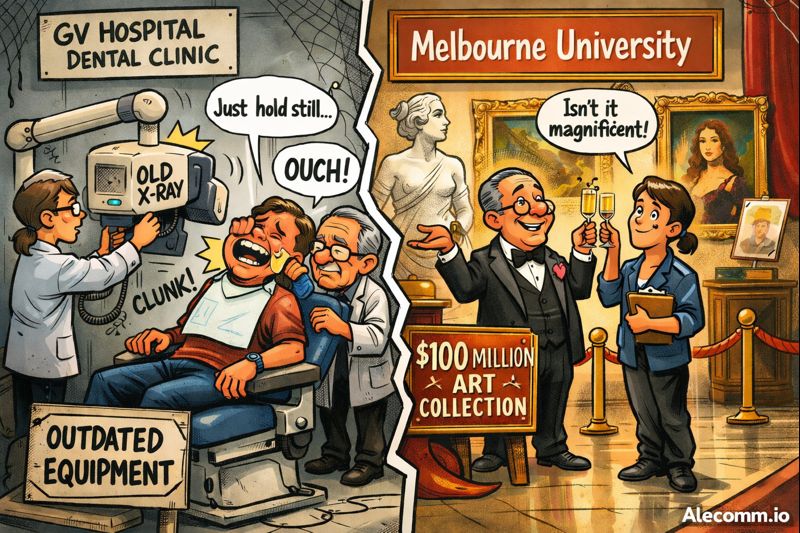
Melbourne University proudly holds over $100 million worth of art. Paintings. Sculptures. Prestige pieces. Climate-controlled rooms. Curators. Plaques.
Meanwhile, at Goulburn Valley Health in Shepparton, where Melbourne Uni trains its dental students, patients are biting down on outdated, painful dental X-ray equipment that belongs in a museum—not a teaching hospital.
That’s not a metaphor.
That’s a priorities problem.
Let’s be clear: this isn’t about “tight budgets,” “regional challenges,” or “complex procurement pathways.” Those excuses collapse the second you realise a modern intraoral digital dental X-ray system costs less than a minor art acquisition. We’re talking tens of thousands of dollars. Not millions. Not even close.
So why are patients still enduring:
- thick, rigid sensors that dig into the mouth
- higher radiation exposure than necessary
- slower imaging
- equipment students won’t even see in a modern practice after graduation
Because regional patients don’t generate prestige.
Universities love regional training sites. They look great in brochures. They tick accreditation boxes. They help with workforce narratives. But when it comes time to invest? Suddenly the responsibility gets shuffled:
- “It’s the hospital’s equipment.”
- “It’s not directly ours.”
- “It’s still functional.”
Functional is not the same as acceptable.
And let’s talk about education, because this is supposed to be a teaching hospital. Training future dentists on obsolete imaging technology doesn’t just inconvenience patients—it actively lowers clinical standards. Students learn workarounds instead of best practice. They normalise discomfort. They carry outdated habits forward.
That’s how mediocrity spreads quietly.
The irony is staggering:
- World-class university
- Global reputation
- Enormous asset base
- Cutting-edge rhetoric
Yet regional patients and students are told, implicitly: “You’ll do.”
This isn’t about art being bad. Art is fine.
It’s about values.
If an institution can safeguard nine-figure artworks, it can damn well ensure patients aren’t biting on relics while helping train the next generation of clinicians.
No one is asking for luxury.
They’re asking for basic, modern, humane equipment.
Regional healthcare should not be the place where standards quietly decay because no one important is watching.
Well—people are watching now.
Upgrade the machines.
Stop hiding behind administrative fog.
And stop treating regional patients and students like second-class participants in a first-class institution.
Because right now, the message is loud and clear:
There’s always money for art.
Just not for your mouth.

Leave a Reply