
Accountability Starts at the Bench
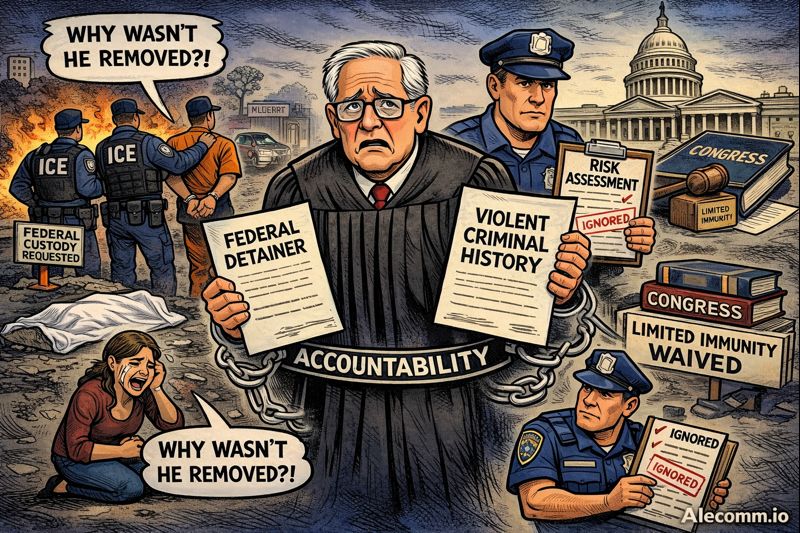
Section 1. Short Title
This Act may be cited as the “Judicial Accountability for Preventable Violent Crime Act.”
Section 2. Congressional Authority
This Act is enacted pursuant to Congress’s authority under:
- Article I, Section 8 (regulation of federal law enforcement cooperation and conditions on federal funding);
- The Commerce Clause, where violent crime substantially affects interstate commerce;
- Section 5 of the Fourteenth Amendment, to protect individuals from deprivation of life and liberty caused by state action exhibiting deliberate indifference.
Section 3. Legislative Findings
Congress finds that:
- Judicial independence protects good-faith adjudication, not conduct exhibiting deliberate indifference to known and documented risks.
- Courts routinely receive:
- verified criminal histories,
- validated risk assessments, and
- formal federal detainers intended to prevent further harm.
- When a judge knowingly disregards both documented violent risk and a lawful federal custody request, subsequent violent crimes are reasonably foreseeable.
- Absolute immunity doctrines were never intended to immunize reckless or willful disregard of public safety, particularly where federal law-enforcement warnings are ignored.
- Narrow, well-defined civil accountability mechanisms do not violate judicial independence when limited to extreme, documented misconduct.
Section 4. Definitions (Narrowed and Precise)
- “Violent crime” means a felony involving:
- homicide,
- rape or sexual assault,
- aggravated assault,
- kidnapping, or
- use of a deadly weapon.
- “Federal detainer” means a written custody request issued by a federal law-enforcement agency pursuant to lawful authority.
- “Documented violent history” means:
- two or more prior violent felony convictions, or
- one violent felony conviction plus a validated risk assessment classifying the individual as high-risk for violent recidivism.
- “Deliberate judicial disregard” means a release decision where the judge:
- had actual notice of the violent history,
- had actual notice of a valid federal detainer, and
- affirmatively declined custody without articulating a risk-mitigating rationale grounded in evidence.
Mere error, disagreement, or policy preference shall not constitute deliberate judicial disregard.
Section 5. Preservation of Judicial Independence
Nothing in this Act shall:
- permit review of legal reasoning or statutory interpretation;
- allow liability for good-faith discretionary decisions;
- create criminal penalties for judicial acts;
- permit retroactive liability.
This Act applies only to civil liability arising from deliberate judicial disregard as expressly defined.
Section 6. Limited Waiver of Judicial Immunity
(a) Judicial immunity is preserved except where deliberate judicial disregard is established by clear and convincing evidence.
(b) Immunity is waived only for civil actions seeking:
- compensatory damages directly resulting from a subsequent violent crime, and
- statutory civil penalties as provided herein.
(c) Punitive damages are expressly prohibited.
Section 7. Causation Safeguards
Liability shall attach only where:
- the subsequent violent crime occurs within 180 days of release;
- the crime is of the same general class of violence previously documented; and
- no intervening extraordinary event breaks the causal chain.
Section 8. Mandatory Written Findings
When declining a federal detainer for an individual meeting the criteria in Section 4, the judge shall issue a written finding addressing:
- the documented violent history;
- the federal detainer;
- specific, evidence-based reasons for release.
Failure to issue such findings creates a rebuttable presumption of deliberate judicial disregard.
Section 9. Safe Harbor Provision
A judge shall not be subject to liability if:
- the federal detainer is later found invalid;
- the criminal history was materially inaccurate; or
- the judge relied in good faith on erroneous information supplied by another agency.
Section 10. Federal Funding Conditions
States receiving federal criminal-justice funding shall:
- track detainer compliance rates;
- report subsequent violent offenses linked to detainer refusals;
- certify annual compliance with reporting requirements.
Failure to comply may result in graduated funding reductions.
Section 11. Civil Action Procedures
- Claims must be filed within two years of the offense.
- Venue lies exclusively in federal court.
- Qualified immunity defenses are unavailable where deliberate judicial disregard is established.
Section 12. Severability
If any provision of this Act is held invalid, the remainder shall not be affected.
Section 13. Effective Date
This Act applies to release decisions made 180 days after enactment.
Leave a Reply