
The River, the Lie, and the Checkout Aisle
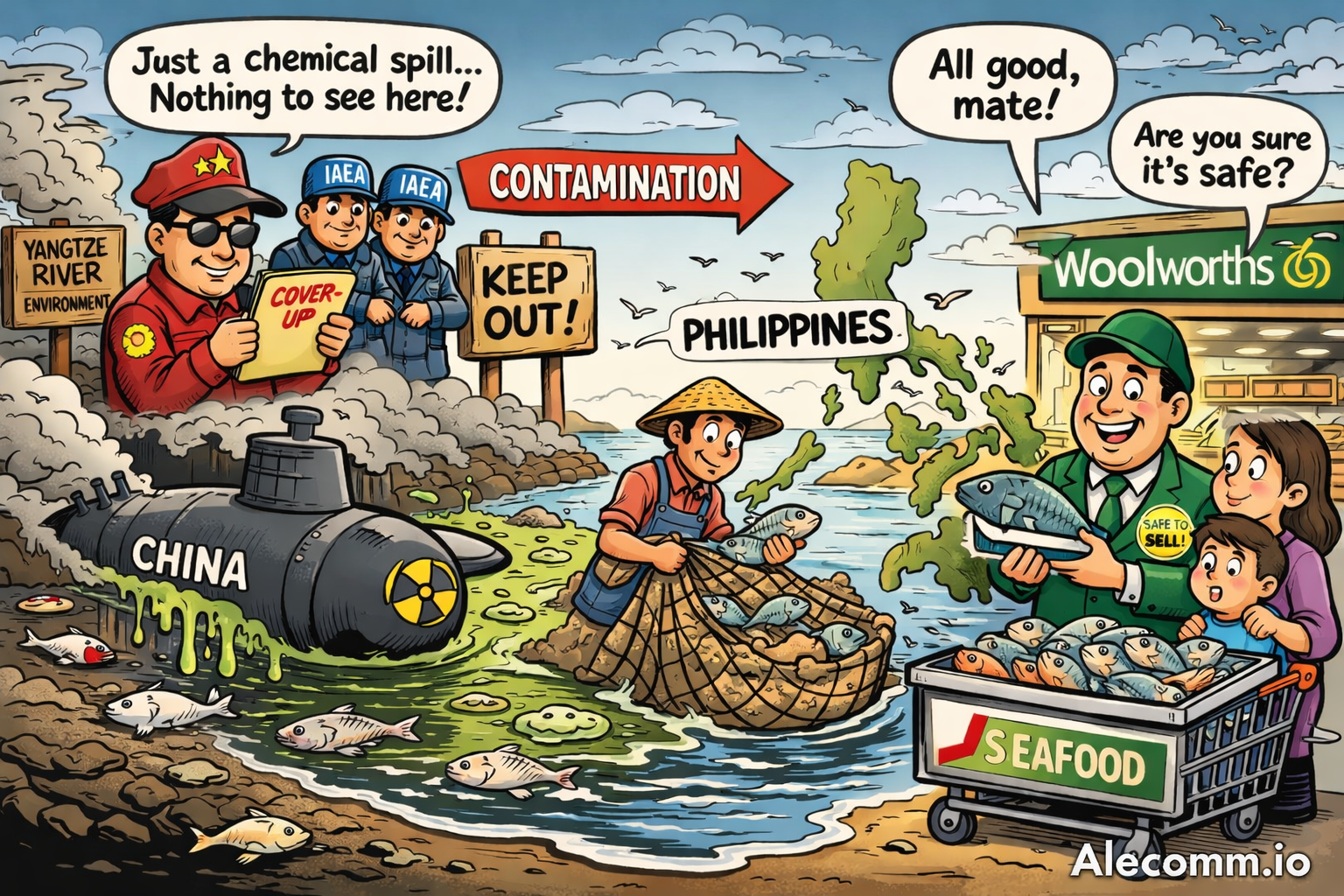
During what should have been a routine mooring exercise, one of China’s nuclear submarines reportedly suffered a cascading failure — the kind that only happens when corners are cut, systems are rushed, and workmanship is garbage. Power failures. Loss of control. Structural faults. A platform designed to project strength instead exposed the reality beneath the propaganda: cheap build quality wrapped in secrecy.
A nuclear submarine doesn’t sink quietly during mooring unless something is fundamentally wrong. And when it does, the response isn’t transparency — it’s erasure. No admission. No investigation made public. No accountability. Just silence, deflection, and a scramble to control the narrative before the river, the sea, and the rest of the world notice.
Because when a nuclear asset fails inland, the danger isn’t just military embarrassment.
It’s what leaks after the lie.
So China poisoned a river. Then it poisoned the truth. And Australia is still eating the Fallout – literally.
And from May 2024 onward, the Yangtze system lit up with the same red flags every time something serious goes wrong in China: mass fish deaths, black water, foul odours, rushed clean-up crews, and instant excuses. Chemical leaks. Warehouse fires. “Private companies.” Seasonal hypoxia. Anything—anything—except the one category Beijing cannot afford to acknowledge.
This is standard operating procedure for the “When the cause threatens legitimacy or military credibility”, the response isn’t investigation—it’s narrative substitution.
Then the problem crossed a line China can’t censor.
Anomalies were detected in Philippine waterways. Once contamination shows up outside China’s borders, the “local accident” story collapses. Rivers drain. Seas circulate. Biology concentrates. Physics does not negotiate.
And when the world’s nuclear watchdog asked the obvious questions, Beijing did the most revealing thing possible: it refused to cooperate. China declined full transparency with the —no meaningful disclosure, no independent access, no joint verification. In nuclear governance, that isn’t neutrality. That’s non-compliance. You don’t stonewall the IAEA unless the truth is inconvenient.
Here’s the choreography that matters:
- fish die-offs acknowledged, causes diluted
- testing discouraged or declared unnecessary
- no isotope panels released
- no international oversight invited
- rapid pivot to “recovery” stories
That isn’t environmental management. It’s damage control for the story.
Now comes the part that should infuriate Australians.
Despite detections in waterways—despite unresolved questions about upstream sources and China’s refusal to disclose— continues to purchase and sell seafood sourced from the Philippines.
Let’s be blunt:
Compliance paperwork is not safety.
Silence is not clearance.
And “within standards” means nothing when the upstream state refuses transparency.
Seafood supply chains don’t end at borders. They trace currents. When contamination appears downstream and the source country blocks the nuclear watchdog, every importer has a choice: pause and verify—or sell and hope.
Woolworths chose the checkout.
Dead fish were treated as collateral.
Downstream nations were treated as someone else’s problem.
Australian consumers were treated as acceptable risk.
This isn’t a conspiracy theory. It’s a pattern:
- China controls the narrative.
- The watchdog is sidelined.
- Retailers hide behind compliance.
- Consumers inherit the uncertainty.
The Yangtze wasn’t just polluted. It was censored. And when that censorship eventually washed into Philippine waters, pretending nothing changed stopped being ignorance and became recklessness.
If China won’t disclose, importers must pause. If importers won’t pause, consumers are being used as the buffer.
The spill isn’t just in the river anymore.
It’s on the shelf.
Seafood from the Philippines:
– 555 Sardines in Tomato Sauce 425g (Made in Philippines)
– 555 Sardines in Tomato Sauce 155g (Made in Philippines)
– 555 Hot Sardines in Tomato Sauce 155g (Made in Philippines)
– 555 Sardines in Tomato Sauce Hot 425g (Made in Philippines)
– Century Tuna with Calamansi 180g (Made in Philippines)
– Salu Salo Bagoong Alamang 340g (Product of Philippines)
– Barrio Saute Shrimp Paste Spicy 500g (Product of Philippines)
– Marca Pina Patis Fish Sauce 1L (Product of Philippines)
Seafood from Taiwan:
– Just Caught Barramundi Skinless Fillets 700g (Product of Taiwan)
– Woolworths Frozen Barramundi
– KB Seafood Co. Barramundi Fillet Skin On 260g
Leave a Reply