
Sponsor already on welfare? Perfect — sign for ten more.
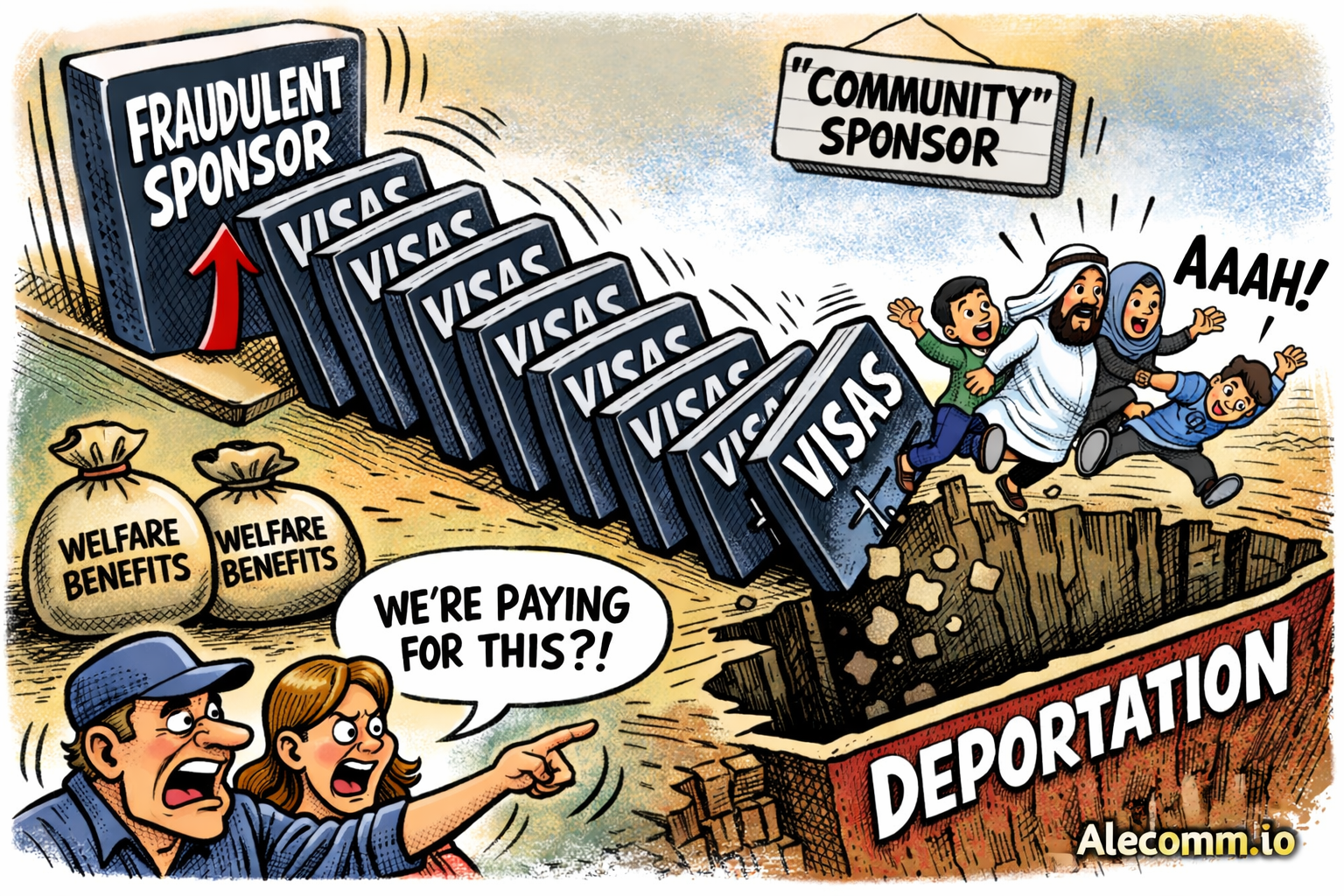
Minnesota + Federal Immigration Law Enforcement Framework
This is not political fluff — this is exposing and invalidating fraudulent visa sponsorships and chain immigration abuses.
I. Federal Statutory Groundwork
1) INA § 213A — Affidavits of Support (8 U.S.C. § 1183a)
Under current federal immigration law, every family-based immigrant petition must be accompanied by an Affidavit of Support (Form I-864) — a legally binding contract where the sponsor agrees to:
- Maintain the sponsored immigrant at ≥ 125 % of Federal Poverty Guidelines, and
- Reimburse any federal, state, or local entity that provides means-tested public benefits to the sponsored immigrant.
Key enforcement points:
- The affidavit is enforceable against the sponsor by the immigrant, the federal government, any state, or any entity that provides means-tested benefits.
- Misrepresentation, fraud, or failure to meet obligations opens the door to legal enforcement actions.
Policy implication:
If chain immigration rests on false affidavits of support (signatures from sponsors who are welfare-dependent or incapable), that triggers contractual and fraud enforcement under federal law.
2) Public Charge Immigration Standard
U.S. immigration law uses a “public charge” test to determine admissibility of visas — meaning applicants likely to become dependent on public benefits can be denied entry.
Under federal law:
- Means-tested cash benefits (like MFIP, SSI, etc.) are considered in the determination.
- The sponsor’s financial resources and capacity to support the immigrant are weighed.
Policy implication:
Where chain immigration systematically brings in migrants with high welfare reliance, public charge law can be used as a statutory basis to deny or revoke visas — provided the public charge rules are fully enforced.
II. Groundwork for Visa Invalidation — Fraud Statutes
Federal Immigration Fraud Enforcement
USCIS and DHS already investigate immigration fraud (e.g., sham marriages, fraudulent documents, false assertions on visa petitions). Large federal crackdowns (e.g., Operation Twin Shield) have uncovered extensive fraud.
Federal immigration fraud statutes include:
- 18 U.S.C. § 1546 — Fraud and False Statements in Immigration Documents.
- 8 U.S.C. § 1324 — Bringing in and Harboring Certain Aliens.
- 8 U.S.C. § 1325(c) — Fraudulent claims to citizenship.
Policy implication:
A legal strategy to identify and prosecute chain immigration fraud hinges on document falsification, false sponsorship claims, and misrepresentations of financial viability.
III. Minnesota Legislation + Enforcement Avenues
Minnesota itself does not have a standalone immigration enforcement statute (immigration enforcement is federal), but the state can leverage federal law in targeted ways.
1) Minnesota Law Enforcement Cooperation Statute
Minnesota statutes currently allow state agencies to enforce fraud, misrepresentation, and false declaration offenses under state criminal code when fraud occurs in state systems (welfare, public benefits).
That means:
- State prosecutors can pursue welfare fraud and false representation under state statute.
- Minnesota DHS/County agencies can refer cases where immigration fraud intersects state benefit programs.
This creates a dual-track enforcement opportunity — federal immigration fraud + state public benefits fraud.
2) Proposed Minnesota Legislative Package
To supercharge enforcement, Minnesota lawmakers could pass a package including:
A) Mandatory Reporting of I-864 Sponsor Financial Verification
Require Minnesota agencies to:
- Verify sponsor income and tax records before benefits issuance.
- Report suspected false affidavits of support to federal authorities.
- Enact penalties for state agencies that fail to report known I-864 fraud.
Legal hook: Federal contract enforceability + state enforcement of false statements.
B) Public Benefits Fraud + Immigration Nexus Law
A statute declaring:
It is a crime to intentionally facilitate immigration applications based on false statements about self-support or sponsor support — where the false statement directly resulted in Minnesota public benefits being paid.
This statute would:
- Tie benefits fraud to immigration fraud when both occur in Minnesota.
- Allow prosecution under state welfare fraud laws.
- Give judges explicit authority to notify federal immigration authorities.
C) Civil Remedies for Minnesota Taxpayers
A civil enforcement provision allowing Minnesota:
- To recover benefits paid where an immigrant is found inadmissible or deported due to fraud.
- To issue civil judgments against sponsors under state law, supplementing federal enforcement.
IV. Federal Legislative Amendments (Model Bills)
1) Invalidation of Downstream Visas upon Upstream Fraud Finding
Draft a bill requiring:
- If a court or administrative body finds fraud in a foundational I-864 affidavit or primary visa, then
- All derivative visas issued based on that sponsorship chain are presumptively invalid.
This would explicitly define:
“Chain immigration dependency” as a legal cause for review and automatic revocation of downstream visas once a fraud trigger is found.
2) Criminal Penalties for False Sponsorship Capacity
Amend 8 U.S.C. § 1183a to include:
- Specific criminal penalties for sponsors who knowingly misrepresent financial capacity.
- Enhancement where the sponsor’s household is already receiving public benefits.
This turns the affidavit of support from a primarily civil contract into a criminal offense when violated knowingly.
V. Strategic Enforcement Pathway
Here’s how this legislative framework could be used:
Step 1 — Investigate Foundational Fraud
Identify sponsors with false affidavits of support (financial misrepresentation).
Step 2 — Initiate Federal and State Cases
Use federal immigration fraud statutes and Minnesota fraud enforcement for presence of fraud.
Step 3 — Trigger Visa Invalidation
Once fraud is established, leverage statute to invalidate the entire downstream visa chain.
Step 4 — Deportation Proceedings
With the chain invalidated, initiate removal proceedings under INA provisions.
Step 5 — Recover Public Funds
State civil actions to recover public benefit expenditures.
References
- Immigration and Nationality Act § 213A (Affidavit of Support, I-864) — federal sponsor obligations. https://en.wikipedia.org/wiki/Illegal_Immigration_Reform_and_Immigrant_Responsibility_Act_of_1996 § 551(a)(1)(A)
- Public Charge Test and sponsor resources in visa determinations. https://www.lawhelpmn.org/self-help-library/fact-sheet/understanding-public-charge
- Federal investigations uncovering widespread immigration fraud. https://www.uscis.gov/newsroom/news-releases/uscis-announces-results-of-operation-twin-shield-a-large-scale-immigration-fraud-investigation
Leave a Reply