
Babies Come Last in Australia
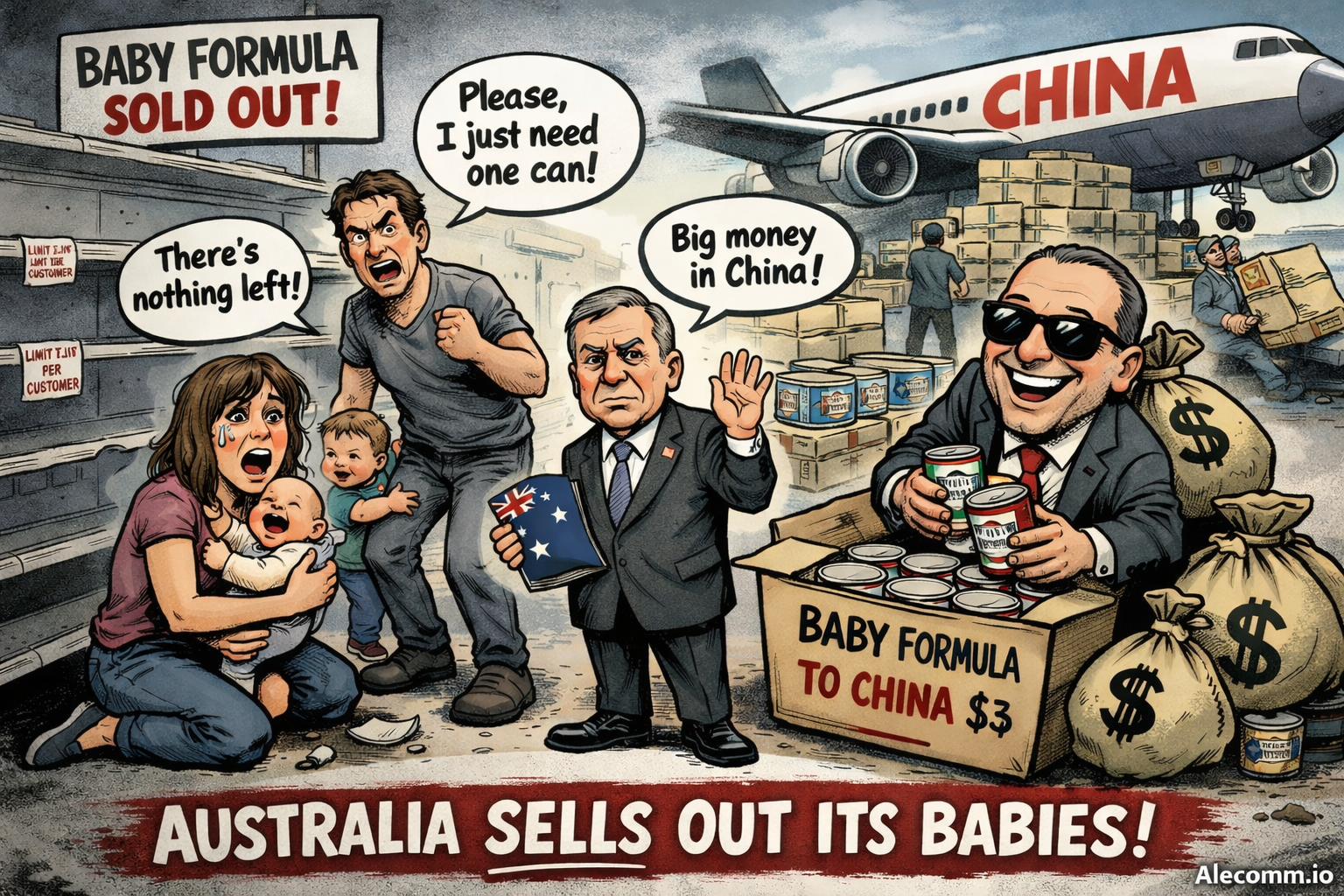
In the midst of mounting parental frustration and empty supermarket shelves, one uncomfortable truth has emerged: Australian baby formula — a life-sustaining product for infants — is being exported in vast quantities overseas, particularly to China, leaving local families scrambling.
Some estimates put the figure at up to 90 tonnes per week being purchased in Australia and shipped offshore. That’s not a rounding error. That’s a systemic failure.
This isn’t just a supply issue. It’s a policy choice.
What’s Driving the Export Boom?
The driver is simple: trust and profit.
After historic food-safety disasters overseas, Australian-made formula is treated as “gold standard”, commanding massive resale premiums. That demand fuels a secondary export market where buyers strip shelves clean — not for Australian babies, but for resale abroad.
Suitcases. Freight pallets. Airport trolleys stacked high.
Retail limits don’t stop it. They never did.
The Reality for Australian Parents
For Australian families, the outcome is brutal and absurd:
- Multiple supermarkets
- Multiple pharmacies
- Multiple days
- Sometimes no formula at all
Parents aren’t being inconvenienced — they’re being forced into desperation. When an essential infant food becomes a scavenger hunt, the system has already failed.
This is not a “free market working as intended.”
This is a market actively harming its own population.
Why Government Intervention Is Not Optional
Let’s be clear: infant formula is not discretionary consumer goods. It is medical nutrition for babies who cannot breastfeed.
That changes everything.
1. Retail Limits Are Toothless
Two-tin limits look good on paper and fail in practice. Organised buyers simply rotate shoppers, stores, and time slots. The shelves still empty — just more quietly.
2. Export Controls Are Rational
Australia already restricts exports of:
- Medicines
- Medical equipment
- Strategic resources
Why should infant nutrition be treated with less seriousness?
A permit-based export system would:
- Prioritise domestic supply
- Allow surplus export only after Australian demand is met
That’s not radical. That’s responsible governance.
3. Prescription-Only Access Is the Nuclear Option — and It Works
Uncomfortable? Yes.
Effective? Also yes.
Making formula prescription-based would:
- End bulk hoarding overnight
- Tie access to actual infant need
- Eliminate profiteering incentives
We already do this with essential medicines. Babies deserve the same protection.
The Unspoken Question
Why are Australian parents competing with international resellers for food meant for newborns?
Why is profit arbitrage being prioritised over infant nutrition?
And why is the government still pretending supermarket ration signs are a solution?
Bottom Line
Australia can be a major exporter and protect its own families — but not without rules.
Until policymakers stop pretending this is “temporary” or “market-driven,” parents will keep losing access to something no child should ever go without.
Baby formula is not a luxury.
It is not a trade chip.
It is not negotiable.
If supply cannot be guaranteed locally, it should not be exported at all.
Leave a Reply