Abundant Water, Empty Policy
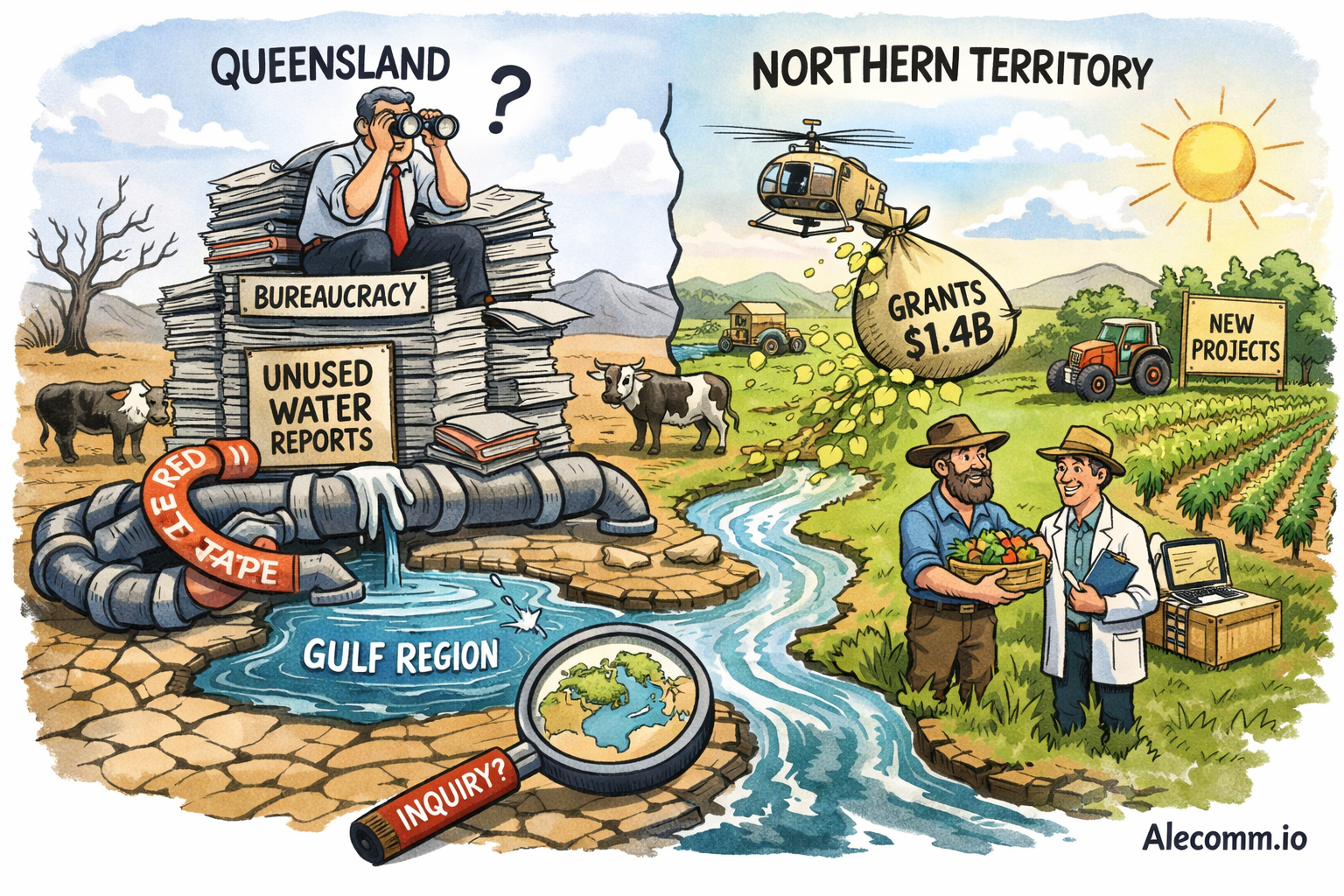
Comparative Governance and Water Resource Utilisation in Northern Australia
The approaches of the Queensland Government and the Northern Territory Government to regional development—particularly in relation to water resource utilisation—are markedly divergent. These differences are not merely administrative; they have material consequences for economic development, agricultural expansion, and long-term regional resilience.
There is a compelling case for a formal inquiry into why substantial volumes of available water in the Gulf region of North Queensland remain unused, despite persistent claims that water scarcity constrains development.
Absence of Consolidated Data on Unused Water in North Queensland
There is no single, publicly available figure quantifying unused water allocations across North Queensland.
The does not publish a consolidated total of water that is:
- unassigned
- unallocated, or
- unused in practice
across the region’s catchments.
The closest official classification is “unallocated water”, defined as water that may be released without adversely affecting existing licence holders. However, this category is:
- Published only on a catchment-by-catchment basis
- Released selectively, at the government’s discretion
- Not aggregated into any regional or statewide total
Published Catchment-Level Figures (Fragmented Reporting)
- Flinders and Gilbert Catchments
Approximately 636 GL of unallocated water remains
(755 GL original volume; 119,360 ML currently allocated) - Mitchell Catchment
Approximately 70,000 ML of unallocated water across designated reserves - Gulf Region (Overall)
No published aggregate total
Only the Flinders and Gilbert systems have been formally quantified
Key point:
There is no North Queensland–wide figure, nor a statewide total, capturing the scale of unused or unallocated water resources in the Gulf region.
This absence of consolidated reporting limits transparency, constrains informed policy debate, and undermines evidence-based decision-making on regional development and water security.
Contrast with Northern Territory Development Policy
By comparison, the demonstrates a more explicit linkage between:
- Public funding
- Agricultural development
- Economic outcomes
In late December 2025, the NT Government announced targeted funding allocations to primary producers following a competitive grant process involving 53 applicants, aimed at strengthening a primary industries sector valued at approximately $1.4 billion.
Policy Implications
The contrast between these governance approaches raises critical questions regarding:
- Institutional capacity
- Policy priorities
- Regulatory inertia
- Effective mobilisation of natural resources
In Queensland’s case, the persistent lack of consolidated data on unused water—particularly in a region with significant development potential—suggests the need for:
- Greater transparency
- Coordinated regional reporting
- Strategic oversight and accountability
An independent inquiry into water allocation practices and reporting frameworks in the Gulf region would be a necessary and constructive step toward aligning water policy with broader economic and regional development objectives.
Leave a Reply