
America’s Blind Spot: Cartel-Controlled Telecom Inside the U.S.
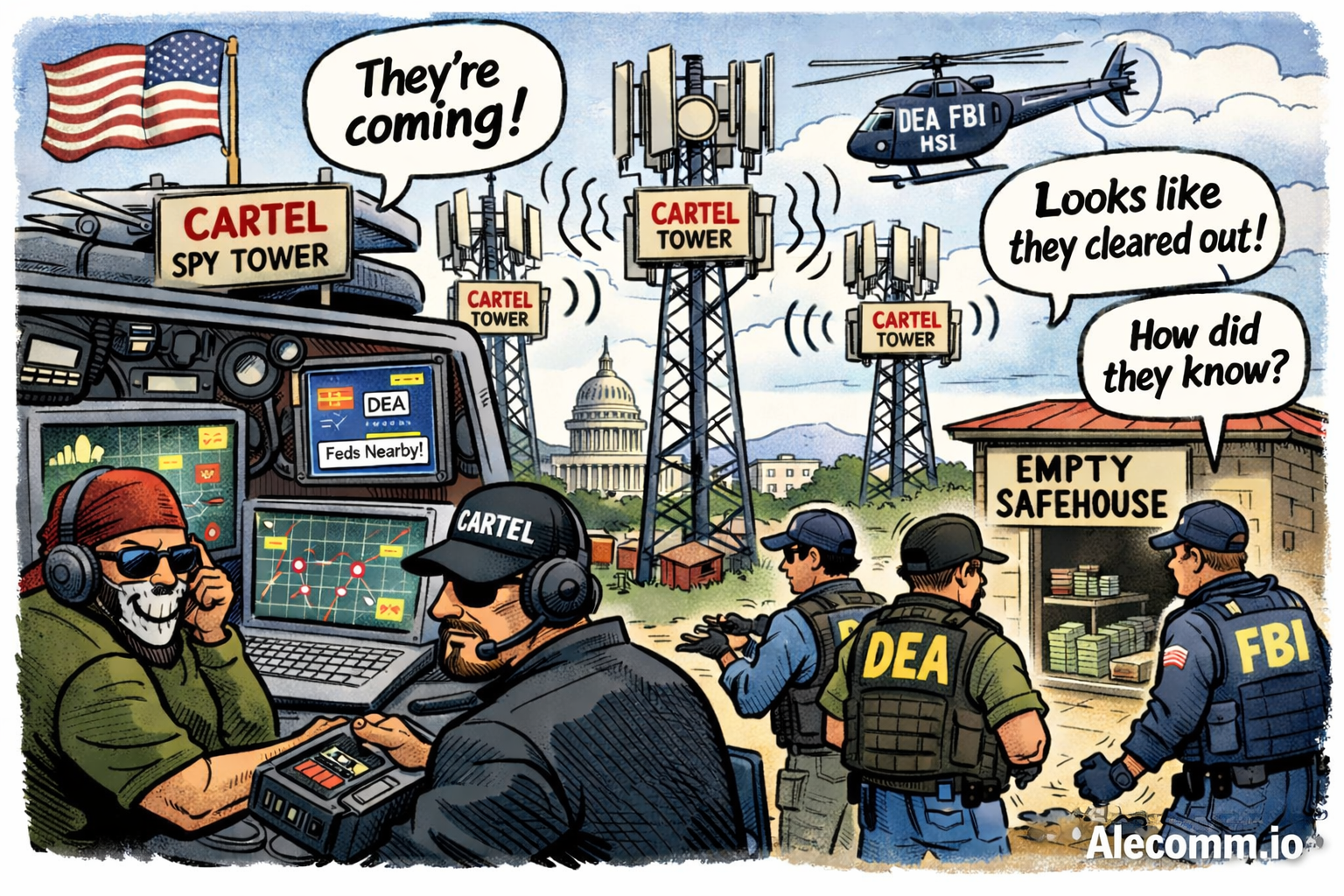
The most disturbing part of the Sinaloa Cartel story isn’t the drugs, the money, or even the violence. It’s that, inside the United States, a foreign criminal organisation quietly built and operated its own telecommunications surveillance network.
They controlled roughly 340 cell towers, repeaters, and interception devices operating on US soil. These were not accidental signal boosters or backyard experiments. They were rogue base stations designed to force nearby phones to connect through cartel-controlled infrastructure.
This wasn’t discovered because regulators were vigilant. It was discovered because law enforcement kept losing.
Raids repeatedly hit empty stash houses. Surveillance targets vanished minutes before warrants were executed. Interdictions failed without leaks, tips, or corruption explaining why. Eventually, investigators noticed the common thread: the cartel always seemed to know.
Technical sweeps later detected unauthorised radio-frequency emissions operating on licensed cellular bands where no lawful towers existed. Phones were being pulled off legitimate networks. Equipment was found mounted on rooftops, rural structures, and vehicles, using identifiers not registered to any carrier. Once seized and analysed, the purpose became obvious.
These systems allowed the cartel to identify, track, and pattern devices used by U.S. law enforcement, including the , the , and other federal and task-force units. Even when communications were encrypted, metadata was enough. Device presence, movement, clustering, and timing told the cartel when an operation was forming, where it was headed, and how long it would last.
In plain terms, they weren’t listening to the raid ~ they were watching it assemble.
That capability changed the game. Drugs were moved. Couriers rerouted. Personnel disappeared. Warrants arrived late to locations already scrubbed clean. Law enforcement wasn’t compromised from the inside; it was operating inside someone else’s sensor network.
This matters far beyond narcotics enforcement. A non-state actor deployed and operated a parallel telecom and surveillance layer inside the United States, against federal agencies, without immediate detection or shutdown. That is not just organized crime. It is a failure of telecom oversight, spectrum enforcement, and domestic counter-intelligence.
We talk endlessly about border security, cyber threats, and foreign influence. Meanwhile, a cartel ran a shadow signals-intelligence operation in the open, using infrastructure that should never have existed.
If a criminal organization can control the informational terrain, it doesn’t need to win gunfights. It wins by knowing first.
That should alarm anyone who still thinks this is just a drug problem.
Leave a Reply