Leadership, Risk, and the Cost of Gain-of-Function Policy
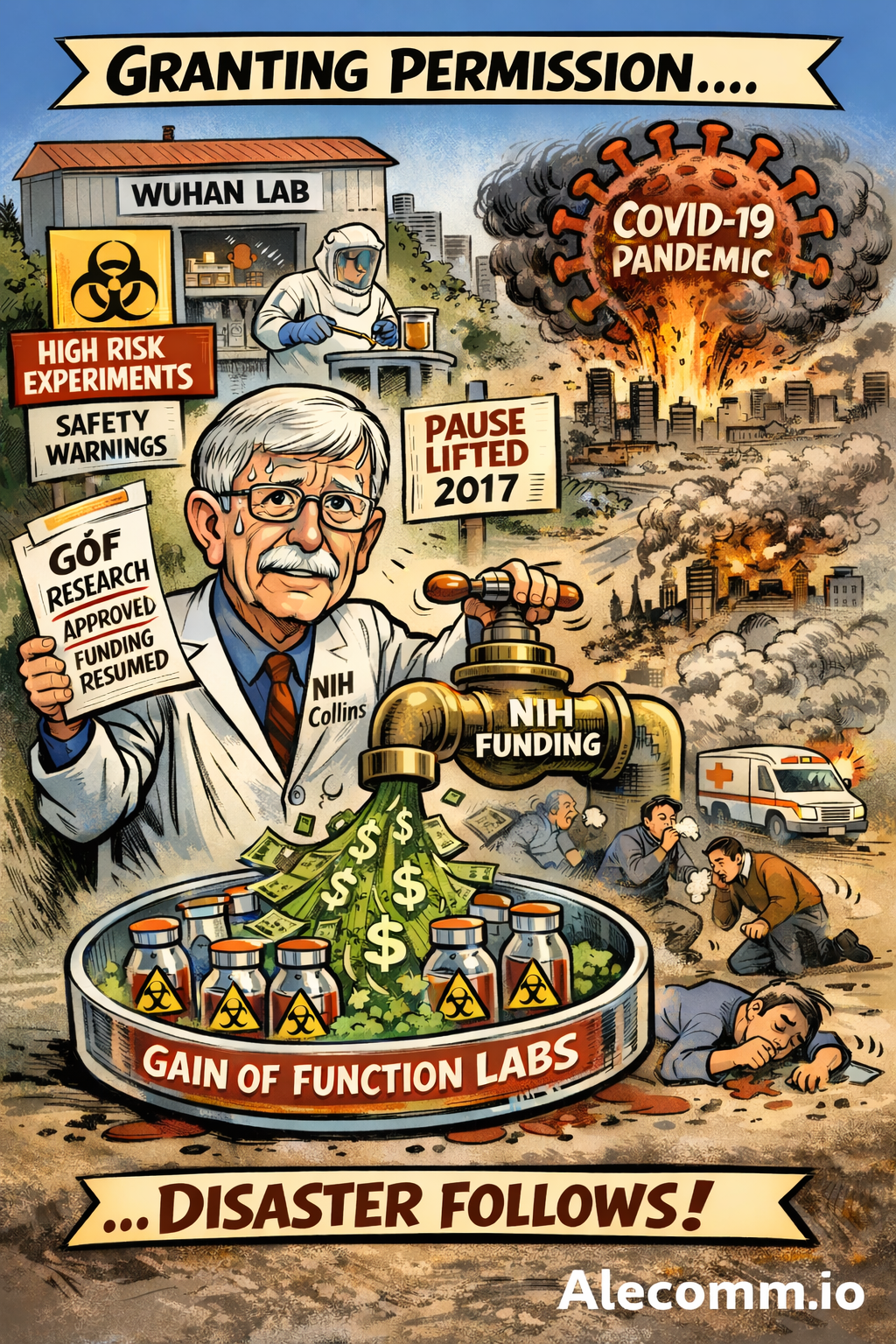
By any honest accounting, the COVID-19 catastrophe did not emerge from a vacuum. It emerged from a system that knowingly permitted extreme-risk pathogen research to continue, despite explicit warnings, prior funding pauses, and unresolved biosafety concerns. At the center of that system sat the Director of the U.S. National Institutes of Health: .
This is not an accusation of laboratory pipetting. It is an accusation of authorization, continuation, and policy responsibility.
The Key Fact No One Can Wish Away
The United States paused gain-of-function (GOF) research in 2014 because senior officials acknowledged that certain experiments could plausibly trigger a pandemic if something went wrong. That pause was not symbolic. It was a recognition that the risk was existential.
And yet, in December 2017, under Collins’ leadership, the NIH lifted that pause.
Not partially. Not hesitantly. Fully.
It did so by adopting the HHS P3CO Framework — a bureaucratic mechanism that did not ban dangerous research, but instead re-licensed it under internal review, largely shielded from public scrutiny.
That decision matters. Everything that followed flows from it.
“Oversight” Is Not a Force Field
Defenders argue that GOF research was allowed only under “strict oversight.” That phrase collapses on contact with reality.
Oversight does not eliminate:
- human error
- institutional bias
- financial incentives
- international enforcement gaps
- or biological unpredictability
Oversight does not prevent leaks. It does not reverse evolution. And it does not resurrect the dead.
Allowing GOF research involving potential pandemic pathogens is not a neutral act. It is a calculated risk decision, taken by administrators — not viruses.
Funding Is Permission
NIH funding is not passive. It is authorization.
When the NIH funds research:
- labs exist because of it
- collaborations persist because of it
- lines of inquiry continue because of it
If NIH leadership believed such research was too dangerous, they had one guaranteed kill-switch: don’t fund it.
They chose otherwise.
The Lab-Leak Question Was Not “Conspiracy”
When early discussion of a lab-origin hypothesis was dismissed and marginalized, it was not because the idea was scientifically absurd. It was because admitting plausibility would have implicated the very policy choices that allowed the research ecosystem to exist.
That ecosystem did not appear spontaneously. It was maintained.
By funding. By waivers. By redefinitions. By silence.
Responsibility Without Intent Is Still Responsibility
No one needs to prove that Collins intended a pandemic. That’s a straw man.
If a regulator knowingly:
- authorizes high-risk activity,
- ignores repeated warnings,
- resumes funding after a safety pause,
- and the predicted catastrophe occurs
then responsibility is not erased by lack of malice.
Airline safety chiefs don’t get absolved because they didn’t personally loosen the bolts.
The Moral Accounting
COVID-19 killed millions worldwide, devastated economies, shattered trust in public health, and permanently altered societies.
Those outcomes were not caused by “nature alone.” They were enabled by policy decisions that treated catastrophic risk as an acceptable tradeoff for scientific ambition.
Francis Collins was not a bystander to those decisions. He was the final authority who signed off on the framework that kept gain-of-function research alive.
History will decide how that choice is judged.
But pretending it was inconsequential — or that leadership bears no responsibility for what it authorizes — is not science.
It’s denial.
Leave a Reply