
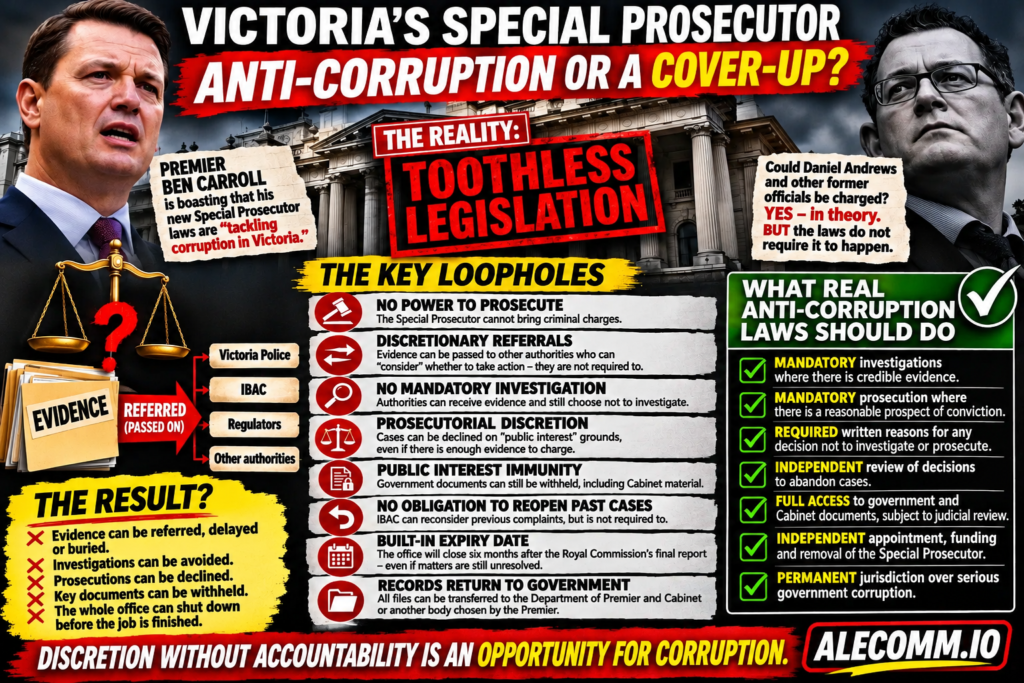
 A special prosecutor without the power to prosecute. Authorities without an obligation to act. Evidence without a guarantee of criminal proceedings. Is this really tackling corruption, or simply creating another bureaucratic mechanism through which accountability can be avoided?
Victorian Premier Ben Carroll has been promoting his government’s introduction of special prosecutor legislation as a significant step towards tackling corruption in Victoria.
However, a closer examination of the Inquiries Amendment (Special Prosecutor) Act 2026 reveals significant deficiencies in the legislation that should concern every Victorian taxpayer.
Whilst the government congratulates itself on establishing the Office of the Special Prosecutor, the legislation leaves multiple avenues through which investigations and criminal prosecutions can be delayed, declined or abandoned.
Establishing an anti-corruption mechanism is not the same as establishing enforceable accountability.
A Special Prosecutor Without The Power To Prosecute
The legislation passed both Houses of Parliament on 24 September 2026 and received Royal Assent on 1 October 2026.
Yet, extraordinarily, the legislation does not expressly empower the Special Prosecutor to commence or conduct criminal prosecutions independently.
Instead, section 52K(2) establishes a mechanism through which evidence can be passed to:
- Victoria Police.
- The Independent Broad-based Anti-corruption Commission (IBAC).
- Regulatory and licensing authorities.
- Other relevant state and Commonwealth authorities.
Those authorities can then consider whether to take action.
Consider. Not compel. Not require. Not mandate.
The government has effectively established another layer of administration through which evidence of potentially serious criminal conduct can be passed from one government authority to another, without guaranteeing that anyone will ultimately be held accountable.
Passing The Buck Has Been Legislated
The legislation fails to establish an unequivocal statutory obligation requiring authorities receiving evidence from the Special Prosecutor to pursue criminal proceedings where the necessary evidentiary threshold has been satisfied.
There is no express requirement within the referral mechanism for mandatory investigations, prescribed investigation deadlines, publicly accountable reasons for declining prosecution or independent judicial review before a matter is abandoned.
Furthermore, authorities receiving information are permitted to report back on what action they intend to take.
Reporting back is permitted rather than universally mandated.
What happens when an authority receives compelling evidence of criminal conduct and decides not to proceed?
Where is the mandatory independent review?
Where are the enforceable consequences for an authority that unreasonably fails to investigate or pursue criminal conduct?
Victorians should not have to rely upon the goodwill of government institutions to hold other government institutions accountable.
Prosecutorial Discretion: Another Potential Escape Route
Even where sufficient admissible evidence exists to establish a reasonable prospect of conviction, Victoria’s existing prosecutorial framework allows consideration of whether prosecution is in the public interest.
This creates a separate discretionary threshold through which criminal proceedings can be declined.
But how could prosecuting serious government corruption, fraud, misappropriation of public funds or misconduct in public office reasonably be considered contrary to the public interest merely because of the political consequences?
The public interest should belong to the public, not the government whose conduct is under investigation.
Political embarrassment, damage to a political party, electoral consequences or the reputational damage suffered by former and serving ministers should never constitute legitimate grounds for declining criminal proceedings.
Where sufficient admissible evidence establishes a reasonable prospect of conviction for serious public corruption, prosecution should be mandatory, subject only to narrowly defined and independently reviewable legal exceptions.
Public Interest Immunity: Why Has This Protection Been Retained?
Section 18 of the Inquiries Act 2014 retains public interest immunity as a potential lawful excuse for refusing to comply with a Royal Commission notice.
This means that certain government documents and information could be withheld on public interest grounds.
During parliamentary debate on 9 September 2026, Opposition MP James Newbury raised concerns about this protection, specifically in relation to former Premier Daniel Andrews.
Proposed reforms addressing these protections were not adopted.
The government also refused to support an amendment that would have enabled IBAC to access Cabinet documents relevant to its investigations.
Instead, the government proposed establishing another expert panel, with recommendations due by May 2027.
How can an anti-corruption investigation be expected to operate effectively when access to potentially incriminating government documents remains restricted?
Cabinet confidentiality should never provide a mechanism through which criminal conduct can be concealed.
Where immunity is claimed over evidence relevant to suspected criminal conduct, that claim should be determined by an independent judicial authority, rather than left solely to the institutions seeking to withhold the information.
Can Daniel Andrews And Other Former Government Officials Be Prosecuted?
Yes. However, the ability to investigate and prosecute someone is very different from a statutory obligation to do so.
The accompanying Independent Broad-based Anti-corruption Commission Amendment Act 2026 expands IBAC’s investigative jurisdiction to include historical conduct.
This potentially encompasses:
- Former premiers and ministers.
- Former members of Parliament.
- Former government employees.
- Government contractors and subcontractors.
- Union officials.
- Private entities involved in government-funded projects.
However, whilst the amendments enable IBAC to reconsider certain previously dismissed complaints, they do not compel IBAC to reopen those matters.
Once again, Parliament has provided the authority to act without necessarily imposing the obligation to act.
Should sufficient evidence of criminal conduct be uncovered involving Daniel Andrews, Jacinta Allan or any other former or serving government official, their position, political influence or departure from public office should never prevent prosecution.
Criminal accountability should not expire with a political career.
Political Involvement In Appointment And Removal
The Special Prosecutor is appointed by the Governor in Council upon the recommendation of the Premier, following consultation with the Royal Commissioner.
The Premier also has a role in recommending extensions to the appointment and removal from office on specified statutory grounds.
Whilst the legislation expressly prohibits ministers from directing or controlling the Special Prosecutor’s performance of their duties, the appointment and removal arrangements nevertheless retain executive government involvement.
A genuinely independent anti-corruption institution should have appointment, funding and removal arrangements that are insulated from the political institutions whose conduct it could ultimately be required to investigate.
The government should not have significant influence over who occupies an office responsible for pursuing government corruption.
An Anti-Corruption Office With An Expiry Date
The Office of the Special Prosecutor will cease operating six months after the Construction Royal Commission’s final report is tabled.
What happens if criminal referrals remain unresolved?
What happens if investigations are deliberately or unnecessarily prolonged?
What happens if further evidence emerges shortly before the office is scheduled to close?
The legislation does not expressly guarantee the continuation of the office until every outstanding criminal matter has been appropriately resolved.
Even more concerning is the provision for the office’s records to be transferred to the Department of Premier and Cabinet, or another body determined by the Premier, subject to existing records and privacy laws.
Records relating to suspected government corruption should remain under independent statutory custody.
An anti-corruption investigation should conclude when the work is completed, not simply because a legislated expiry date has arrived.
Promising Powers That Have Not Yet Been Legislated
The Carroll Government has indicated that further legislation will be introduced in early 2027.
However, the government’s second reading speech states that subsequent reforms may include additional investigative and prosecutorial powers.
May is not must.
Victorians are being asked to celebrate the establishment of a Special Prosecutor based partly upon powers that have not yet been legislated.
Furthermore, the office’s existing jurisdiction is connected to the Construction Royal Commission rather than serious government corruption across all government departments and publicly funded activities.
Why should effective criminal accountability be restricted to one industry or one Royal Commission?
The Legislative Loopholes At A Glance
| Legislative Deficiency | Potential Consequence |
|---|---|
| No independent prosecutorial powers | Dependence upon other authorities |
| Discretionary referrals | Evidence may not progress |
| No mandatory investigation under the referral mechanism | Credible evidence may remain uninvestigated |
| Discretionary prosecution | Criminal proceedings may be declined |
| Discretionary reporting | Inadequate accountability for inaction |
| Public interest immunity | Access to relevant evidence may be restricted |
| Cabinet confidentiality | Government documents may remain inaccessible |
| Discretionary reopening of historical complaints | Previous decisions may remain unchallenged |
| Executive involvement in appointments | Potential institutional conflicts of interest |
| Executive involvement in removal | Reduced structural independence |
| Restricted jurisdiction | Corruption outside the Commission’s scope remains outside the office’s remit |
| Legislated expiration of office | Unresolved matters may outlast the institution |
| Government custody of records | Reduced independence over historical evidence |
| Future powers not yet legislated | No guarantee of a fully empowered Special Prosecutor |
What Genuine Anti-Corruption Legislation Should Look Like
Victoria requires legislation that imposes enforceable obligations rather than merely providing discretionary powers.
Such legislation should establish:
- Mandatory investigations where credible evidence of criminal conduct exists.
- Mandatory prosecution where sufficient admissible evidence establishes a reasonable prospect of conviction, subject to narrowly defined legal exceptions.
- Mandatory written reasons for every decision not to investigate or prosecute.
- Mandatory independent review of decisions to abandon criminal proceedings.
- Statutory investigation deadlines to prevent unreasonable delays.
- Independent judicial determination of public interest immunity claims.
- Independent appointment, removal and funding arrangements.
- Permanent jurisdiction over serious government corruption.
- Recovery of misappropriated public funds and unlawfully acquired assets.
- Statutory penalties for deliberate obstruction, concealment or destruction of evidence.
- Enforceable accountability for officials who deliberately or unlawfully obstruct investigations.
- Independent custody and preservation of evidence.
- Equal criminal accountability for former and serving government officials.
Proposed Mandatory Prosecution Provision
Where sufficient admissible evidence exists to establish a reasonable prospect of conviction for an offence involving corruption, fraud, misconduct in public office, misappropriation of public funds or abuse of public authority, the responsible prosecutorial authority must commence criminal proceedings unless an independently reviewable legal impediment prevents prosecution.
The political affiliation, former or current position, seniority, reputation, wealth or influence of the person concerned must not constitute grounds for declining, delaying or discontinuing criminal proceedings.
Political embarrassment, reputational damage to government or potential electoral consequences must not constitute grounds for declining prosecution.
Any decision not to prosecute must be supported by written reasons and subjected to independent review.
Accountability Is Not A Political Achievement Until It Is Enforceable
Premier Ben Carroll should be judged not by the title of his legislation, the number of offices he establishes or the promises he makes, but by the enforceable accountability that his legislation delivers.
Royal Commissions, investigative bodies, special prosecutors and integrity agencies are of limited value if evidence can repeatedly be referred, deferred, withheld or dismissed without adequate independent scrutiny.
The Victorian Government has demonstrated that it can legislate to establish new institutions.
It must now demonstrate that it is prepared to legislate to hold its own institutions and officials criminally accountable.
Discretion without accountability is an opportunity for corruption.
A referral is not a prosecution.
An investigation is not justice.
And legislation that permits accountability without requiring it should never be celebrated as the eradication of government corruption.
Sources And References
Victorian Government. (2026, September 8). More powers for Construction Royal Commission.
https://www.premier.vic.gov.au/more-powers-construction-royal-commission
Victorian Parliament. (2026). Inquiries Amendment (Special Prosecutor) Bill 2026. Act No. 44/2026.
https://www.legislation.vic.gov.au/bills/inquiries-amendment-special-prosecutor-bill-2026
Victorian Parliament. (2026, September 8). Hansard: Inquiries Amendment (Special Prosecutor) Bill 2026.
https://www.parliament.vic.gov.au/parliamentary-activity/hansard/hansard-details/HANSARD-2145855009-37093
Victorian Parliament. (2026, September 9). Hansard: Inquiries Amendment (Special Prosecutor) Bill 2026.
https://www.parliament.vic.gov.au/parliamentary-activity/hansard/hansard-details/HANSARD-2145855009-37275
Victorian Parliament. (2026, September 10). Hansard: Legislative Council.
https://www.parliament.vic.gov.au/parliamentary-activity/hansard/hansard-details/HANSARD-974425065-36989
Victorian Parliament. (2026). Independent Broad-based Anti-corruption Commission Amendment Bill 2026. Act No. 43/2026.
https://www.legislation.vic.gov.au/bills/independent-broad-based-anti-corruption-commission-amendment-bill-2026
Victorian Parliament. (2026, September 24). Hansard: Independent Broad-based Anti-corruption Commission Amendment Bill 2026.
https://www.parliament.vic.gov.au/parliamentary-activity/hansard/hansard-details/HANSARD-974425065-37257
Office of Public Prosecutions Victoria. (2026). Policy of the Director of Public Prosecutions for Victoria.
https://www.opp.vic.gov.au/wp-content/uploads/2026/04/DPP-Policy.pdf
Office of Public Prosecutions Victoria. Our role and the prosecution test.
Leave a Reply