
When political privilege is threatened, suddenly party differences disappear.
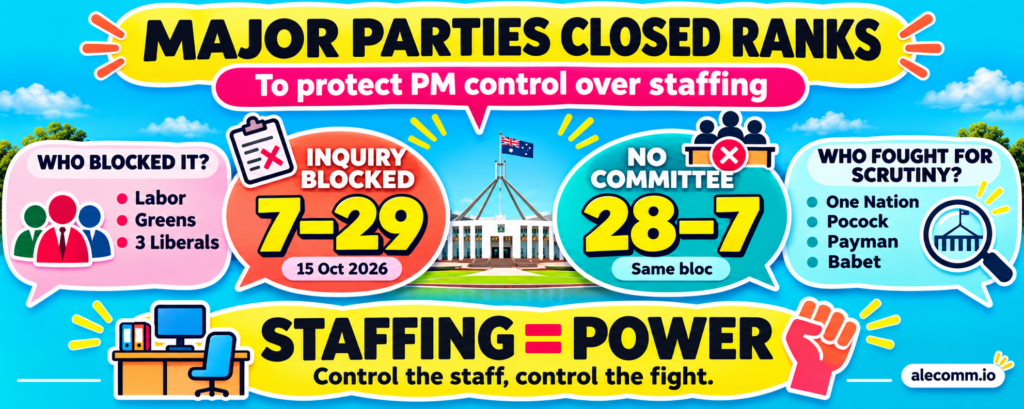
On 15 October 2026, Labor, the Greens and three Liberal senators united to prevent public scrutiny of the Prime Minister’s power over parliamentary staffing allocations.
Senator Pauline Hanson’s Members of Parliament (Staff) Amendment (Safe Staffing Guarantee) Bill sought to establish an independent and equitable allocation of personal staff for non-government MPs and senators, removing that power from the discretionary control of the Prime Minister.
Hanson moved to refer the bill to the Finance and Public Administration Legislation Committee for a public inquiry, with a report due by 24 November 2026.
They refused to even investigate it.
- 7–29: The motion to establish an inquiry was defeated.
- 28–7: Katy Gallagher’s subsequent amendment directing that the bill not be referred to any committee was carried.
They did not simply oppose the proposed reform. They actively voted to prevent it from being subjected to public scrutiny.
Who Voted To Prevent Scrutiny?
- Labor: Voted to preserve a system that gives its Prime Minister discretionary control over the parliamentary resources available to political opponents.
- The Greens: Every recorded Greens senator voted against the inquiry, demonstrating just how selectively they apply their much-publicised commitments to transparency and accountability.
- The Liberals: Senators Jonathon Duniam, Maria Kovacic and Matt O’Sullivan sided with Labor, effectively endorsing the very power that a Labor Prime Minister can exercise against them.
Who Stood For Parliamentary Accountability?
- Pauline Hanson
- Malcolm Roberts
- Warwick Bell
- Tyron Whitten
- David Pocock
- Fatima Payman
- Ralph Babet
Just seven senators voted to allow an inquiry into whether parliamentary staffing arrangements are fair, equitable and free from political interference.
Staffing Is Power
Parliamentary staff are responsible for researching legislation, drafting amendments, preparing speeches, investigating government misconduct, managing constituent matters and supporting elected representatives in holding governments accountable.
Restricting parliamentary staffing can effectively restrict political representation.
When the Prime Minister controls the resources available to political opponents, the government possesses the capacity to undermine their effectiveness without ever having to silence them directly.
It can restrict their resources, impede their investigations, diminish their legislative capacity and compromise their ability to represent the Australians who elected them.
That is not an administrative inconvenience.
It is an institutional vulnerability that can be exploited for political advantage at the expense of representative democracy.
The Hypocrisy Is Staggering
Labor talks about equality.
The Liberals talk about individual freedom and government overreach.
The Greens talk about transparency, accountability and democratic integrity.
Yet when presented with an opportunity to investigate a system capable of undermining every one of those principles, their recorded votes told an entirely different story.
Apparently, accountability is only desirable when it applies to someone else.
What Are They Afraid Of?
If parliamentary staffing allocations are fair, why oppose an inquiry?
If the Prime Minister’s discretionary powers are exercised appropriately, why resist independent scrutiny?
If there is nothing to conceal, why prevent Australians from examining the system?
The division record identifies who voted to prevent the inquiry, but provides no individual justification for those votes.
Australians deserve answers.
Parliament belongs to the Australian people. It is not a private members’ club operated for the convenience, protection and political survival of its establishment parties.
Every Australian deserves effective political representation, regardless of whom they voted for.
Democracy is not merely the right to elect a representative. It is also the right to have that representative adequately equipped to represent you.
Leave a Reply