
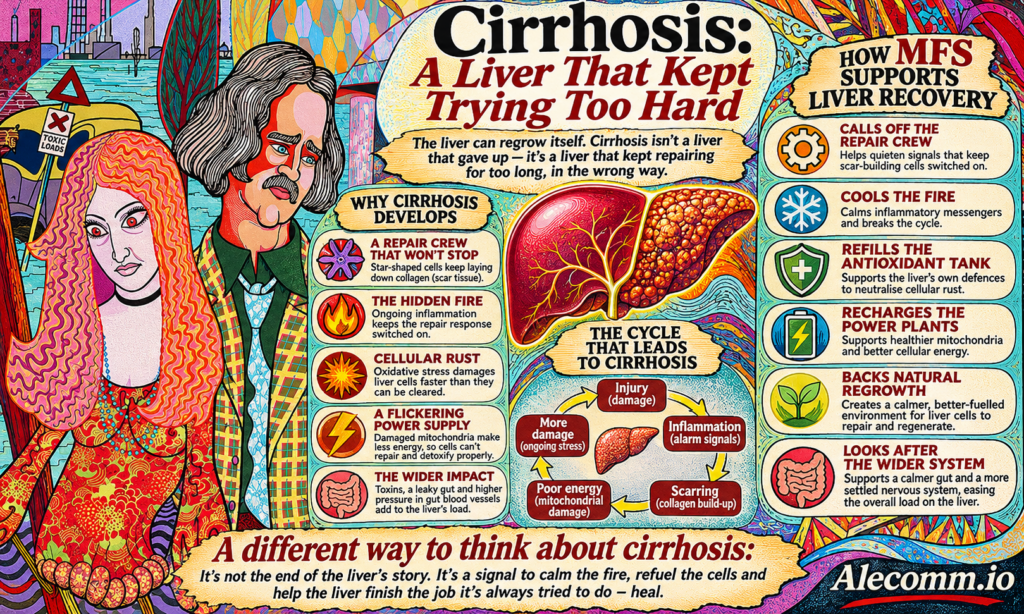
 Your liver is the only organ in your body that can regrow itself. Cut away a large share of a healthy liver and, given time, it rebuilds. So here’s a puzzle worth sitting with: if the liver is such a gifted healer, why does cirrhosis happen at all?
The surprising answer is that cirrhosis isn’t a story about a liver that stopped trying. It’s a story about a liver that kept trying too hard, in the wrong way, for far too long.
A Repair Crew That Won’t Clock Off
Every time liver cells are hurt, whether by alcohol, a virus, a build-up of fat or years of low-grade inflammation, the liver calls in its repair crew. Tucked between the liver cells are quiet, star-shaped cells that normally sit quietly minding their own business. When damage hits, they wake up, change shape and start laying down collagen, the same tough protein that forms a scar on your skin.
In a one-off injury, that’s brilliant. The patch holds things together while fresh liver cells grow back, then the crew packs up and the scar is quietly cleared away.
But when the damage keeps coming, the crew never gets the signal to go home. Scar is laid on top of scar. Bands of stiff tissue start to wrap around little islands of liver cells, squeezing the blood vessels that feed them and blocking the channels that carry bile away. Soft, spongy liver slowly turns firm and knobbly. That’s cirrhosis: not one wound, but thousands of repairs that never finished.
The Hidden Fire Underneath
Why does the repair crew stay switched on? Two things keep fanning the flames.
The first is inflammation. Injured liver cells send out alarm signals, and the liver’s resident immune cells answer by releasing more chemical messengers. Those messengers tell the repair crew to keep building scar, and the scar itself keeps irritating the tissue. It’s a loop that feeds itself.
The second is oxidative stress, a kind of cellular rust. Breaking down alcohol and other toxins throws off highly reactive molecules that damage fats, proteins and even DNA inside liver cells. The liver normally mops these up with its own built-in antioxidant reserves, but in a liver under constant strain, those reserves run dry. Once they do, damage piles up faster than it can be cleared.
Running on a Flickering Power Supply
Liver cells are some of the busiest cells in the body. They filter blood, make proteins, store fuel, build bile and neutralise toxins around the clock. All of that runs on energy made inside mitochondria, the tiny power plants in each cell.
In cirrhosis, those power plants struggle. Damaged mitochondria make less energy and leak more of those rust-like molecules, which damages them further. Cells that can’t make enough energy can’t repair themselves, can’t detoxify properly and are more likely to die off, leaving even more space for scar to fill. It’s one reason people with liver disease so often describe a heavy, bone-deep tiredness that sleep doesn’t fix.
When the Liver’s Trouble Travels
A struggling liver doesn’t keep its problems to itself. When it can’t clear toxins well, some of them reach the brain, which is why people with advanced liver disease can notice brain fog, poor concentration and changes in sleep. The gut feels it too. Scarring raises pressure in the blood vessels that drain the gut, and an inflamed gut lining lets more unwanted material leak back toward the liver, adding to its load.
In other words, cirrhosis is really a whole-body conversation, with the liver at the centre of it.
Where MFS Comes In
If cirrhosis is a loop of injury, inflammation, rust, low energy and endless scarring, then the smartest support doesn’t just target one piece. It works on the whole loop at once. That’s the thinking behind MFS.
Calling off the repair crew. MFS is designed to quieten the signals that keep those star-shaped cells stuck in scar-building mode. With the “keep building” message turned down, the liver has a better chance of slowing new scar formation and giving its own clean-up processes room to work.
Cooling the fire. MFS helps settle the inflammatory messengers that keep the loop spinning, so the liver isn’t constantly shouting for help.
Refilling the antioxidant tank. MFS supports the liver’s own antioxidant defences, helping it neutralise cellular rust before it does more harm, rather than simply masking it.
Recharging the power plants. By supporting healthier mitochondria and better cellular energy, MFS helps liver cells do what they do best: repair, detoxify and regrow.
Backing natural regrowth. Because the liver wants to regenerate, MFS aims to give surviving liver cells a calmer, better-fuelled environment to do it in, while also helping clear out worn-out cells that hang around sending inflammatory signals.
Looking after the wider system. MFS also supports a calmer gut and a clearer, more settled nervous system, easing some of the knock-on load that a struggling liver places on the rest of the body.
A Different Way to Think About Cirrhosis
It’s easy to picture cirrhosis as a door slammed shut: the liver is scarred, and that’s that. But the liver’s whole personality is about bouncing back. The scarring happens because its repair system is stuck on, not because its healing ability has vanished.
That shifts the question. Instead of asking, “How much damage has been done?” we can also ask, “What’s keeping the repair crew from going home, and how do we help the liver finish the job?”
MFS was built around that second question: calming the fire, refuelling the cells and giving one of the body’s most remarkable organs the conditions it needs to keep doing what it has always tried to do, which is heal.
Leave a Reply