
Take a breath. Now imagine doing it through a drinking straw, all day, every day, while climbing a flight of stairs. That is how many people describe living with chronic obstructive pulmonary disease, or COPD. It creeps in slowly: a cough that never quite leaves, a little more puffing on the hill, a few more pillows needed at night. Then one day the simple act of breathing has become hard work.
Most people think of COPD as damaged lungs and nothing more, a one-way street with an inhaler at the end of it. But what if the breathlessness is being driven by a set of quieter processes inside the lungs, and what if those processes can be eased rather than just endured?
That is the question MFS was built to answer.
More than worn-out lungs
Your lungs hold hundreds of millions of tiny air sacs, each one wrapped in a mesh of blood vessels so fine that oxygen can slip straight across into the blood. In COPD, years of irritation from smoke, pollution, dust or repeated infections leave the airways swollen and the air sacs damaged. Air goes in, but it struggles to get out again, and stale air stays trapped.
What keeps the condition rolling, though, is not just the original damage. It is the body’s ongoing response to it: an immune system that will not switch off, airways that keep producing sticky mucus, and lung cells that slowly run out of the energy they need to repair themselves.
The four pressures behind the breathlessness
COPD tends to be driven by several forces working together:
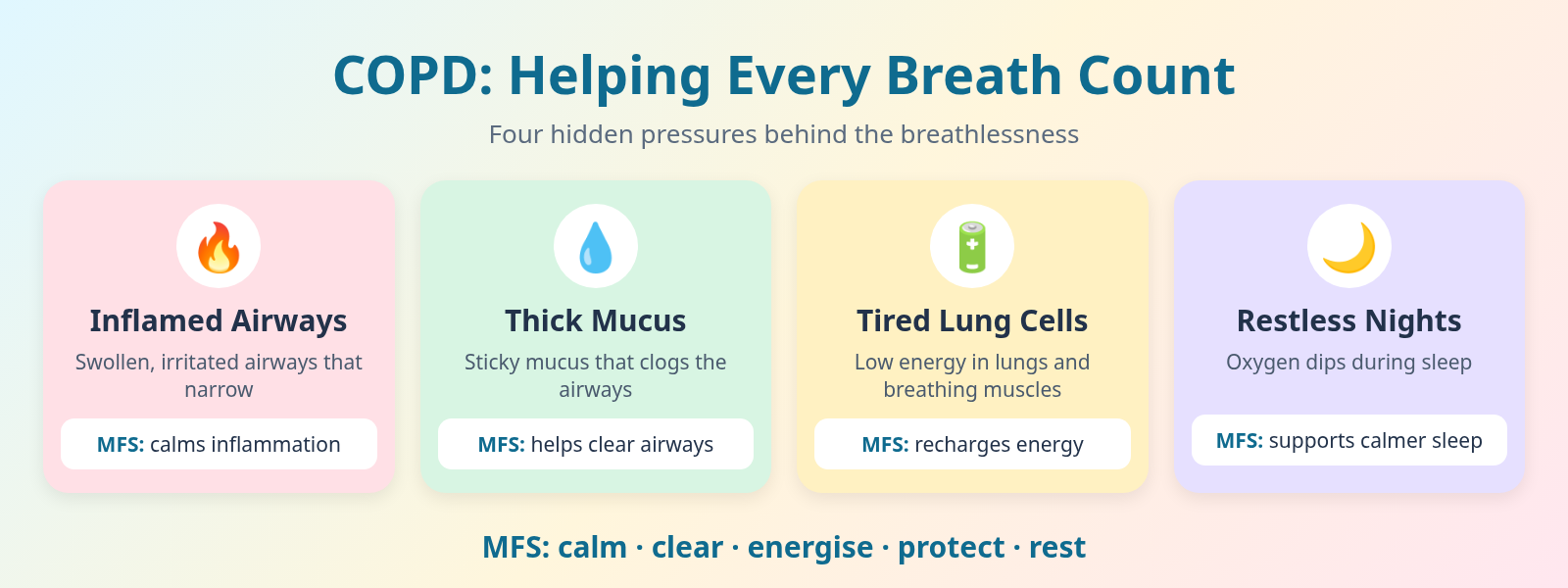
- Inflamed airways, where immune messengers stay switched on, keeping the airway walls swollen and narrow
- Thick, sticky mucus that clogs the smaller airways, traps germs and makes every cough exhausting
- Oxidative stress, where unstable molecules keep damaging the delicate lining of the air sacs
- Energy failure, as struggling mitochondria leave lung cells and breathing muscles tired and slow to recover
Each of these feeds the others. Inflammation drives more mucus, mucus invites infection, infection fuels more inflammation, and tired cells cannot keep up with the repairs. Easing just one of them rarely breaks the cycle. Easing all of them together is where things start to shift.
How MFS works with the lungs
MFS is a whole-system formula, so rather than chasing a single symptom it works on several layers at once.
Calming the fire. MFS helps quieten the inflammatory signals that keep the airways swollen and irritated, so there is more room for air to move in and out.
Clearing the way. MFS supports the breakdown of thick, stubborn mucus, helping the airways clear more easily and reducing the heavy, congested feeling that comes with it.
Shielding the air sacs. By boosting the body’s own antioxidant defences, MFS helps protect the fragile lining of the lungs from the ongoing damage that oxidative stress causes.
Recharging tired cells. MFS supports mitochondrial energy production in lung cells and in the muscles that power each breath, helping them do their job with less effort.
Steadying the immune system. Instead of simply suppressing immunity, MFS aims to bring it back into balance, so it is neither overreacting nor leaving the lungs open to infection.
The surprising link between your gut and your lungs
Here is something many people never hear: the gut and the lungs talk to each other. Scientists call it the gut–lung axis. When the gut lining is irritated or out of balance, inflammation can spill into the bloodstream and travel all the way to the airways.
MFS supports a healthier gut lining and better digestion, which helps turn down that background inflammation at its source. It is one of the less obvious ways a formula taken by mouth can make a difference to how well you breathe.
Why nights can be the hardest part
For many people with COPD, the real struggle happens after dark. During sleep, especially in the deepest dreaming stages, breathing naturally becomes shallower. In lungs already under strain, oxygen levels can dip again and again through the night, leaving people waking unrefreshed, foggy and more breathless the next day.
MFS supports deeper, more settled sleep and steadier breathing rhythms overnight. It also helps calm the body’s “fight or flight” response, which can otherwise keep the heart racing and the breathing muscles working overtime while you are meant to be resting.
The brain–lung connection
Breathlessness is frightening, and fear makes breathing harder. It is a loop that many people with COPD know too well. MFS supports the nervous system pathways that help regulate mood, relaxation and breathing coordination, helping the body find a calmer, more efficient rhythm.
The takeaway
COPD is not just a story of damaged lungs. It is a story of inflammation, mucus, oxidative stress, tired cells, restless nights and an anxious nervous system, all feeding into one another. MFS is designed to meet that whole picture at once: calming the airways, helping them clear, protecting the air sacs, recharging energy and supporting better rest.
Because when every breath takes effort, helping each one count makes all the difference.
Leave a Reply