Albanese’s Office Circulated a ‘Dirt Sheet’ Targeting Anti-Corruption Committee Deputy Chair Helen Haines After She Challenged His $6 Million Golf Club Grant
23 October 2026 | Political Accountability, Government Grants And Parliamentary Integrity
A controversy involving Prime Minister Anthony Albanese’s office has raised serious questions about political retaliation, government transparency and the treatment of parliamentarians who challenge the allocation of taxpayer funds.
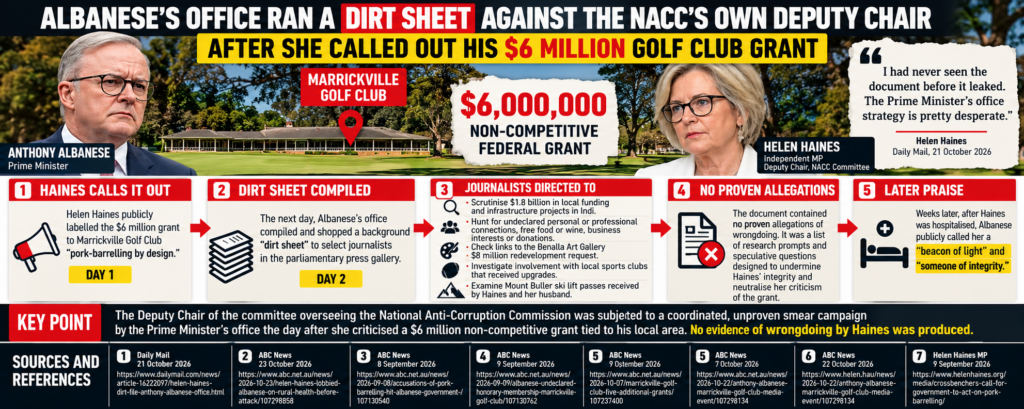
Independent MP Dr Helen Haines, Deputy Chair of the Parliamentary Joint Committee on the National Anti-Corruption Commission (NACC), publicly challenged a $6.05 million federal grant awarded to Marrickville Golf Club in Albanese’s electorate of Grayndler.
Haines questioned why the golf club had been selected for substantial taxpayer funding through an invitation-only grants program when comparable community organisations elsewhere had been denied even the opportunity to apply.
Shortly afterwards, according to reporting by the Daily Mail, a document containing potentially damaging questions about Haines’ own activities was circulated from the Prime Minister’s office to selected journalists in Canberra’s parliamentary press gallery.
The document did not establish that Haines had committed misconduct. Instead, it encouraged scrutiny of her community funding advocacy, personal associations, possible benefits and potential conflicts of interest.
The central accountability question is straightforward: Why was the office of the Prime Minister circulating material questioning the integrity of a parliamentarian who had challenged the government’s handling of public money?
The $6 Million Golf Club Grant That Started The Dispute
The controversy began with the Albanese government’s Major Local Community Infrastructure (MLCI) program, an invitation-only funding scheme worth approximately $560 million.
Unlike an ordinary competitive grants program, organisations could not simply submit applications for assessment against competing proposals. Projects were selected for invitation through a process controlled by the government.
Marrickville Golf Club received a $6.05 million commitment for redevelopment works, including clubhouse improvements, dining facilities, accessibility upgrades and stormwater infrastructure.
The grant attracted particular scrutiny because:
- Albanese had a decades-long association with the club.
- He held an honorary membership that had not been declared on his parliamentary register of interests.
- The club was located in his electorate.
- The grant was awarded through a closed, non-competitive process.
- The funding program disproportionately benefited Labor-held and politically competitive electorates.
- Other community organisations, including golf clubs requiring substantial repairs, were unable to compete for the same funding.
The ABC subsequently reported that Marrickville Golf Club had already received five earlier federal grants totalling $57,860 through closed funding processes.
Constitutional law professor Anne Twomey questioned the repeated allocation of public money without competitive assessment and criticised the broader practice of politicians selecting projects for taxpayer funding.
Helen Haines Challenged The Process, Not Community Funding
Haines’ criticism concerned the fairness of the allocation process.
As the independent member for Indi, she had advocated for numerous community projects throughout regional Victoria, including sporting facilities, tourism infrastructure and public amenities.
Advocating for local investment is a routine responsibility of federal parliamentarians.
However, there is an important distinction between advocating for projects through an accessible, independently assessed grants process and participating in a system where government-selected applicants receive exclusive invitations.
Haines highlighted the position of Rutherglen Golf Club in her electorate, which required significant repairs but had no opportunity to compete for funding under the MLCI scheme.
Her criticism raised a fundamental question about equality in public expenditure: Why should a golf club associated with the Prime Minister receive an invitation to seek millions of dollars while other clubs with demonstrable infrastructure needs are excluded?
That question is particularly relevant to a parliamentarian serving on the committee responsible for overseeing Australia’s national anti-corruption body.
The Document Circulated To Journalists
According to the Daily Mail’s reporting, the Prime Minister’s office circulated a background document encouraging journalists to investigate Haines’ advocacy and personal connections.
The document reportedly identified a range of possible avenues for investigation rather than presenting established findings of misconduct.
These included:
1. The $1.8 Billion In Funding Associated With Indi
Journalists were encouraged to examine the approximately $1.8 billion in funding and infrastructure projects Haines had advocated for in her electorate.
The apparent comparison was between her support for regional development and the government’s decision to award millions to Marrickville Golf Club.
However, the amount of funding advocated for by a parliamentarian does not, by itself, establish who selected the projects, whether competitive assessment occurred or whether the parliamentarian had a conflict of interest.
2. Personal Relationships And Hospitality
The document reportedly encouraged scrutiny of possible personal or professional relationships with organisations benefiting from government funding.
Questions extended to hospitality, meals, wine, donations, business interests and other potential benefits.
Such matters can legitimately warrant investigation when supported by evidence. But questions about whether something happened are not evidence that it did.
3. Benalla Art Gallery
The document reportedly identified an $8 million redevelopment proposal involving Benalla Art Gallery and suggested examining whether Haines had personal connections with people or organisations associated with the project.
No established improper relationship was identified in the reporting.
4. Local Sporting Organisations
The suggested inquiries extended to whether Haines had played sport, trained with local clubs or received sporting clothing or equipment from organisations that had benefited from infrastructure funding.
The existence of community relationships is not inherently improper. A relevant conflict-of-interest assessment would require evidence of a material benefit, a decision-making role and an applicable disclosure obligation.
5. Mount Buller Ski Lift Passes
The document also reportedly raised questions about ski lift passes received by Haines and her husband, alongside her subsequent advocacy for infrastructure funding associated with the alpine region.
Whether any benefit required disclosure, was properly declared or created a conflict would depend on the relevant circumstances and parliamentary rules.
The reporting did not establish that Haines had improperly influenced funding decisions.
The Difference Between Accountability And Political Targeting
Every parliamentarian should be subject to appropriate scrutiny, including Haines and Albanese.
The issue is not whether journalists should investigate conflicts of interest. They should.
The issue is whether government staff used their access, resources and relationships with journalists to encourage adverse reporting about a political critic immediately after she questioned a grant associated with the Prime Minister.
There is a significant difference between providing journalists with evidence of wrongdoing and distributing speculative questions designed to generate suspicion.
The former can advance public accountability.
The latter raises concerns about the potential use of political communications machinery to discourage criticism.
If the document was prepared and circulated in response to Haines’ comments, the timing and purpose of that decision deserve scrutiny.
The Prime Minister’s Response
When questioned about the document, Albanese did not initially provide a direct explanation of whether he had authorised it or known about its circulation.
Instead, he defended Haines’ work as a local member and described her as a strong advocate for her community.
Deputy Prime Minister Richard Marles also faced questions about the document while emphasising the importance of respectful political debate.
The controversy became more pronounced following Haines’ hospitalisation after a serious incident outside her electorate office.
Albanese publicly praised her character and called for greater restraint in political discourse.
His public expressions of respect were contrasted by critics with the earlier circulation of material questioning her integrity.
The existence of that contrast does not establish that Albanese personally directed the document’s preparation. It does, however, make the question of who authorised its distribution especially relevant.
New Evidence Raises Further Questions About The Golf Club Funding
Separate reporting published by the ABC on 22 October 2026 added another dimension to the controversy.
Documents obtained under Freedom of Information laws revealed that the Prime Minister’s office had been considering a media opportunity at Marrickville Golf Club shortly before his previously undeclared honorary membership became public.
The proposed event would have promoted the $6.05 million redevelopment.
The departmental briefing described clubhouse refurbishment, hospitality improvements, a new pro shop, toilets, a dog-walking station and stormwater harvesting.
It did not identify the prevention of raw sewage entering the Cooks River as the central purpose of the grant.
That matters because Albanese had publicly defended the funding in parliament by referring to sewage flowing into the river during flooding.
The ABC reported that separate NSW government funding of approximately $269,500 had been provided for sewerage-related works.
These revelations raise legitimate questions about whether the government’s public explanation accurately reflected the project for which federal funding was originally approved.
They also reinforce the importance of examining the grant selection process independently of the political dispute with Haines.
The Parliamentary Integrity Questions
The controversy warrants answers to several specific questions:
- Who requested, drafted, reviewed and authorised the document concerning Helen Haines?
- Was the Prime Minister aware of its preparation or distribution?
- Were taxpayer-funded ministerial or parliamentary staff involved?
- Was the document circulated through official government communications channels?
- What evidence, if any, supported the questions and insinuations contained in it?
- Were similar background investigations prepared about other parliamentarians who criticised government grants?
- Did the document serve a legitimate government communications purpose or a party-political purpose?
- What safeguards prevent government resources from being used to target parliamentary critics?
- Will the government disclose the document and relevant records of its preparation and circulation?
- Will the government provide a full explanation of the selection and approval process for the Marrickville Golf Club grant?
These questions do not require a presumption of criminality or corruption. They require transparency about the conduct of public office.
Why This Matters Beyond Helen Haines
The broader concern is the potential chilling effect on parliamentary scrutiny.
Independent MPs, opposition members and parliamentary committee officeholders must be able to question government spending without facing improper retaliation.
A parliamentarian who challenges a grant should expect her own conduct to remain open to legitimate scrutiny. She should not have to accept the use of unsubstantiated insinuations as a substitute for answers about government decisions.
The same standard must apply to every political party and every government.
The Marrickville Golf Club grant raises questions about how public money was allocated.
The document concerning Haines raises a separate question about how the Prime Minister’s office responded when that allocation was challenged.
Both matters deserve independent scrutiny, documentary transparency and clear answers from those responsible.
Public accountability cannot operate effectively if questions about government expenditure are answered with questions about the personal integrity of the parliamentarian asking them.
Sources And References
1. Daily Mail | 21 October 2026
Albanese’s Office Circulated Dirt Sheet Against Helen Haines
https://www.dailymail.com/news/article-16222097/helen-haines-dirt-file-anthony-albanese-office.html
2. ABC News | 23 October 2026
Albanese Office Document And Helen Haines
https://www.abc.net.au/news/2026-10-23/helen-haines-lobbied-albanese-on-rural-health-before-attack/107298858
3. ABC News | 8 September 2026
Invitation-Only Grants And Pork-Barrelling Concerns
https://www.abc.net.au/news/2026-09-08/accusations-of-pork-barrelling-hit-albanese-government-/107130540
4. ABC News | 9 September 2026
Albanese’s Undeclared Honorary Golf Club Membership
https://www.abc.net.au/news/2026-09-09/albanese-undeclared-honorary-membership-marrickville-golf-club/107130762
5. ABC News | 7 October 2026
Marrickville Golf Club’s Five Previous Federal Grants
https://www.abc.net.au/news/2026-10-07/marrickville-golf-club-five-additional-grants/107237400
6. ABC News | 22 October 2026
Freedom Of Information Documents Reveal Golf Club Grant Details
https://www.abc.net.au/news/2026-10-22/anthony-albanese-marrickville-golf-club-media-event/107298134
7. Helen Haines MP | 9 September 2026
Crossbench Calls For Action On Pork-Barrelling
Leave a Reply