
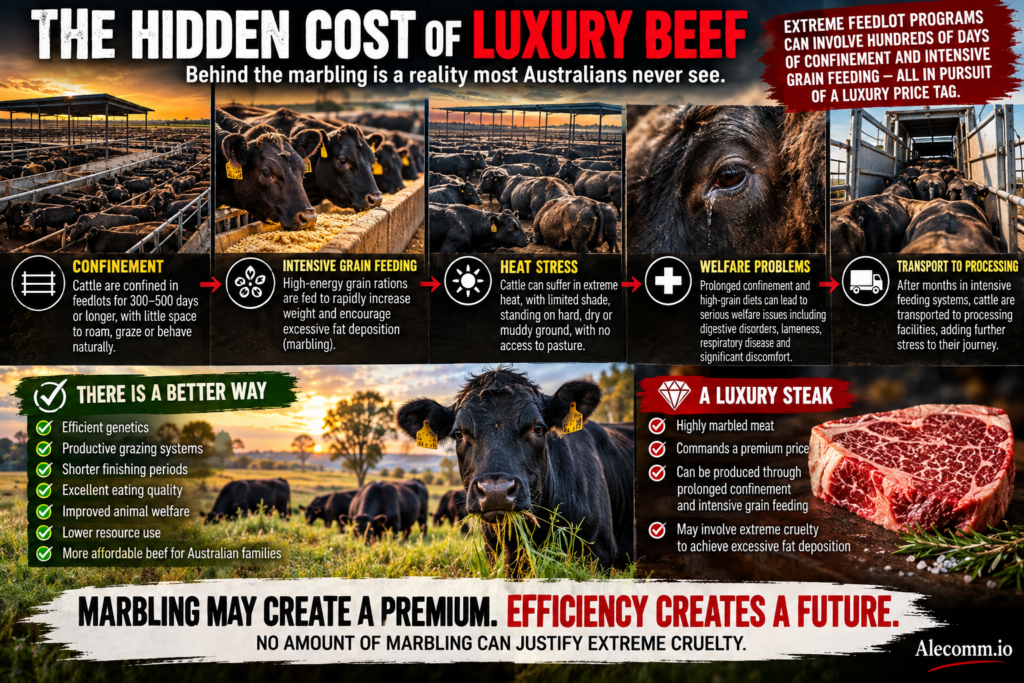
The Hidden Environmental Cost Of Luxury Beef: How Much Is Extreme Marbling Really Costing Australia?
Hundreds Of Days Of Additional Feeding, Mountains Of Manure, Greenhouse Gas Emissions And Industrial-Scale Resource Consumption. All To Put More Fat Into A Steak.
Australia has some of the finest cattle genetics and grazing resources in the world. Yet certain premium beef production systems continue to celebrate prolonged grain feeding and extreme marbling as though consuming more resources automatically means producing better beef.
But what happens when we look beyond the luxury label? What happens when we count the grain, diesel, water, manure, methane, land use and additional days of animal confinement? And what happens when we ask whether modern cattle genetics could deliver exceptional beef with fewer inputs?
The environmental cost of a steak doesn’t begin at the supermarket. It begins long before the animal reaches the processing plant.
🌍 The Climate Bill Behind The Marbling
Consider a hypothetical feedlot containing 1,000 cattle undergoing an additional 300 days of intensive finishing. Using illustrative feed consumption and published Australian feedlot emissions measurements, that additional period could involve:
Illustrative gross quantities during the additional 300 days, not verified net increases relative to a different finishing system. Actual figures vary with cattle, feed, climate and management.
That’s 300,000 additional animal-days of feeding, confinement, manure production and industrial management.
And those figures don’t fully capture the upstream resources needed to grow the grain, manufacture fertiliser, operate machinery or transport feed.
🌱 Calculate The Environmental Burden Yourself
How much grain, methane, ammonia and nitrous oxide might be associated with different numbers of cattle and additional feeding days? Move the sliders and see what happens.
🌱 Interactive Environmental Calculator
Explore the estimated impact of additional feedlot finishing.
Illustrative gross feedlot-period estimates using fixed emissions rates of 113 g methane, 176 g ammonia and 3.3 g nitrous oxide per animal per day. Changing the feed slider changes feed consumption only; it does not model changes in emissions caused by different rations. These are not net differences against alternative production systems.
🌾 Grain Doesn’t Magically Appear In A Feed Bunk
Four thousand five hundred tonnes of feed is an enormous quantity of agricultural material. It must be produced somewhere.
That can mean cultivated land, fertiliser, irrigation where required, machinery, harvesting, storage and transport. Every stage can carry environmental consequences.
We’re using agricultural resources to feed animals for additional months, partly to produce the extra fat that luxury markets are willing to reward.
That deserves scrutiny when efficient breeding and alternative finishing strategies may achieve desirable eating quality with fewer inputs.
However, the comparison must account for the full production system. Grain finishing can also accelerate weight gain, and grazing alternatives have their own land, methane and resource requirements.
Measure the resources consumed per kilogram of saleable, high-quality beef, not simply the marbling score achieved.
💩 The Manure Problem Nobody Photographs For The Wagyu Brochure
Imagine thousands of cattle concentrated in a relatively small area. They eat. They drink. They urinate. They defecate. Every single day.
Multiply that by hundreds of additional days and the scale of waste management becomes impossible to ignore.
- Ammonia emissions: Air quality and nitrogen pollution.
- Nutrient runoff: Potential waterway contamination if containment fails.
- Nitrous oxide: A powerful greenhouse gas associated with nitrogen cycling.
- Odour, dust and flies: Impacts on surrounding communities.
- Manure handling: Land, machinery, labour and environmental controls.
Properly managed manure can be a useful fertiliser. Feedlots can also use engineered drainage, holding ponds and nutrient-management systems to reduce pollution. But these measures don’t eliminate the underlying volume of waste generated.
The manure doesn’t disappear because the meat is sold as premium Wagyu.
🚛 The Diesel, Freight And Energy Nobody Sees
Every tonne of additional grain has a supply chain. Fields must be worked. Crops must be harvested. Grain may need drying, processing and storage. Trucks move feed. Machinery distributes rations. And eventually cattle are transported for processing.
Longer feeding periods can increase cumulative energy and operating requirements, although they do not necessarily mean more cattle journeys or longer transport distances.
The correct environmental calculation includes the whole chain, not just the feedlot gate.
🐂 The Animal Welfare Cost
The animal doesn’t know what a marbling score is. It doesn’t know that its meat may command a luxury premium. And it doesn’t benefit from another few hundred dollars added to the price of its eventual steak.
Some high-marbling Wagyu programs involve 300–500 days or longer in intensive finishing systems.
Prolonged confinement can restrict opportunities for natural grazing and movement. Heat, mud, stocking density, diet management and animal health can become serious welfare concerns when conditions are inadequate.
Where intensive production subjects cattle to severe and avoidable suffering, that is extreme cruelty — regardless of the value of the finished meat.
Not every feedlot operates under cruel conditions, and duration alone does not prove suffering. But welfare should be assessed independently, rather than excused by a premium product.
No amount of marbling can justify extreme cruelty.
🧬 Australia Has A Better Question To Ask
What if the industry rewarded cattle for delivering exceptional eating quality alongside:
- Superior feed conversion.
- Strong average daily weight gain.
- Higher saleable carcass yield.
- Efficient use of pasture and supplementary feed.
- Reduced unnecessary confinement.
- Measurable animal welfare.
- Lower whole-of-life environmental impacts.
That would recognise the skill of Australian breeders and producers who are improving productivity. It would also move the conversation beyond the assumption that expensive production automatically means superior agriculture.
A gold medal for fat is not a gold medal for farming. And it certainly isn’t a gold medal for environmental responsibility.
💰 Now Put A Price On The Extra Feedlot Time
The environmental burden is only part of the story. Every additional day requires feed, labour, water, equipment, infrastructure and capital.
Using an illustrative daily feedlot cost of $7–$10 per animal, the additional expenditure can become substantial.
Move the sliders and calculate the additional cost yourself.
💰 The True Cost Of Extra Feedlot Days
Interactive production cost estimator
Australian dollars. Illustrative gross costs, not net losses. Does not account for additional liveweight value, carcass premiums or alternative production costs. Feed assumes 15 kg per animal per day; methane uses 113 g per animal per day.
🔥 The Real Cost Is Bigger Than The Price Tag
An extra 300 days of intensive finishing for 1,000 cattle, at $8.50 per animal per day, represents $2.55 million in additional feeding and feedlot expenditure.
That is a substantial investment in achieving a particular market specification. The additional time also involves feed consumption, waste management, emissions and welfare responsibilities.
Whether the resulting premium justifies those costs is a question the industry should be willing to answer with evidence.
Australia doesn’t need to win a competition for the world’s most expensive steak. It needs to lead the world in producing outstanding beef intelligently, efficiently and humanely.
Marbling May Create A Premium. Efficiency Creates A Future.
And no luxury steak should be so valuable that we stop questioning the environmental, financial and animal welfare costs of producing it.
Alecomm.io
Sources And References
- Meat & Livestock Australia — Greenhouse Gas Emissions From Australian Beef Cattle Feedlots
- Queensland Government Research Archive — Resource Use And Greenhouse Gas Emissions From Australian Feedlots
- Meat & Livestock Australia — Life Cycle Assessment Of The Australian Lot Feeding Sector
- Beef Central — Feedlot Trading Budget
Leave a Reply