

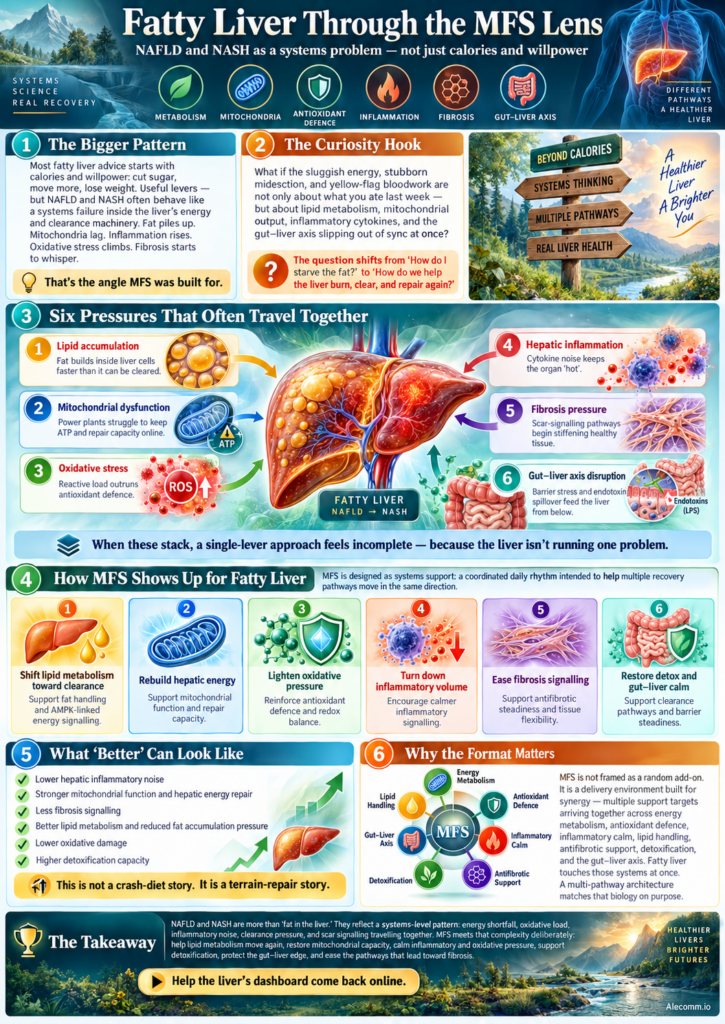
Most fatty liver advice starts with calories and willpower. Cut the sugar. Move more. Lose weight. Useful levers — but they miss the bigger pattern: non-alcoholic fatty liver disease (NAFLD) and its progressive form, NASH, often behave like a systems failure inside the liver’s energy and clearance machinery. Fat piles up. Mitochondria lag. Inflammation rises. Oxidative stress climbs. Fibrosis starts to whisper.
That’s the angle MFS was built for.
The curiosity hook most fatty-liver conversations skip
What if the sluggish energy, the stubborn midsection, the “my bloodwork keeps waving yellow flags” feeling aren’t only about what you ate last week — but about lipid metabolism, mitochondrial output, inflammatory cytokines, and the gut–liver axis all slipping out of sync at once?
That reframes the question from “How do I starve the fat?” to “How do we help the liver burn, clear, and repair again?”
Six pressures that often travel together
In the MFS lens, fatty liver sits among patterns where several forces tend to overlap:
- Lipid accumulation — fat building inside liver cells faster than it can be cleared
- Mitochondrial dysfunction — the liver’s cellular power plants struggling to keep ATP and repair capacity online
- Oxidative stress — reactive load outrunning antioxidant defence in hepatocytes
- Hepatic inflammation — cytokine noise (the kind that keeps the organ “hot”)
- Fibrosis pressure — scar-signalling pathways starting to stiffen healthy tissue
- Gut–liver axis disruption — barrier stress and endotoxin spillover feeding the liver from below
When those stack, a single-lever approach feels incomplete — because the liver isn’t running one problem.
How MFS shows up for fatty liver
MFS is designed as systems support — a coordinated daily rhythm meant to help multiple recovery pathways move in the same direction. For NAFLD/NASH, that support is multidimensional: mitochondrial repair, detoxification capacity, antioxidant regulation, lipid modulation, and antifibrotic steadiness.
Shift lipid metabolism back toward clearance
Fatty liver isn’t only storage — it’s a traffic jam in how the liver handles fat. MFS is positioned to support pathways that encourage better lipid handling and metabolic signalling (including AMPK-linked energy sensing), so fat accumulation has somewhere to go besides “more of the same.”
Rebuild energy where hepatic fatigue begins
When mitochondria underperform, the liver loses repair bandwidth. Supporting cellular energy restoration and more efficient mitochondrial function is part of how MFS aims to address that drained, overloaded organ feeling — not with a stimulant, but with capacity.
Lighten oxidative pressure on liver cells
Oxidative stress and lipid peroxides are core burdens in NAFLD/NASH. MFS is designed to reinforce antioxidant defence networks and redox balance so hepatocytes face less daily damage while they try to recover.
Turn down inflammatory volume
Hepatic inflammation keeps the cycle spinning: cytokines climb, immune tone stays loud, recovery stalls. MFS is framed around calmer inflammatory signalling — less background “heat” in the organ so repair has room to work.
Ease fibrosis signalling before it hardens the story
Progression toward NASH often involves scar-pathway activation and stellate-cell overdrive. MFS is described as supporting antifibrotic steadiness — helping the liver stay more pliable and regenerative rather than quietly stiffening.
Restore detox and gut–liver calm
The liver’s clearance systems and the gut barrier are linked. When detox capacity drops and gut spillover rises, the organ carries a heavier load. MFS is designed as a delivery environment that also supports detoxification pathways and gut–liver steadiness as part of the wider recovery rhythm.
What “better” can look like in this framing
Across the MFS outcomes for fatty liver, the intended direction of travel is clear:
- Lower hepatic inflammatory noise
- Stronger mitochondrial function and hepatic energy repair
- Less fibrosis signalling
- Better lipid metabolism and reduced fat accumulation pressure
- Lower oxidative damage
- Higher detoxification capacity
That’s not a crash diet story. It’s a terrain repair story.
Why the format matters
MFS isn’t framed as a random add-on. It’s a delivery environment built for synergy — multiple support targets arriving together across energy metabolism, antioxidant defence, inflammatory calm, lipid handling, antifibrotic support, detoxification, and the gut–liver axis.
Fatty liver touches those systems at once. A multi-pathway architecture matches that biology on purpose.
The takeaway worth remembering
NAFLD and NASH are more than “fat in the liver.” They’re a systems-level pattern: energy shortfall, oxidative load, inflammatory noise, clearance pressure, and scar signalling travelling together.
MFS meets that complexity deliberately: help lipid metabolism move again, restore mitochondrial capacity, calm inflammatory and oxidative pressure, support detoxification, protect the gut–liver edge, and ease the pathways that lead toward fibrosis.
That’s not “eat less and hope.” It’s help the liver’s dashboard come back online — and for a lot of people staring at rising liver markers, that’s exactly what makes it interesting.
Leave a Reply