And Why Its Destruction Was Buried Deeper Than the Bodies On Board
For years, rumours drifted through defence circles about a “ghost freighter” somewhere between the Caribbean and the mid-Atlantic — a monstrous cargo vessel that never docked, never registered, and never broadcast a transponder signal. A ship that moved millions in narcotics, laundered money across continents, and held trafficked labourers as disposable machinery.
Most people dismissed it as cartel mythology.
Governments politely pretended they’d never heard of it.
NGOs suddenly “lost” their human-trafficking files.
And every time the name El Azabache surfaced, it was chalked up to whispers and sailor folklore.
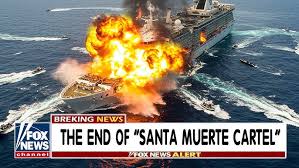
Then it burned.
A Fortress Disguised as a Freighter
This wasn’t a fishing boat, a tug, or a rust bucket with three kilos of cocaine under a tarp.
This thing was a floating industrial complex:
- Multi-deck internal corridors like a small cruise ship.
- A full cocaine processing line.
- Fentanyl precursor labs lifted straight out of Chinese factory blueprints.
- Radar.
- Signal jammers.
- Weapons lockers.
- Cells — yes, literal cells — packed with trafficked workers taken from 17 different countries and forced into chemical labour.
Some were tricked with fake fishing contracts.
Some were straight-up kidnapped.
None were ever meant to leave alive.
Who Ran It
The fortress wasn’t one cartel’s trophy — it was a criminal coalition:
- Rogue Venezuelan military elements providing protection and fuel.
- PDVSA-linked logistics operators quietly diverting maritime assets.
- Dissident FARC offshoots handling the chemical end.
- Caribbean smugglers ferrying shipments to land.
- Mexican transport syndicates managing the long-haul routes.
The “boss” didn’t use a name — only rotating aliases.
That’s why the media can’t “find him.”
There was nothing to find.
The Marines Who Never Existed — Officially
The public story is simple:
“U.S. forces struck Venezuelan narco boats.”
But the public story leaves out the part where a U.S. Marine reconnaissance team boarded a support vessel linked to the fortress, took fire, and suffered casualties.
Those names never reached headlines.
The Pentagon locked the incident behind secure compartments and fed reporters the sanitized version.
One reason the White House ordered a kinetic takedown?
Because leaving that fortress afloat after American blood was spilled would have been political suicide.
The Strike
When the order finally went through, it wasn’t a gentle intercept.
It was:
- A precision missile strike
- Followed by a rapid-approach assault
- Followed by systematic neutralisation of armed defenders
The trafficked workers — the ones still alive — were extracted.
The higher-ups scattered like cockroaches into Venezuela’s interior.
And the ship, crippled and burning, was later scuttled to prevent it becoming a floating crime scene for journalists and UN bureaucrats.
Why the World Pretended It Never Happened
Simple:
Too many governments had fingerprints on the supply chain.
- The human trafficking networks ran through Africa, Asia, and South America.
- The chemical precursors came from factories operating under “don’t ask, don’t tell” regulatory regimes.
- The shell shipping companies were registered through jurisdictions that sell secrecy as a service.
- NGOs and human-rights groups had reports — but quietly shelved them once the political cost became obvious.
A multi-nation criminal empire hiding on the open ocean?
Nobody wanted to answer how it was allowed to exist at all.
The Truth Is Ugly — And That’s Why It Matters
People think modern slavery looks like a basement in a city or a brothel in some corrupt capital.
No.
It also looks like a massive cargo ship drifting in international waters, guarded by cartel rifles, cooking millions in narcotics, staffed by people who were never meant to see land again.
That floating fortress didn’t sink because the world suddenly grew a conscience.
It sank because it became a liability.
And the only reason anyone outside military channels even hears whispers about it now is because the official narrative can’t smother every leak — or every survivor.
Leave a Reply