
The Big Lie About “Illegal Orders” — And Why Narco-Terrorist Boat Engagements Are Fully Lawful
Every time the United States takes decisive action against the narco-terrorist vessels blasting across the sea lanes from Venezuela toward American waters, a predictable chorus erupts:
“You can’t fire on them! It’s illegal! The Law of War says so!”
This is nonsense.
Worse than nonsense — it’s weaponised ignorance masquerading as legal authority.
So let’s dismantle this bad-faith interpretation once and for all.
The Manual They Keep Citing Doesn’t Say What They Think It Says
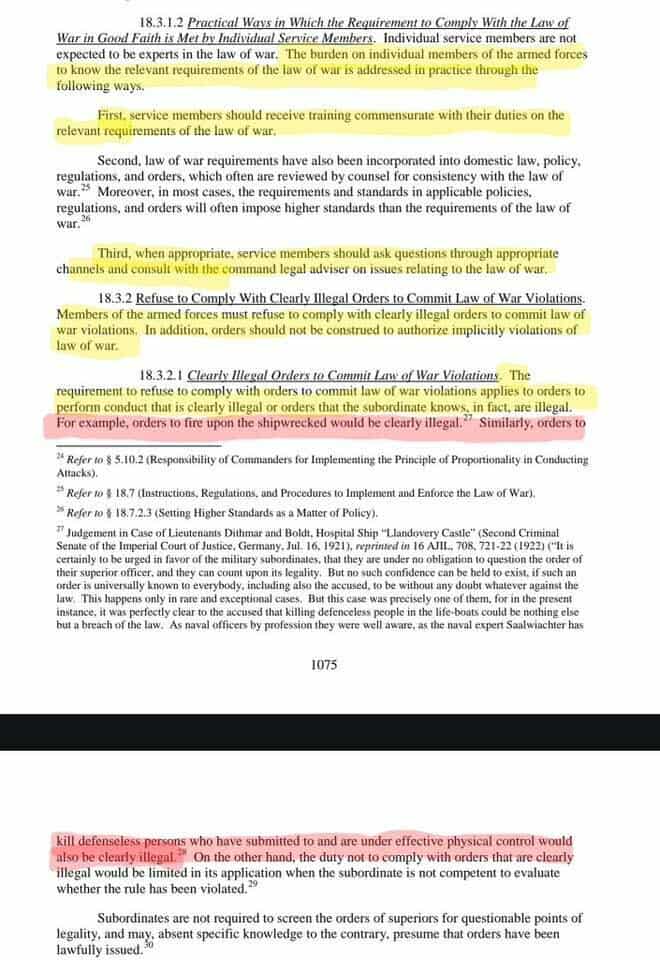
Recently, activists and self-appointed “experts” began circulating a screenshot of a page from a U.S. military law-of-war manual. It contains two highlighted sections:
-
Yellow: generic guidance about how service members receive training and can ask questions internally.
-
Red: a rule stating that “clearly illegal orders” such as killing shipwrecked, defenseless persons must be refused.
Looks dramatic.
Sounds serious.
Too bad it’s completely irrelevant to the mission at hand.
Because the people claiming this paragraph applies to narco-terrorist boats heading toward the United States do not understand the material they’re quoting. Or worse — they’re misusing it deliberately.
Either way, the argument collapses under gravity.
Fact: Narco-Terrorist Vessels Are Not ‘Defenceless Persons’
The red-highlight portion in that manual covers situations like:
- firing on surrendered personnel,
- killing unarmed captives,
- shooting shipwreck survivors in lifeboats,
- harming people already under U.S. control.
That is the standard.
That is the threshold.
And it has zero overlap with a boat full of cartel operatives, fentanyl runners, armed smugglers, or cross-border actors intentionally evading maritime interdiction.
These vessels are hostile, operational, armed, evasive, and engaged in a continuing criminal/terrorist action.
There is no plausible universe in which this scenario resembles a shipwrecked civilian waving a white flag.
Trying to equate the two is either (1) dishonest or (2) deeply uninformed.
Fact: Engagement of Hostile Actors at Sea Is Lawful Under ROE, Counter-Drug, and Maritime Security Authorities
The United States has clear legal frameworks governing maritime engagements:
- Rules of Engagement (ROE)
- Counter-Drug (CD) authorities
- Maritime Interdiction Operations (MIO)
- Homeland Security maritime authorities
- Use of force for hostile intent / hostile act
These frameworks allow U.S. forces to:
- intercept
- disable
- board
- seize
- or engage
vessels participating in hostile or criminal activity, especially when tied to cartel, terror, or transnational threats.
Nothing in the Law of War prohibits this.
Nothing in the highlighted text limits it.
Nothing in that screenshot even touches the issue.
So yes — the order to stop, disable, or engage these vessels is not only lawful, it is mandatory when hostile intent is confirmed.
So Why Are Some Politicians and Activists Misrepresenting This?
Because the real game isn’t about legal doctrine.
It’s about politics.
Certain actors want service members to believe that following lawful orders is somehow suspect — that political activists supersede JAG officers, that Twitter memes outrank the chain of command, or that “public opinion” overrides maritime engagement statutes.
This isn’t harmless confusion.
This is interference.
And, under federal law, interference with military discipline is not a casual matter — it sits under a cluster of serious statutes, including:
- 18 U.S.C. § 2387 – Activities Affecting the Armed Forces (seditious interference)
- UCMJ protections against mutiny, sedition, and disobedience
- Federal statutes against obstructing national security operations
Telling troops to ignore lawful orders, refuse interdiction duties, or consider engagement “illegal” when it clearly isn’t is a direct breach of these provisions.
This is not up for debate.
The Yellow Highlights? They Mean Nothing to Outsiders.
The screenshot’s yellow highlights cover administrative doctrine:
- troops receive law-of-war training
- troops may ask their own command legal adviser questions
- troops must follow clearly lawful orders and refuse clearly illegal ones
This is inward-facing guidance.
It governs internal military conduct — not public discourse, not political activists, not media pundits, and certainly not random civilians attempting to “educate” the military.
If someone outside the military thinks these sections give them the authority to lecture service members about ROE, they’re wrong.
Legally wrong.
Factually wrong.
And arrogantly wrong.
The military does not take legal instruction from the public.
That is not how any of this works.
The Screenshot Proves Nothing — Except That Some People Don’t Understand Military Law
The highlighted passage floating around social media is:
- misquoted
- misused
- taken out of context
- and irrelevant to maritime interdiction
Narco-terrorist boats are not shipwrecked civilians.
They are hostile, armed, and operational threats — and the United States is fully within its rights to interdict them with appropriate force.
The real scandal isn’t the ROE.
It’s the political sabotage dressed up as “concern” for legality.
And that’s why this entire argument collapses:
The red highlight does not apply.
The yellow highlight is irrelevant.
The engagement is lawful.
The interference is not.
Leave a Reply