
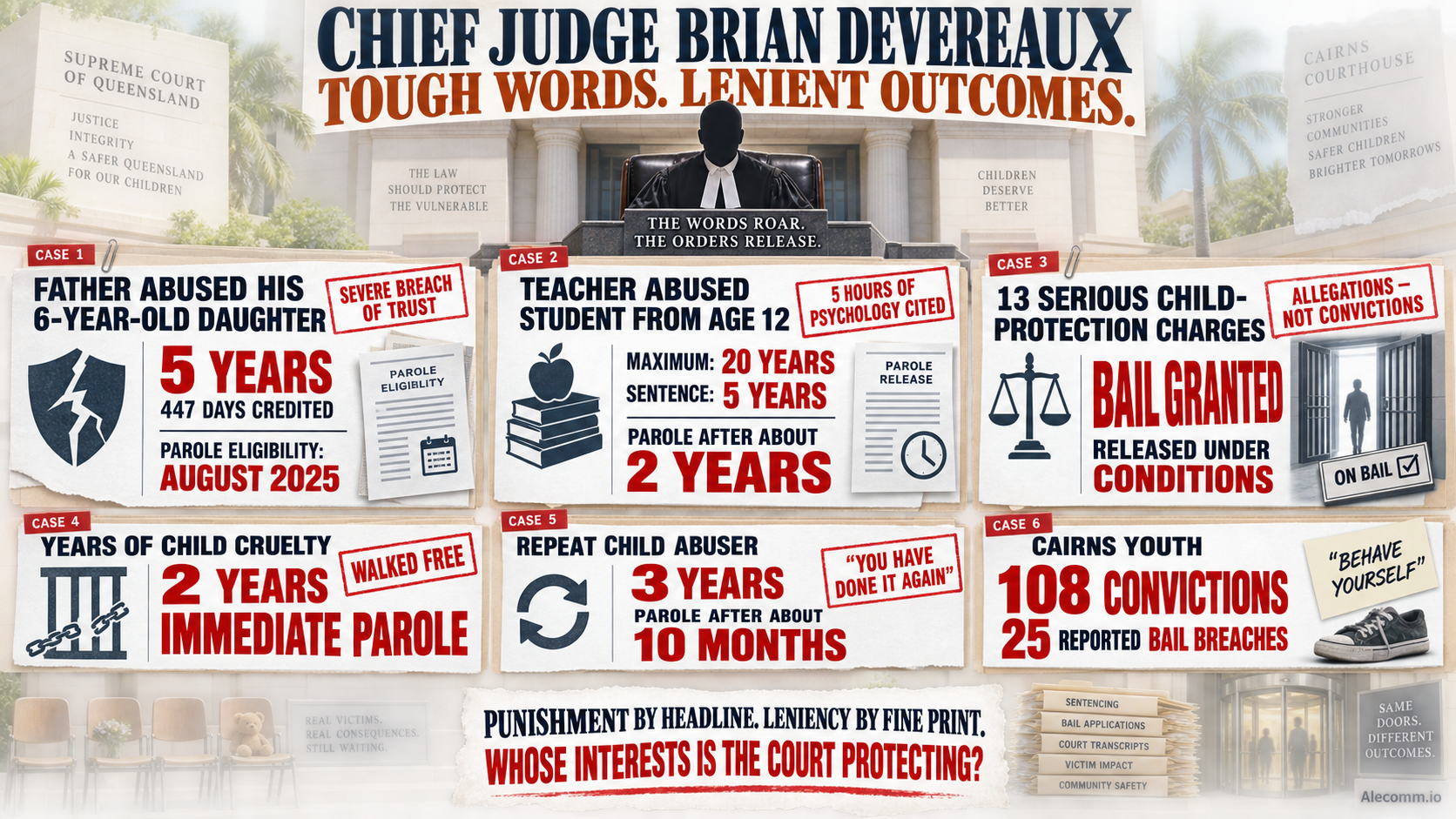
 Brian Devereaux: The Chief Judge Whose Words Roar While His Sentences Whisper
An examination of child-sex, child-exploitation and child-cruelty cases decided by Queensland Chief Judge Brian Devereaux reveals a disturbing gulf between the severity of his courtroom language and the consequences offenders actually face.
Queensland’s Chief Judge has repeatedly described offences against children in uncompromising terms:
- “Appalling”
- “Criminal”
- “Pure cruelty”
- An outrageous breach of trust
- A trail of misery
- Conduct that left children in “a state of terror”
But the practical outcomes have included:
- Immediate parole
- Immediately suspended imprisonment
- Parole eligibility after a fraction of the headline sentence
- Release under supervision
- Another collection of written bail conditions
The denunciations sound severe.
The Orders Frequently Do Not.
The following cases document the gap between what Devereaux says about crimes against children and what his decisions ultimately mean for the offender.
The Child-Sex And Exploitation Cases
1. The Father Who Sexually Exploited His Six-Year-Old Daughter
Offender: Name withheld under reporting restrictions
Victim: His six-year-old daughter
Sentence: Five years’ imprisonment
Presentence custody credited: 447 days
Parole eligibility: 18 August 2025
This was not merely possession of child-abuse material.
The court heard that the father directly involved his own six-year-old daughter in sexual offending.
His conduct included:
- Exposing the child to pornography
- Instructing her to select a pornographic video
- Committing a sexual act with a sex toy in front of her
- Threatening the child to keep her silent
- Producing child-abuse material
- Distributing sexualised images of children
- Sharing 27 images
- Discussing the acquisition of further material
The child was not targeted by a stranger hiding behind an anonymous online account.
She was exploited by her own father—the person responsible for protecting her.
Devereaux described the direct offending against the child as a severe breach of trust. He reportedly characterised the distribution of the images as being at the “lower end of the scale.”
That description demands examination.
Lower Than What?
The deliberate exchange of sexualised images of children is not an accidental act.
It requires an offender to:
- Obtain the material
- Retain the material
- Select recipients
- Transmit the material
- Participate in a market that exists only because children have been sexually exploited
This offender went further. He allegedly created material involving his own children and used it to obtain access to further images.
The five-year headline sentence sounded substantial.
The practical outcome was considerably less dramatic:
- 447 days were recognised as time already served
- Parole eligibility was fixed for August 2025
- The offender could seek release well before completing the five-year term
A father used his six-year-old daughter as an instrument of sexual exploitation.
Nothing About That Belongs At The “Lower End” Of Any Moral Scale.
The Scrutiny Issue
This case raises serious questions about:
- The weight given to the child’s extreme vulnerability
- The aggravating effect of parental betrayal
- The production and circulation of child-abuse material
- The practical period of custody before parole eligibility
- The appropriateness of describing deliberate distribution as “lower end”
Reference: Source 1
2. The Teacher Who Groomed And Sexually Abused A Student From The Age Of 12
Offender: Kellie Ann-Marie Whiteside
Position: Primary-school teacher
Victim’s age when grooming began: 12
Sentence: Five years’ imprisonment
Parole eligibility: March 2027
Maximum penalty for the offence: 20 years’ imprisonment
Whiteside was not a teenager involved with another teenager.
She was an adult teacher who exploited a child entrusted to her care.
The court heard that Whiteside:
- Groomed the student over a period of months
- Encouraged the child to watch pornography to “learn about sex”
- Supplied the child with alcohol
- Committed sexual acts on school grounds
- Used public toilets and a sporting facility
- Committed sexual acts inside the family home
- Exploited her position of trust and authority
- Continued the abusive relationship for years
The child was 12 when the grooming began.
The relationship reportedly continued until March 2023. Whiteside ultimately pleaded guilty to maintaining a sexual relationship with a child during the charged period.
The offence carried a maximum penalty of 20 years’ imprisonment.
Devereaux sentenced her to five years, with parole eligibility in March 2027—approximately two years after sentencing.
Five Years On Paper. Approximately Two Years Before Parole Eligibility.
During sentencing, Devereaux considered:
- Whiteside’s admissions
- Her guilty plea
- Her claimed remorse
- The fact that the plea avoided a trial
- Her alleged progress towards rehabilitation
An ABC investigation reported that the rehabilitative psychology undertaken before sentencing amounted to approximately five hours.
Five hours of treatment was presented as evidence supporting rehabilitation after years of grooming and sexual exploitation.
Devereaux told Whiteside:
“I accept in your case … you really regret what you did.”
The victim’s supporters reportedly shook their heads in disbelief.
Their reaction was understandable.
The offender’s regret was being assessed through admissions, a guilty plea and several hours of treatment.
The victim described consequences that could follow her for life.
The Scrutiny Issue
The case presents a brutal disparity:
- The offender’s rehabilitation was measured in hours
- The child’s exploitation continued for years
- The maximum available sentence was 20 years
- The sentence imposed was five years
- Parole eligibility arrived after approximately two
Whiteside’s loss of her teaching career was advanced as part of her personal consequences.
But losing access to children is not an additional punishment for a teacher who sexually abused a child.
It Is The Absolute Minimum Required To Protect Other Children.
The central question is whether Devereaux gave greater practical weight to the offender’s remorse, guilty plea and rehabilitation than to the duration of the offending, the abuse of professional authority and the lifelong damage inflicted upon the victim.
References: Sources 2 and 3
3. The Alleged Child-Exploitation Network Participant Granted Bail
Accused: Unnamed 66-year-old Kelso man
Charges: Thirteen child-sex and exploitation offences
Time already spent in custody: Approximately two years
Decision: Bail granted
The accused allegedly became involved in a child-exploitation network investigated through Operation Tango Rosetta.
The 13 charges reportedly included:
- Grooming a child under 16
- Indecent treatment of a child
- Making child-exploitation material
- Distributing child-exploitation material
- Possessing child-exploitation material
- Conduct connected with an alleged network procuring children for sexual exploitation
The allegations involved two complainants and conduct said to have occurred between 2019 and 2021.
Devereaux granted bail after the accused had spent approximately two years in presentence custody.
The conditions included:
- No contact with witnesses or co-accused
- Residence at a verified address
- Weekly reporting to police
- Restrictions on internet communications
The Crown did not oppose the bail application. Responsibility for the release therefore did not rest with Devereaux alone.
Nevertheless, Devereaux made the order.
He said:
“He has no criminal history, and particularly he has no history for breaching bail conditions or failing to appear.”
He concluded that the conditions were sufficiently strong to reduce the risk of reoffending.
The accused had not been convicted, and the presumption of innocence remained intact.
But the decision remains relevant because it illustrates Devereaux’s willingness to place substantial confidence in:
- Written restrictions
- Police reporting
- Internet limitations
- Residential supervision
- Promises of compliance
That same faith in supervision would later appear in the Cairns youth-bail controversy.
The Scrutiny Issue
The case raises questions about whether bail conditions can realistically neutralise the risk presented by a person facing multiple allegations of grooming, child exploitation and participation in an alleged exploitation network.
The prosecution’s decision not to oppose bail also deserves examination.
Reference: Source 4
The Child-Cruelty And Violence Cases
4. Years Of Child Cruelty—Immediate Parole
Offender: Claudean Uamaki-Mu
Convictions: Two counts of cruelty to children
Sentence: Two years’ imprisonment
Practical outcome: Immediate parole
Actual custody following sentence: None
Uamaki-Mu subjected two girls to years of physical and psychological abuse.
The court heard that her conduct included:
- Pushing the children
- Striking them
- Hitting one girl with a cane
- Swearing at them
- Terrorising them
- Creating an environment of sustained fear
The victim-impact statements described devastating consequences.
One victim developed:
- Complex post-traumatic stress disorder
- Persistent flashbacks
- Intrusive memories
- An inability to work
- A constant state of alertness and fear
The other described:
- An eating disorder
- Alcohol dependency
- Severe anxiety
- Suicidal thoughts
She told the court:
“Some mornings I wake up in tears because I’m still alive.”
Devereaux’s description of the offending was not restrained.
He called it:
- “Appalling”
- “Criminal”
- A “trail of misery”
- Conduct that left the children in a “state of terror”
He then sentenced Uamaki-Mu to two years’ imprisonment and granted her immediate parole.
She Walked Free From Court.
The sequence is staggering:
- Years of abuse
- Two child victims
- Complex PTSD
- Alcohol dependency
- Suicidal thoughts
- A trail of misery
- A state of terror
- Immediate release
Uamaki-Mu had also faced more serious charges, including 12 counts of rape and two counts of sexual assault. Those charges were discharged and were not convictions before Devereaux.
Their disappearance requires separate scrutiny of the prosecution.
The child-cruelty sentence, however, belonged to Devereaux.
His Language Said Terror. His Order Said Go Home.
The Scrutiny Issue
A sentence cannot be evaluated by its headline alone.
“Two years’ imprisonment” sounds like incarceration.
“Immediate parole” means the offender leaves the courthouse.
The practical punishment following sentencing was therefore not two years behind bars.
It was release.
Reference: Source 5
5. Repeat Child Abuser Eligible For Parole After Ten Months
Offender: Rebecca Beverley Naawi
Victim: Five-year-old girl
Sentence: Three years’ imprisonment
Parole eligibility: January 2025
Practical period before eligibility: Approximately ten months
Previous history: Prior child-cruelty conviction
Naawi subjected a five-year-old girl to deliberate starvation, physical violence and humiliation.
The court heard that she:
- Deprived the child of food
- Told the girl she wanted her to starve
- Beat her with a wooden spoon
- Left bruising on her legs and face
- Caused a scar to her head
- Shaved off the child’s hair
This was not Naawi’s first conviction for child cruelty.
She had previously been convicted over the severe neglect of another child and sentenced to two-and-a-half years’ imprisonment.
Devereaux recognised the repetition.
He told her:
“You have done it again. It is not out of character for you.”
He also rejected the suggestion that she had merely become overwhelmed.
He found a “degree of deliberateness” in her conduct.
Naawi received three years’ imprisonment but became eligible for parole in January 2025—after approximately ten months.
The Scrutiny Issue
Every critical feature was present:
- A five-year-old victim
- Deliberate starvation
- Repeated physical assaults
- A previous child-cruelty conviction
- Prior imprisonment that had failed to prevent another offence
- Judicial recognition that the conduct was no longer out of character
Yet parole eligibility arrived before the completion of a single year.
A Repeat Child Abuser Was Recognised As A Repeat Child Abuser—Then Given Another Short Road Back Into The Community.
Reference: Source 6
6. Nineteen Violent Offences Against Two Children—Then Release
Offender: Unnamed 45-year-old man
Victims: Two teenage relatives
Offences: Nineteen violent offences
Sentence: Four years’ imprisonment
Presentence custody: More than 600 days
Outcome: Remaining sentence immediately suspended for four years
The offender carried out a four-month campaign of physical and psychological abuse against two teenage relatives.
The reported conduct included:
- Beating the children with objects
- Forcing acts of humiliation
- Threatening a boy with drowning
- Forcing him to stand in a river
- Assaulting a girl over trivial accusations
- Inflicting lasting damage upon both children
The victims described damage to their:
- Mental health
- Self-worth
- Emotional security
- Daily functioning
Devereaux reportedly rejected attempts to dismiss the conduct as misguided discipline.
He described it as:
“Pure Cruelty.”
The man received a four-year prison sentence.
More than 600 days were recognised as time already served. The remainder was immediately suspended for four years.
The Offender Walked Free.
Once again, the courtroom produced:
- Savage judicial language
- Detailed evidence of harm
- A substantial-sounding headline sentence
- Immediate release
The Scrutiny Issue
The public was told the conduct amounted to “pure cruelty.”
The victims were told their suffering had been recognised.
The offender was told he could leave.
At Some Point, The Public Is Entitled To Stop Listening To The Adjective And Start Examining The Order.
Reference: Source 7
The Cairns Revolving Door
A Cairns teenager reportedly came before the court with:
- 108 convictions
- 25 bail breaches during the year
- Another serious accusation
- A demonstrated history of ignoring court orders
Devereaux’s reported response was:
“I Expect You To Be Really Well Supervised And To Behave Yourself.”
There it was again:
- Supervision
- Conditions
- Expectations
- Another warning
- Another gamble imposed upon the public
The teenager’s record was not merely evidence of possible future risk.
It documented the repeated failure of earlier interventions.
The court did not need to predict whether supervision might fail.
The Previous 25 Bail Breaches Had Already Answered That Question.
Yet the same exhausted formula remained:
- Release
- Supervise
- Warn
- Hope
- Repeat
This was not a second chance.
It was not even a tenth chance.
A Twenty-Sixth Bail Opportunity Is A Systems Failure With A Human Face In A Robe.
Reference: Source 8
A Career At The Centre Of Queensland Criminal Justice
Brian Devereaux is not an inexperienced or peripheral judicial officer.
His professional history includes:
- Admission as a Queensland barrister in 1988
- Employment within the Public Defender’s Office
- More than a decade serving as Queensland’s Public Defender
- Permanent appointment to the District Court in 2009
- Appointment as Chief Judge in August 2020
- Membership of the Queensland Law Reform Commission
- Participation in the Commission’s review of sexual-consent laws and the excuse of mistake of fact in rape and sexual-assault cases
- Influence over judicial administration and youth-justice resources
That history matters.
Devereaux understands:
- The purpose of parole eligibility
- The practical effect of suspended imprisonment
- The limitations of supervision
- The significance of repeat offending
- The difference between a headline sentence and actual custody
- The lifelong consequences of child sexual abuse and cruelty
These Outcomes Cannot Be Dismissed As The Mistakes Of An Inexperienced Judge.
They are decisions made by one of Queensland’s most experienced and influential judicial officers.
References: Sources 9–11
The Pattern Behind The Sentences
Across these cases, the same sequence repeatedly appears:
- The offending is condemned in severe language.
- The suffering of the child is acknowledged.
- The breach of trust is recognised.
- The offender’s remorse, guilty plea or rehabilitation receives substantial attention.
- A serious-sounding prison term is announced.
- Early parole, suspension or immediate release reduces its practical effect.
The public hears:
Five Years’ Imprisonment.
The offender hears:
Parole Eligibility After Approximately Two.
The public hears:
Three Years’ Imprisonment.
The offender hears:
Eligible After Ten Months.
The public hears:
Two Years Behind Bars.
The offender walks straight out of court.
This Is Punishment By Headline And Leniency By Fine Print.
A Judicial Audit Is Overdue
Queensland should conduct a comprehensive examination of:
- Every child-sex sentence imposed by Devereaux
- Every child-cruelty sentence involving immediate parole or suspension
- The actual custody served—not merely the nominal sentence
- The weight given to remorse and minimal rehabilitation
- Sentences involving offenders occupying positions of trust
- Cases involving repeat child abuse
- Bail orders involving serious or repeated offending
- Appeals lodged against his sentencing decisions
- Differences between prosecution submissions and the final orders
- The outcomes of offenders released under supervision
Judicial independence does not mean judicial invisibility.
A robe is not a shield against examination.
Savage language is not punishment.
A substantial headline sentence is meaningless if its practical operation allows an offender to leave the courtroom or seek release after serving only a fraction of it.
When A Chief Judge Repeatedly Describes Terror, Misery And Cruelty—Then Opens The Door—Queenslanders Have Every Right To Ask Whose Interests Their Justice System Is Protecting.
Sources And References
- Courier-Mail: Father Sentenced Over The Sexual Exploitation Of His Six-Year-Old Daughter
- ABC News: Former Teacher Kellie Whiteside Jailed For Sexually Abusing Student
- ABC Investigation: A Secret Lived In Plain Sight
- ABC News: Man Facing Child-Exploitation Charges Granted Bail
- 7NEWS: Claudean Uamaki-Mu Walks Free After Pleading Guilty To Child Cruelty
- ABC News: Rebecca Naawi Sentenced For Child Cruelty
- Courier-Mail: Nineteen-Offence Child-Cruelty Campaign
- Cairns Post: Teen Accused Of School Stabbing Granted Bail
- Queensland Government: Appointment Of Chief Judge Brian Devereaux
- Queensland Law Society Proctor: Welcome To Chief Judge Devereaux
- Queensland Law Reform Commission: Devereaux’s Membership And Sexual-Consent Review
Leave a Reply