
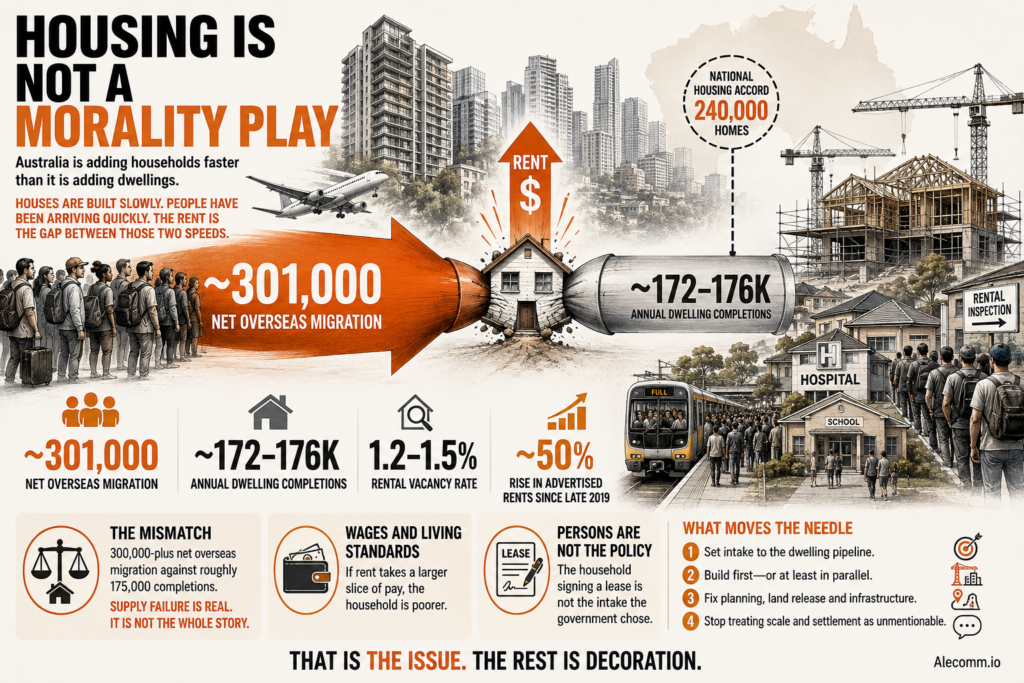
Australia has a housing problem. Rents are up about fifty percent since the end of 2019. Vacancies are scraping one percent. Completions are stuck near mid-1990s volumes. First-home buyers are competing for a shrinking pool of stock while the cost of a roof eats the wage.
That is the problem. A country of 27.8 million is adding households faster than it is adding dwellings. The shortage shows up where shortages always show up: in the rent, the auction, the share-house, the commute, and the decision to delay children.
Housing is a stock of roofs and a flow of extra people who need one. When the flow of people outruns the flow of completions, vacancies shrink and prices rise. That mechanism does not care whether the extra household was formed by a birth, a breakup, or a visa. The dwelling is just scarce.
Governments sit on both sides of the ledger. They control planning, zoning, infrastructure, tax settings and how long a building site takes to become a key. They also set the size and composition of net overseas migration. For several years those two instruments have been pointing in opposite directions.
Population has been run hot. Building has not kept up. That is the issue.
Houses are built slowly. People have been arriving quickly. The rent is the gap between those two speeds.
Prices Are Not A Vibe
Rents and dwelling prices are set by supply and demand. That is not a right-wing talking point. It is how markets work when the thing being traded is scarce.
Australia’s population is about 27.8 million. Natural increase — births minus deaths — is running around 110,000 to 115,000 a year. Net overseas migration has been the rest of the growth:
- A peak of 538,000 in 2022–23
- 429,000 in 2023–24
- Still about 300,000 to 306,000 in 2024–25
In recent years that has been roughly three-quarters of total population growth. Most of it lands in the capital cities.
Dwelling completions have been stuck near 170,000 to 176,000 a year. That is close to a 12-year low, and not far off volumes last seen in the mid-1990s, when the country had about 18 million people.
The National Housing Accord target is 240,000 homes a year.
We are not hitting it.
The Mismatch
| Measure | What It Shows |
|---|---|
| ~301,000 | Net overseas migration, year to December 2025 — about 73% of population growth |
| ~172–176k | Annual dwelling completions, far below the 240,000 Housing Accord target |
| 1.2–1.5% | National rental vacancy rate. A balanced market is closer to 2.5–3% |
| ~50% | Rise in advertised rents since the end of 2019 |
Use a household size of about 2.5 people. A 300,000 net-migration year is demand for something like 120,000 extra dwellings from migration alone — before births, household formation, or the shortfall already in the system.
Official housing-system forecasts have still been showing new demand running ahead of net new supply.
That is why vacancy rates collapsed to around 1.2 to 1.5 percent. A functioning rental market usually needs something closer to 2.5 to 3 percent vacant. Advertised rents are up on the order of 50 percent since late 2019.
The market is doing what a tight market does.
| Period | Net Overseas Migration | What It Collided With |
|---|---|---|
| 2018–19, pre-COVID | ~248,000 | Completions around 213,000 — tight, but not a rupture |
| 2022–23 peak | 538,000 | Completions around 175,000 |
| 2023–24 | ~429,000–446,000 | Completions still ~172,000–176,000 |
| 2024–25 / year to Dec 2025 | ~301,000–306,000 | Still well above pre-COVID NOM; building still missing the Accord target |
Measure the right series. Border crossings and “permanent and long-term arrivals” are not the same thing as ABS net overseas migration. NOM is the population figure that feeds dwelling demand.
It is already large enough without inflating it.
Supply Failure Is Real. It Is Not The Whole Story.
None of this acquits the supply side.
- Planning is slow.
- Density is treated as contamination in the suburbs that already have jobs and trains.
- Infrastructure lags the people.
- Building costs and build times blew out after COVID.
- Tax settings reward existing owners.
- State governments announce housing “accords” and then choke the pipeline.
- Construction labour, materials and finance are not infinite.
All of that belongs in the indictment.
None of it makes hundreds of thousands of extra residents a rounding error.
The Commonwealth sets the visa intake. The states run planning and most of the infrastructure. Running a population surge through a system that cannot complete 180,000 dwellings a year is a policy choice, not a weather event.
You cannot fix a quantity problem by talking only about zoning, or only about visas. The shortage is the two numbers together.
Wages, Labour Supply And The Rent
The same arithmetic shows up in living standards. A larger labour supply, especially in particular skill bands and cities, changes bargaining power. Housing costs then take a slice of whatever wage is left.
The headline rate can look stable while the real position of a renter gets worse.
Australian studies often find small or null average effects of immigration on native wages. Some find complementary effects from skilled inflows, and employment gains in the regions that receive them. That is useful evidence.
It is not a warrant to treat labour supply as irrelevant.
Workers who are close substitutes put more pressure on comparable incumbents. Workers who are complements can raise productivity and pay. Australia’s program is more skilled than many, but it is not only surgeons. Temporary students and other streams work in hospitality, retail, care and parts of construction.
Sectoral crowding, hours and occupational sorting do not disappear because a national average coefficient is close to zero.
And the wage is not the living standard. If rent takes a larger slice of pay, the household is poorer. Congestion, GP waits, classroom places and infrastructure per person work the same way.
People consume houses, trains and hospital beds. Adding people without adding that capacity is a cut in living standards, whether or not the award rate moved that quarter.
Jobs are not a fixed lump to be “stolen.” Relative prices still move. Individual effort still matters.
Neither fact repeals supply and demand.
Persons Are Not The Policy
The household that signs a lease is not the same thing as the intake the government chose.
One is a person making a legal move. The other is a setting that can be 250,000 one year and 500,000 the next.
Policy is the second number, and the second number is what hits the vacancy rate.
The operational question is simple:
What Intake Can This Planning System Actually House, And Who Pays When It Cannot?
That question does not require a party banner. More than one side of politics has used migration as a demand stimulus and a labour tap while under-delivering roofs.
The result is the same in either case:
300,000-plus net overseas migration against roughly 175,000 completions is a quantity mismatch.
The cost lands on renters first, then on anyone trying to buy into the same tight stock.
Other debates — welfare design, remote service delivery, tax, school outcomes — are real. They are also separate. Mixing them into the housing numbers does not change how many dwellings were finished last year.
What Would Actually Move The Needle
The fix is not a vibe. It is sequencing.
- Set the permanent and temporary intake to a number the dwelling pipeline can absorb.
- Build first, or at least in parallel — not years behind the arrivals.
- Fix planning, land release and infrastructure so supply can actually rise.
- Stop treating scale and settlement as unmentionable.
- Stop asking personal grit to conjure a vacant rental in Melbourne.
The people who hold power set the visas and the zoning.
Demand better of both.
Until the speed of building matches the speed of population growth, rents will do what rents do.
That Is The Issue. The Rest Is Decoration.
Figures from ABS overseas migration and population releases, National Housing Supply and Affordability Council housing-system reports, and contemporaneous reporting on dwelling completions and rental vacancies. Net overseas migration, not raw border crossings, is the correct population measure.
Leave a Reply