
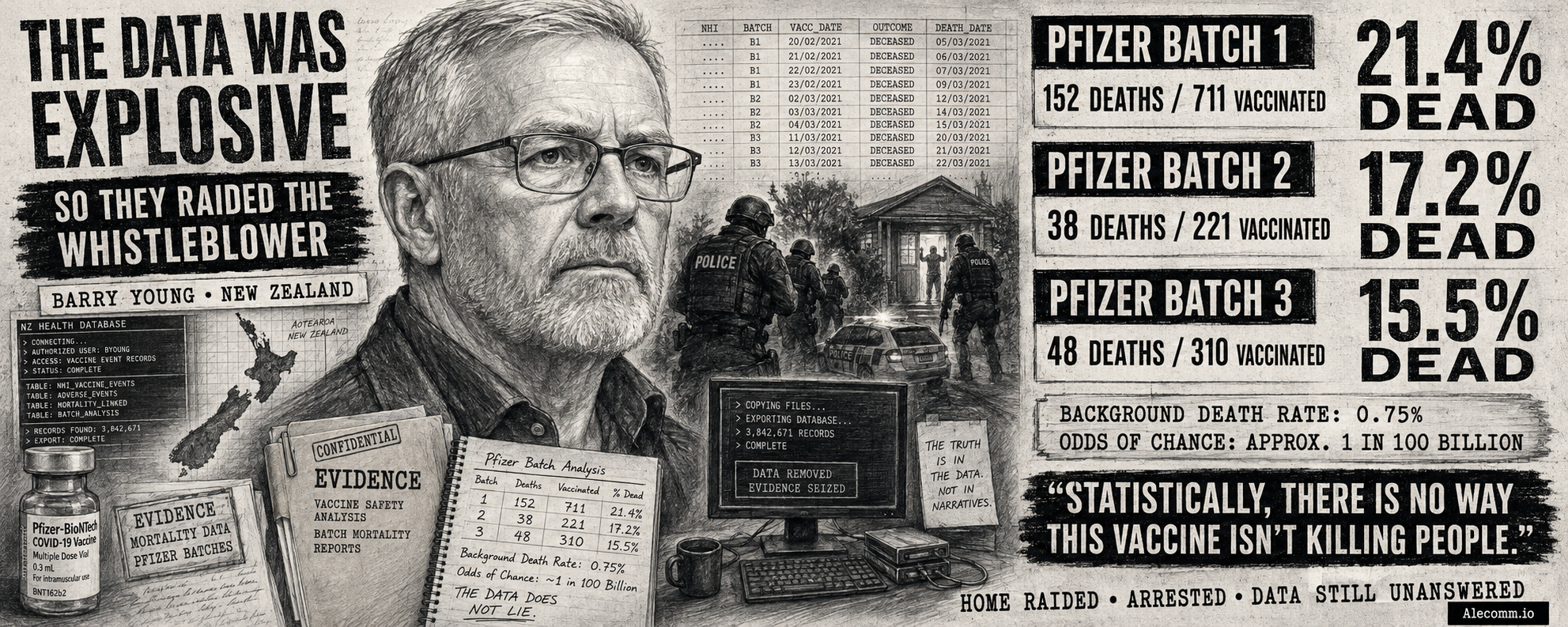
When New Zealand whistleblower Barry Young examined the country’s COVID-19 vaccination records, he says he discovered mortality figures so extreme that they could not reasonably be dismissed as coincidence.
Certain Pfizer vaccine batches appeared to be associated with catastrophic death rates—far beyond New Zealand’s normal background mortality rate.
Young brought the figures into the open.
The authorities responded by raiding his home and arresting him.
The Pfizer Batch Figures
Young identified three Pfizer vaccine batches with extraordinarily high proportions of recorded deaths:
- Batch 1: 152 deaths among 711 vaccinated people—21.4 per cent
- Batch 2: 38 deaths among 221 vaccinated people—17.2 per cent
- Batch 3: 48 deaths among 310 vaccinated people—15.5 per cent
Across these three batches, 238 of the 1,242 vaccinated people were recorded as having died.
That represents an overall death rate of approximately 19.2 per cent.
Young contrasted those results with a background death rate of approximately 0.75 per cent over the relevant period.
The difference was not marginal. It was enormous.
One Chance In 100 Billion
According to Young’s statistical analysis, the probability of such extreme death clusters occurring purely by chance was approximately:
One in 100 billion.
That calculation led him to an uncompromising conclusion:
“Statistically, there is no way this vaccine isn’t killing people.”
These were not a handful of isolated reports submitted by members of the public. Young was examining records from inside New Zealand’s vaccination data system—the type of information governments and health regulators repeatedly told the public they were monitoring.
The figures showed the number vaccinated, the number subsequently recorded as dead and the batches connected to those recipients.
Young says the pattern was unmistakable.
An Alarm That Should Have Triggered An Investigation
Mortality rates of 21.4, 17.2 and 15.5 per cent should have triggered the highest level of independent investigation available.
Health authorities could have immediately:
- Secured and preserved the complete database
- Identified every batch displaying an abnormal death cluster
- Compared mortality across batches
- Examined the timing of deaths following vaccination
- Reviewed the recipients’ clinical and hospital records
- Investigated whether particular manufacturing lots, clinics or vaccination periods were repeatedly associated with deaths
- Released anonymised data for independent statistical examination
- Ordered an external inquiry free from institutional and pharmaceutical conflicts of interest
Instead, the machinery of government moved against the person who exposed the figures.
Young later described what happened:
“They raided my home and arrested me.”
The Whistleblower Became The Target
In December 2023, Health New Zealand made a police complaint concerning the disclosure of vaccination records.
Police raided Young’s home. He was arrested and charged with accessing a computer system for a dishonest purpose, an offence carrying a potential maximum sentence of seven years.
The speed of the response was revealing.
Authorities acted decisively when confidential information escaped their control. Yet the public saw no equally forceful, transparent response to the extreme mortality clusters contained within that information.
The alleged data breach became the headline.
The deaths became secondary.
Arresting Young Did Not Answer The Data
A police raid cannot disprove a statistical finding.
A criminal charge cannot explain why some Pfizer batches were reportedly followed by death rates of more than 15, 17 and 21 per cent.
Seizing computers cannot reduce 152 deaths to zero.
Calling Young’s conclusions “misinformation” cannot substitute for releasing the calculations, batch comparisons and anonymised records needed to settle the matter publicly.
If authorities believed Young had misinterpreted the information, they possessed the complete dataset and the institutional resources necessary to demonstrate it.
- They could have published a comprehensive batch-by-batch analysis.
- They could have appointed independent statisticians.
- They could have shown the public exactly why the identified clusters appeared and provided reproducible calculations supporting their explanation.
Instead, their most visible response was directed at Young.
Privacy Was Used To Shift Attention
Health authorities emphasised the confidentiality of the records and the seriousness of unauthorised access to medical information.
Patient privacy matters. But privacy does not prevent authorities from publishing anonymised statistical results.
No names are required to answer the central questions:
- How many people associated with each Pfizer batch subsequently died?
- Which batches recorded the highest mortality?
- How soon after vaccination did those deaths occur?
- Were unusual clusters reported to New Zealand’s medicines regulator?
- Were the relevant batches independently tested?
- Were coronial, hospital and post-mortem records reviewed?
- Were the results supplied to Pfizer?
- Were other countries warned about the batches?
- Did authorities investigate before publicly dismissing Young?
A government can protect individual identities while still releasing aggregate figures.
Privacy should protect patients. It should not protect institutions from scrutiny.
The Public Was Told The System Was Closely Monitored
Throughout the vaccination campaign, New Zealanders were assured that vaccine safety was being continuously monitored.
That assurance created an obligation.
If internal data revealed extraordinary death clusters, officials had a duty to investigate them openly and rigorously. They could not reasonably demand public trust while keeping the underlying batch information beyond independent examination.
“Trust the science” cannot mean trusting only the conclusions selected by government agencies.
Science requires evidence that can be examined, tested and reproduced.
Young says he followed the evidence available to him—and the evidence led to the batches.
Why Batch-Level Analysis Matters
Overall national statistics can conceal extreme variations within smaller groups.
If most batches display comparatively ordinary results while several show severe death clusters, combining them into one national average can bury the signal. The safer batches dilute the apparent effect of the dangerous ones.
That is why batch-level analysis is so important.
It can identify:
- Manufacturing inconsistencies
- Contamination or degradation
- Storage and transportation failures
- Incorrect concentration or formulation
- Administration problems
- Geographical clustering
- Differences between production runs
- Concentrated adverse outcomes hidden within national averages
Young’s findings centred precisely on that problem: certain batches appeared to show radically worse outcomes than others.
A general statement about the vaccination programme could not answer that specific concern.
Only a transparent batch-by-batch investigation could.
The Statistical Disparity Was Enormous
Young’s reported background mortality rate was approximately 0.75 per cent.
Against that benchmark:
- Batch 1’s recorded rate of 21.4 per cent was approximately 28.5 times higher
- Batch 2’s rate of 17.2 per cent was approximately 22.9 times higher
- Batch 3’s rate of 15.5 per cent was approximately 20.7 times higher
Those are not minor statistical fluctuations.
They are massive disparities.
Young’s estimated probability—approximately one chance in 100 billion—expressed just how improbable he considered the clusters to be under normal conditions.
His conclusion was therefore not that the data presented a faint or ambiguous signal.
His conclusion was that the signal was overwhelming.
The Institutional Response Created A Larger Scandal
Authorities may argue that Young broke rules governing access to confidential data.
But that does not erase what the records reportedly showed.
It creates two separate questions:
- Was the information accessed and disclosed lawfully?
- Why did the data show catastrophic death clusters associated with particular Pfizer batches?
The authorities concentrated on the first.
The public is still entitled to an answer to the second.
By moving aggressively against the whistleblower without placing the complete statistical evidence before independent scrutiny, the government ensured that suspicions would deepen.
That outcome was entirely predictable.
Whistleblowers Are Rarely Convenient
Whistleblowers do not usually arrive through approved communications departments carrying carefully sanitised information.
They emerge when someone inside a system concludes that official channels have failed, that uncomfortable evidence is being ignored or that the public interest outweighs personal security.
Their disclosures are often disruptive because the information itself is disruptive.
Young risked his employment, reputation, liberty and future because he believed the records revealed an unacceptable danger.
The appropriate response was not to make the data disappear behind legal proceedings.
It was to investigate the deaths.
New Zealanders Deserve The Complete Truth
The people represented inside Young’s tables were not abstract numbers.
They were parents, partners, grandparents, children, friends and members of communities.
Their families deserve to know whether the batches they received were properly investigated.
The broader public deserves to know whether authorities detected these clusters, when they detected them and what action followed.
Young’s findings require the release of:
- Complete anonymised batch-level mortality data
- Precise vaccination and death intervals
- Batch manufacturing and distribution records
- Adverse-event reports linked to each batch
- Relevant safety communications between New Zealand authorities and Pfizer
- The statistical methods used by officials to dismiss Young’s conclusions
- Records showing whether an investigation into the identified batches occurred
Anything less leaves the central issue unresolved.
The Question That Will Not Disappear
Barry Young says Pfizer batches were associated with recorded death rates as high as 21.4 per cent, compared with a background rate of approximately 0.75 per cent.
He calculated the probability of the clusters occurring by chance at roughly one in 100 billion.
His conclusion was devastating:
“Statistically, there is no way this vaccine isn’t killing people.”
The government’s response was to raid his home and arrest him.
But arresting the man did not erase the numbers.
- It did not explain the batches.
- It did not investigate the deaths.
And it did not answer the question that remains at the centre of the entire affair:
If Barry Young’s statistics were wrong, why have the complete anonymised batch records and a transparent, reproducible rebuttal not been placed before the public?
Sources And References
- Barry Young’s Recent Interview And Batch Claims
- 1News: Barry Young Charged With Accessing A Computer System For A Dishonest Purpose
- Australian Parliament: Submission Referring To Barry Young’s Data Analysis
- New Zealand Office Of The Privacy Commissioner: Health Information Privacy Code 2020
- Protecting Public-Sector Whistleblowers Against Criminal Prosecution
Leave a Reply