
A Practical Plan To Restore Processing, Access, Competition And Farmer Control
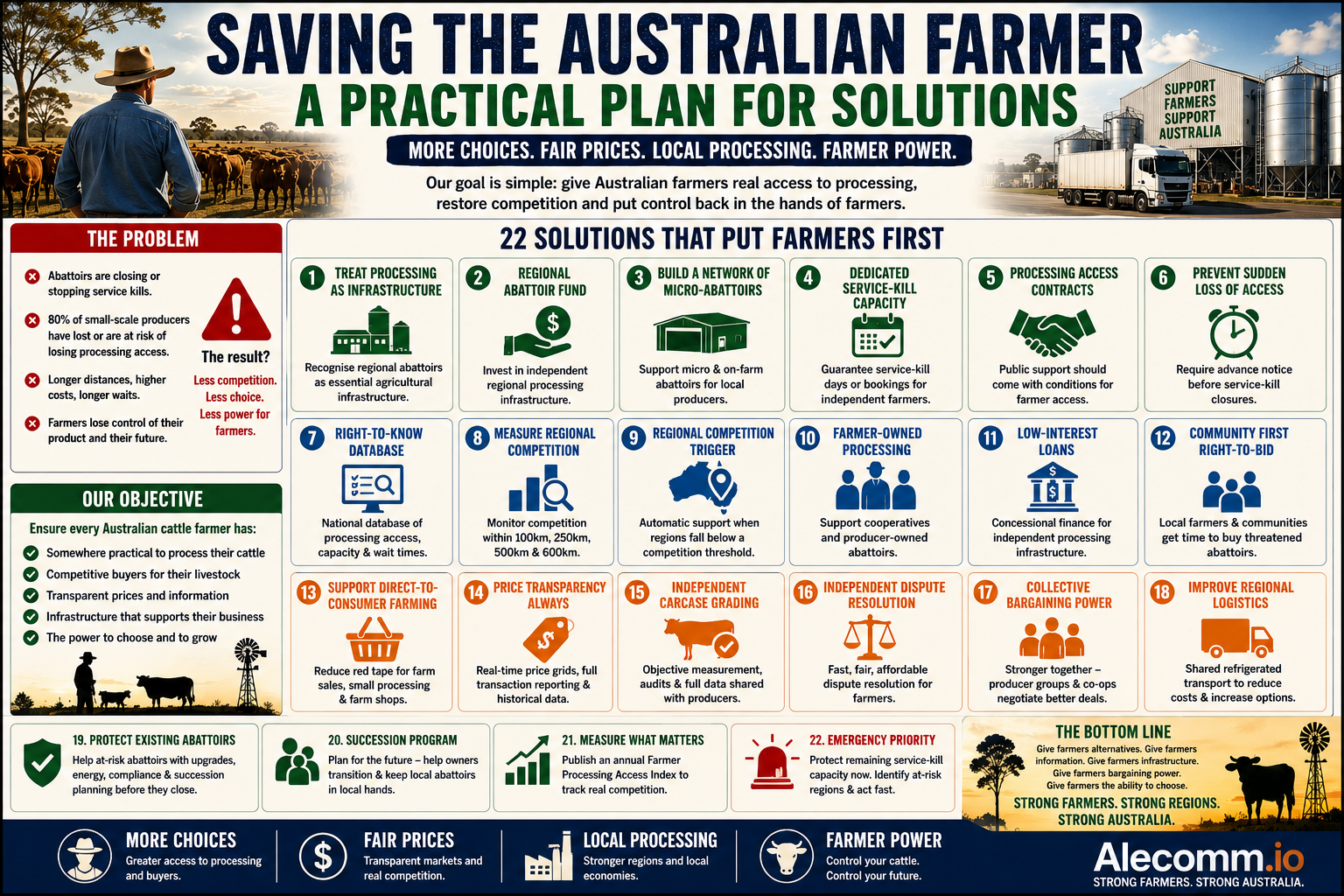
Australia does not have to choose between a productive beef industry and viable independent cattle farmers.
The immediate objective should be much simpler:
Make sure Australian farmers always have somewhere practical to process their cattle, somewhere competitive to sell them, transparent information about what their cattle are worth, and enough alternative buyers that they cannot be trapped by geography or market concentration.
This report is deliberately focused on farmers rather than the commercial interests of major processors.
The policy test should be straightforward:
Does this increase the number of realistic choices available to Australian cattle farmers?
If the answer is yes, pursue it.
If the answer is no, it is not solving the underlying problem.
1. Treat Regional Abattoirs As Essential Agricultural Infrastructure
The first change is conceptual.
Australia routinely treats roads, saleyards, telecommunications, water infrastructure and freight networks as essential to regional economic activity.
Processing infrastructure should be treated the same way.
A cattle farmer cannot sell packaged beef directly to a consumer without legal slaughter and processing.
When the only accessible service-kill abattoir disappears, the farmer can lose an entire business model overnight.
The 2026 Fragility to Resilience research estimated that processing-access problems could put hundreds of millions of dollars of small and medium livestock-producer revenue at risk.
This makes regional processing capacity an agricultural infrastructure issue, not merely a question of whether an individual abattoir happens to be commercially profitable.
Government policy should therefore assess processing access geographically.
Every significant cattle-producing region should have mapped:
- Existing cattle abattoirs
- Service-kill availability
- Maximum and minimum bookings
- Processing capacity
- Waiting periods
- Distance from major cattle-producing districts
- Alternative processors
- Cold-chain infrastructure
- Regional cattle numbers
This would immediately expose Australia’s processing deserts.
2. Establish A National Regional Abattoir Infrastructure Fund
Australia should establish a dedicated capital program for independent regional slaughter and processing infrastructure.
Funding should prioritise locations where farmers have lost processing access or where only one practical processor remains.
Eligible infrastructure should include:
- Regional cattle abattoirs
- Micro-abattoirs
- On-farm micro-abattoirs
- Mobile slaughter infrastructure where legally and operationally appropriate
- Boning rooms
- Cold rooms
- Wastewater treatment
- Refrigeration
- Rendering and waste systems
- Livestock handling infrastructure
- Refrigerated transport
The objective should not be to subsidise inefficient businesses forever.
The objective should be to overcome the enormous capital barrier preventing new competitors from entering processing markets.
Once an abattoir disappears, replacing it can require millions of dollars before the first animal is processed.
That barrier protects existing processing concentration.
Government infrastructure assistance can break it.
3. Create A National Network Of Micro-Abattoirs
Not every region needs another enormous export works.
That would be unnecessary and financially unrealistic.
What many regions need is a facility capable of efficiently processing relatively small numbers of cattle for local producers.
Victoria has already moved in this direction.
Planning reforms announced in 2025 were designed to make small on-farm abattoirs easier to establish.
That principle should be expanded nationally.
A network of strategically positioned micro-abattoirs could give farmers access to processing without requiring a conventional multimillion-dollar industrial facility in every district.
Micro-abattoirs could service:
- Direct-to-consumer cattle farmers
- Regenerative farms
- Organic producers
- Small beef brands
- Farm shops
- Independent butchers
- Restaurants buying directly from farms
- Farmers’ markets
The critical objective is maintaining ownership of the animal through processing.
That allows the farmer to sell their beef, rather than being forced to sell their cattle into somebody else’s supply chain.
4. Establish Dedicated Service-Kill Capacity
The service-kill problem requires a direct solution.
Australia should establish a mechanism ensuring that strategically important regional processing facilities provide predictable service-kill capacity.
This could involve voluntary contracts supported by government incentives rather than attempting to dictate the entire commercial operation of an abattoir.
For example, government could fund or co-fund:
One guaranteed service-kill day each week
or
A specified number of cattle-processing positions each month reserved for independent farmers.
The processor receives predictable throughput and compensation.
The farmer receives guaranteed access.
Most importantly, the farmer can plan.
Farmers cannot run direct beef businesses if processing availability changes without warning.
Breeding, finishing, customer orders and livestock management operate months or years ahead.
Processing access must therefore be predictable, not merely theoretically available.
5. Introduce Processing Access Contracts
Where taxpayers provide substantial assistance to an abattoir, access conditions should follow.
If public money pays for:
- Plant upgrades
- Road infrastructure
- Wastewater facilities
- Energy infrastructure
- Regional-development grants
- Expansion
or other substantial assistance, the public should receive something measurable in return.
One condition could be maintaining agreed service-kill capacity for local farmers.
That would turn public subsidies into tangible regional agricultural infrastructure.
6. Prevent Sudden Loss Of Service-Kill Access
A farmer who has built a direct-to-consumer business around a particular abattoir should not discover with a few weeks’ notice that the service is disappearing.
For strategically important regional facilities, Australia should consider requiring meaningful advance notification before service-kill operations are discontinued.
That notification period could trigger:
- Government assessment
- Farmer consultation
- Alternative capacity arrangements
- Temporary processing contracts
- Expressions of interest from replacement operators
- Community purchase options
The objective isn’t to force an operator to provide an uneconomic service indefinitely.
It is to stop entire regional farming networks being stranded overnight.
7. Create A Farmer Right-To-Know Processing Database
Finding processing capacity should not require farmers to telephone abattoirs across several states.
Australia should establish a national searchable processing-access database.
For every cattle-processing facility it should show:
- Location
- Species processed
- Service kills available — yes or no
- Minimum cattle numbers
- Maximum booking size
- Indicative waiting time
- Organic certification where applicable
- Processing and boning services
- Whether carcasses are returned
- Cold-storage availability
- Geographical service area
- Contact details
Farmers could immediately identify alternatives.
Government could simultaneously identify areas where alternatives do not exist.
8. Measure Competition Regionally
National market concentration can hide local monopolistic conditions.
A farmer in northern Victoria doesn’t benefit because another processor exists 1,500 kilometres away.
Competition monitoring therefore needs to measure regional cattle-buying concentration.
For every cattle-producing region, regulators should know how many economically practical buyers exist within approximately:
- 100 kilometres
- 250 kilometres
- 500 kilometres and, where relevant,
- 600 kilometres
The ACCC has previously recognised the importance of geography when examining cattle-processing competition and has warned that further processor consolidation can substantially reduce competition in regional markets.
If a transaction would reduce a region from three realistic cattle buyers to two — or two to one — that should receive far greater scrutiny than national market-share figures alone suggest.
9. Establish A Regional Competition Trigger
Australia could go further.
If a cattle-producing region falls below a predetermined number of genuinely independent processing or purchasing alternatives, an automatic competition assessment should occur.
For example:
Three or more practical alternatives — normal monitoring
Two alternatives — competition warning
One alternative — critical processing-access region
A critical designation could unlock:
- Infrastructure grants
- Concessional finance
- Micro-abattoir development
- Mobile processing feasibility studies
- Co-operative development assistance
- Transport assistance while replacement capacity is established
Instead of waiting until farmers disappear, intervention occurs when competition disappears.
10. Make It Easier For Farmers To Own Processing Infrastructure
One of the strongest long-term solutions is farmer ownership.
Australia has a long history of agricultural co-operatives.
There is no reason that model cannot be strengthened for meat processing.
Twenty, fifty or one hundred cattle producers collectively have vastly greater throughput and borrowing capacity than an individual farmer.
A producer-owned processing cooperative could give members:
- Guaranteed slaughter access
- Shared processing costs
- Control over scheduling
- Greater bargaining power
- Ownership of downstream infrastructure
- Ability to develop regional beef brands
- Greater retention of value within farming communities
Government could assist with establishment grants, concessional finance, governance expertise and feasibility studies.
Instead of merely protecting farmers from concentration, this gives farmers ownership of the bottleneck itself.
11. Create Low-Interest Agricultural Infrastructure Loans
Capital is one of the largest barriers to processing competition.
Australia should establish long-duration concessional finance specifically for independent meat-processing infrastructure.
Loans could support:
- New regional abattoirs
- Purchase of threatened facilities
- Expansion of existing independent processors
- Micro-abattoirs
- Cold storage
- Boning rooms
- Wastewater upgrades
- Automation
- Energy-efficiency improvements
The important condition should be continuing farmer access.
This converts processing from an impossible capital hurdle into investable regional infrastructure.
12. Give Communities First Opportunity When Regional Abattoirs Are Sold
When strategically important regional abattoirs come onto the market, local farmers and communities should have enough time to investigate purchasing them.
A formal community right-to-bid period could allow:
Producer cooperatives
Local investors
Regional development organisations
Councils
and
Community-owned enterprises
to assemble financing.
It doesn’t require forcing the owner to accept an inferior offer.
It simply prevents critical agricultural infrastructure being transferred before the community has even had the opportunity to organise.
13. Protect Direct-To-Consumer Farming
Direct farm sales are one of the strongest competitive forces available to farmers.
Instead of accepting only the farm-gate value of an animal, farmers can participate in downstream value creation.
Australia should make this model easier.
That means removing unnecessary regulatory barriers around:
- Farm-gate meat sales
- Small boning facilities
- Farm shops
- Refrigerated distribution
- Farmers’ markets
- Small-scale processing
- Direct restaurant supply
Food-safety standards should remain rigorous.
But regulation should be proportionate to scale and risk, rather than forcing a 20-head operation to carry compliance structures designed for industrial plants processing thousands of animals.
14. Make Cattle Prices Completely Transparent
Processing access is only half of farmer bargaining power.
The other half is information.
The ACCC found significant deficiencies in cattle-price transparency and recommended processors publish price grids, improve reporting of actual transactions, strengthen carcase grading integrity and improve access to historical price information.
Progress was initially poor. In 2018, the ACCC reported that little progress had been made on most of its recommendations.
Some improvement followed, including processors publishing price grids online, but the underlying principle remains important.
A farmer preparing 80 cattle for slaughter should be able to open one independent platform and compare:
- Processor A — price
- Processor B — price
- Processor C — price
- Freight
- Weight specifications
- Discounts
- Bonuses
- Grading requirements
- Historical prices
Then the farmer can calculate the genuine net return.
Information creates negotiating power.
15. Independent Carcase Grading
A particularly important ACCC recommendation was greater objectivity and transparency in carcase measurement.
The processor buying the cattle should not possess an unnecessary informational advantage over the farmer selling them.
The ACCC recommended increased unannounced auditing, objective carcase measurement and sharing resulting data with producers.
Technology now makes this increasingly practical.
Farmers should receive complete digital carcase information covering the measurements determining their payment.
That information should be downloadable and comparable across processors.
If cattle are discounted, the farmer should be able to see precisely why.
16. Establish Independent Dispute Resolution
A farmer challenging a processor can face an obvious commercial problem:
They may need that same processor next month.
That makes ordinary disputes inherently unequal.
Australia therefore needs an inexpensive, independent cattle-market dispute mechanism.
The ACCC previously recommended independent dispute resolution across the industry.
It should be capable of dealing rapidly with disputes involving:
- Grading
- Payment
- Contract interpretation
- Unexpected discounts
- Access arrangements
- Service-kill agreements
- Quality assessments
A farmer should not need a six-figure legal budget to challenge a five-figure commercial dispute.
17. Give Farmers Collective Bargaining Power
Small farmers negotiating individually against very large purchasers inevitably face an imbalance of scale.
Producer groups and cooperatives can change that equation.
Groups of farmers should be encouraged to negotiate collectively over:
- Processing prices
- Freight
- Service-kill schedules
- Minimum consignments
- Boning
- Packaging
- Cold storage
- Cattle purchase agreements
A hundred small farmers negotiating together begin to look commercially like a substantial supplier.
That changes bargaining dynamics without requiring those farmers to surrender ownership of their individual businesses.
18. Build Regional Refrigerated Logistics Networks
Distance cannot be eliminated.
Its economic impact can be reduced.
Regional refrigerated transport cooperatives could consolidate meat movements from processing facilities back to farms, butchers and distribution hubs.
Likewise, coordinated livestock transport could reduce the cost of moving smaller cattle consignments.
Shared logistics converts:
Ten farmers each paying for separate transport
into
Ten farmers sharing scheduled transport infrastructure.
That makes geographically distant processing alternatives more competitive and expands the farmer’s practical market.
19. Protect Existing Independent Abattoirs Before Building New Ones
The cheapest abattoir to establish is often the one that already exists.
Before spending millions replacing lost infrastructure, governments should identify independent regional processors at risk of closure.
Problems might involve:
- Wastewater upgrades
- Energy costs
- Old refrigeration
- Labour shortages
- Compliance expenditure
- Equipment replacement
- Veterinary availability
- Succession planning
A $500,000 infrastructure intervention that keeps an existing regional facility operating can be far more sensible than allowing it to disappear and later spending $10 million trying to recreate equivalent capacity.
20. Create A National Abattoir Succession Program
Many small regional processing businesses face another problem:
Their owners are getting older.
A perfectly viable facility can disappear simply because nobody takes over the business.
Government and agricultural organisations should identify strategically important processors whose owners intend to retire within five to ten years.
Potential successors could include:
- Employees
- Local farmers
- Producer cooperatives
- Butchers
- Regional investors
The program could provide business valuation, financing, technical assistance and transition planning.
Australia should not lose irreplaceable infrastructure simply because succession was never organised.
21. Stop Measuring Success By Total Cattle Slaughter Alone
This might be the most important reform.
Australia processing 9 million or 10 million cattle tells policymakers almost nothing about farmer resilience.
Instead, governments should publish an annual Farmer Processing Access Index measuring:
- Number of operating cattle abattoirs
- Number offering service kills
- Average distance farmers travel
- Median waiting period
- Average minimum booking
- Regional buyer concentration
- Number of independent processors
- Number of producer-owned processors
- Number of farmers losing processing access
- Percentage of cattle-producing regions with three or more realistic buyers
That would reveal whether Australia’s processing system is actually becoming healthier for farmers.
22. The Emergency Priority: Protect The Remaining Service-Kill Network
Some reforms will take years.
This cannot.
The 2026 research reported a severe access problem among small and medium livestock producers, with substantial producer revenue potentially exposed when service-kill infrastructure disappears.
The immediate national response should therefore be:
- Identify every remaining cattle service-kill facility.
- Determine its available capacity.
- Identify facilities at risk of stopping the service.
- Identify regions with no practical alternative.
- Fund emergency guaranteed service-kill capacity where necessary.
- Fast-track micro-abattoirs in the worst processing deserts.
- Help farmers collectively purchase threatened facilities where viable.
Do that first.
Everything else can follow.
A Better Australian Beef System
The solution isn’t complicated in principle.
- Give farmers alternatives.
- Give farmers information.
- Give farmers infrastructure.
- Give farmers processing access.
- Give farmers bargaining power.
- Give farmers pathways to ownership.
And prevent critical regional processing infrastructure disappearing before anyone notices what has been lost.
A genuinely competitive Australian cattle industry should allow a farmer to say:
“I don’t like that offer. I have somewhere else to go.”
That sentence is the essence of competition.
The farmer who can choose between several buyers has power.
The farmer who can process their own cattle through an independent facility has another option.
The farmer who belongs to a processing cooperative has another.
The farmer who can sell directly to consumers has another.
The farmer who can compare transparent prices has another.
The farmer with five genuine alternatives cannot easily be dictated to.
Australia’s objective should therefore not be to protect any particular corporation or business model.
It should be to create enough competing pathways that no Australian cattle farmer’s livelihood depends upon the decisions of a single processor, buyer or abattoir.
That is how Australia protects farmers.
And that is how Australia builds a cattle industry capable of surviving for generations.
Sources And References
Australian Competition and Consumer Commission, Cattle and Beef Study Reveals Price Transparency Issues, 31 October 2016.
Australian Competition and Consumer Commission, Cattle and Beef Market Study — Final Recommendations, 7 March 2017.
Australian Competition and Consumer Commission, Poor Progress on Cattle and Beef Industry Market Reform, 4 May 2018.
Australian Competition and Consumer Commission, Transparency Improving in Cattle and Beef Industry, 20 August 2019.
Nous Group / Macdoch Foundation, Fragility to Resilience: Local Meat Processing in Australia at a Crossroads, 2026.
Reporting on the Nous Group research, February 2026, documenting threatened producer revenue, processing-access shortages and proposed responses including service-kill capacity and smaller regional processing infrastructure.
Leave a Reply