
Subject: Possible Purpose of Targeted Coercion of U.S. Aerospace, Nuclear-Adjacent, and Defense Research Personnel by CJNG
Classification: Analytical Hypothesis
Date: August 2026
Purpose of the Operation (Under the Hypothesis)
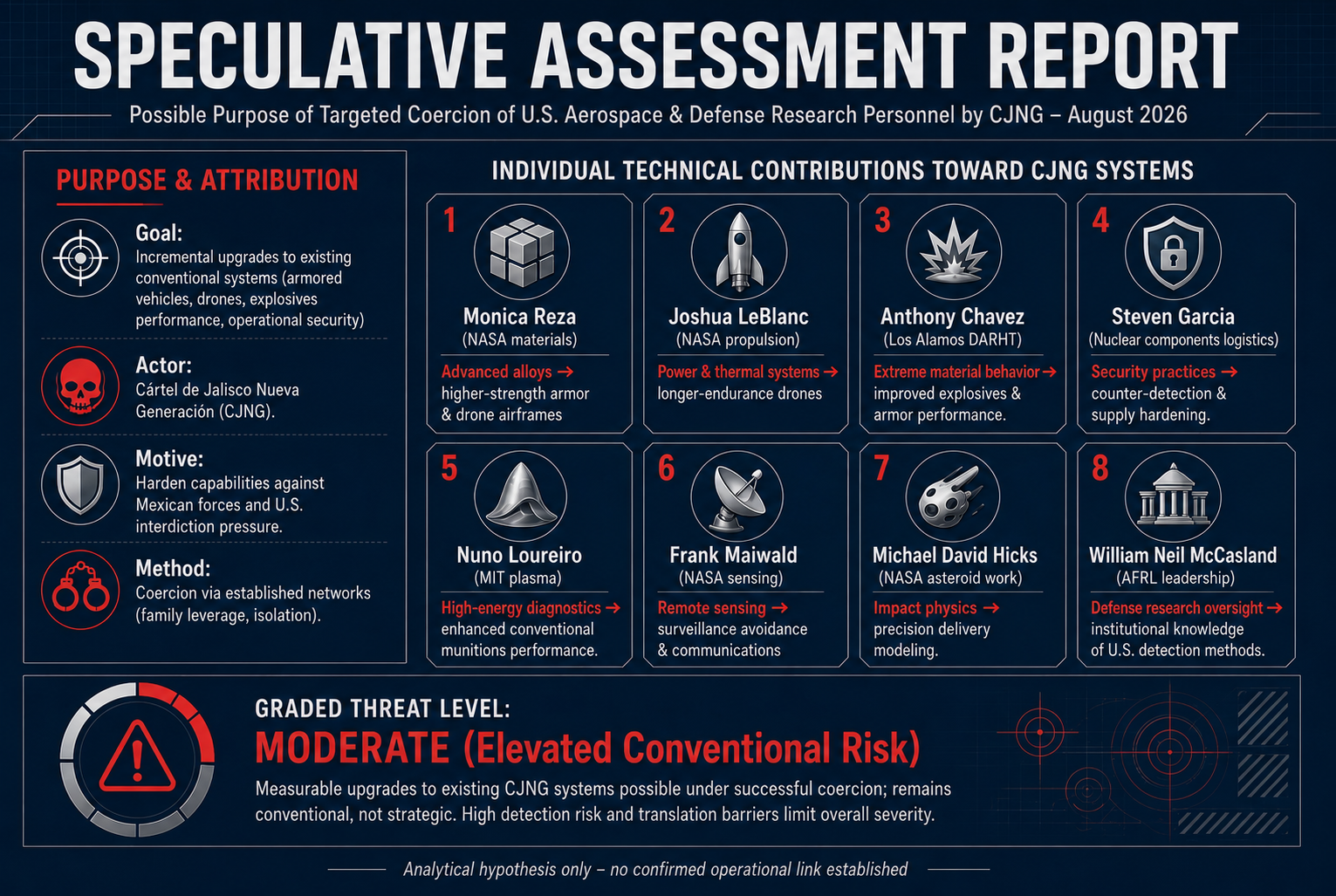
The working hypothesis is that a sustained coercion campaign against a small number of individuals with specialized technical backgrounds was intended to extract incremental improvements to existing CJNG conventional weapons and support systems. The goal is not strategic nuclear capability. It is practical enhancement of the systems the cartel already fields and relies on: improvised armored vehicles, weaponized drones, explosives performance, operational security, and logistics resilience.
Coercion methods already demonstrated by CJNG (family leverage, isolation, controlled environments) would be applied to force technical output rather than voluntary collaboration. The open-border period provided the window for personnel and network establishment that would make long-term holding of high-value individuals more feasible inside or near U.S. territory.
Attribution and Motive
Primary actor: Cártel de Jalisco Nueva Generación (CJNG)
Why CJNG:
- Highest demonstrated willingness among Mexican cartels to field military-grade and improvised heavy systems (RPGs, heavy machine guns, armored “monstruos,” weaponized drones, anti-aircraft attempts).
- Active expansion of technical capacity through forced recruitment and specialized training.
- Direct strategic interest in reducing vulnerability to Mexican security forces and U.S. interdiction.
- Current U.S. prioritization of the organization as a designated threat creates incentive to harden capabilities before pressure intensifies further.
Other cartels lack both the scale of conventional military adaptation and the operational tempo that would justify this level of risk. State actors remain possible alternative explanations under separate hypotheses, but the local-coercion model fits the “no extraterritorial movement required” constraint.
Individual Technical Contributions Toward CJNG Systems
Monica Reza (NASA JPL, materials processing, rocket alloys)
Primary contribution: advanced materials performance. Forced output directed at higher-strength, lighter, or more heat-resistant components for armored vehicle construction, drone airframes, and weapon housings. Directly upgrades survivability and payload of systems CJNG already builds and fields.
Joshua LeBlanc (NASA Marshall, nuclear propulsion / electrical systems)
Primary contribution: compact, high-reliability power and thermal management. Applied to longer-endurance drones, remote sensor platforms, and power systems for dispersed operational nodes. Improves persistence of existing remote-attack and surveillance tools.
Anthony Chavez (Los Alamos, DARHT hydrodynamic testing)
Primary contribution: understanding of material behavior under extreme shock and pressure. Directed at refining conventional explosives performance, armor penetration characteristics, and vehicle protection. Supports incremental gains in the lethality and resilience of IEDs, vehicle-mounted weapons, and armored platforms.
Steven Garcia (Kansas City National Security Campus, high-clearance logistics/property custodianship)
Primary contribution: institutional knowledge of sensitive manufacturing security practices and material/part movement. Applied to counter-detection techniques, supply-chain hardening, and identification of procedural gaps. Improves operational security of any technical workshops or logistics nodes.
Nuno Loureiro (MIT, plasma science and fusion systems)
Primary contribution: high-energy plasma behavior and diagnostic methods. Forced application toward advanced diagnostics for explosives development or high-power electrical systems supporting directed-energy or enhanced conventional munitions concepts. Supports technical edge in existing weapons performance rather than new strategic categories.
Frank Maiwald (NASA JPL, microwave radiometry and space instrumentation)
Primary contribution: remote sensing and signal processing. Directed at improved surveillance avoidance, communications resilience, or ground-based detection systems. Enhances the cartel’s ability to operate under observation and to protect its own networks.
Michael David Hicks (NASA JPL, asteroid characterization and deflection-related work)
Primary contribution: impact physics and trajectory analysis. Applied to precision delivery and terminal-effects modeling for conventional munitions and drone-delivered payloads. Marginal but usable for refining accuracy of existing systems.
William Neil McCasland (Retired USAF Maj Gen, former Air Force Research Laboratory commander)
Primary contribution: senior-level visibility into U.S. defense research priorities, testing protocols, and technology roadmaps. Provides institutional knowledge of detection methods, program vulnerabilities, and development timelines. Supports broader operational security and prioritization of technical efforts.
Carl Grillmair (Caltech / NASA collaborative astronomy)
Lower direct utility. Sensor calibration and large-scale data processing techniques could still feed improved intelligence, surveillance, and reconnaissance support or signal analysis for operational planning.
Lower-technical or administrative roles in the cluster add facilitation value (access, movement, or cover) but limited technical output.
Graded Threat Level
Overall assessed threat level under the hypothesis: Moderate (elevated conventional risk)
Justification:
- Successful extraction and application of the mapped skills would produce measurable upgrades to systems CJNG already uses effectively (armored mobility, remote weapons, explosives, operational security).
- These upgrades would increase lethality and survivability against Mexican forces and complicate U.S. interdiction, particularly in border regions and interior logistics.
- The threat remains conventional rather than strategic. No pathway to nuclear or other WMD capability is required or enabled by the skill set under this model.
- Major limiting factors still apply: sustained coercion of cleared personnel generates intense search pressure; translating knowledge into fielded hardware requires workshops, materials, and testing that create detection opportunities; coerced specialists can withhold critical details or introduce failures.
Threat elevation factors: Prior CJNG investment in military adaptation + current U.S. focus on the organization + any demonstrated ability to hold high-value technical personnel long-term.
Threat reduction factors: Absence of supporting evidence linking the cases to cartel activity, high detection risk of the activity itself, and the incremental (not transformative) nature of the potential gains.
Leave a Reply