
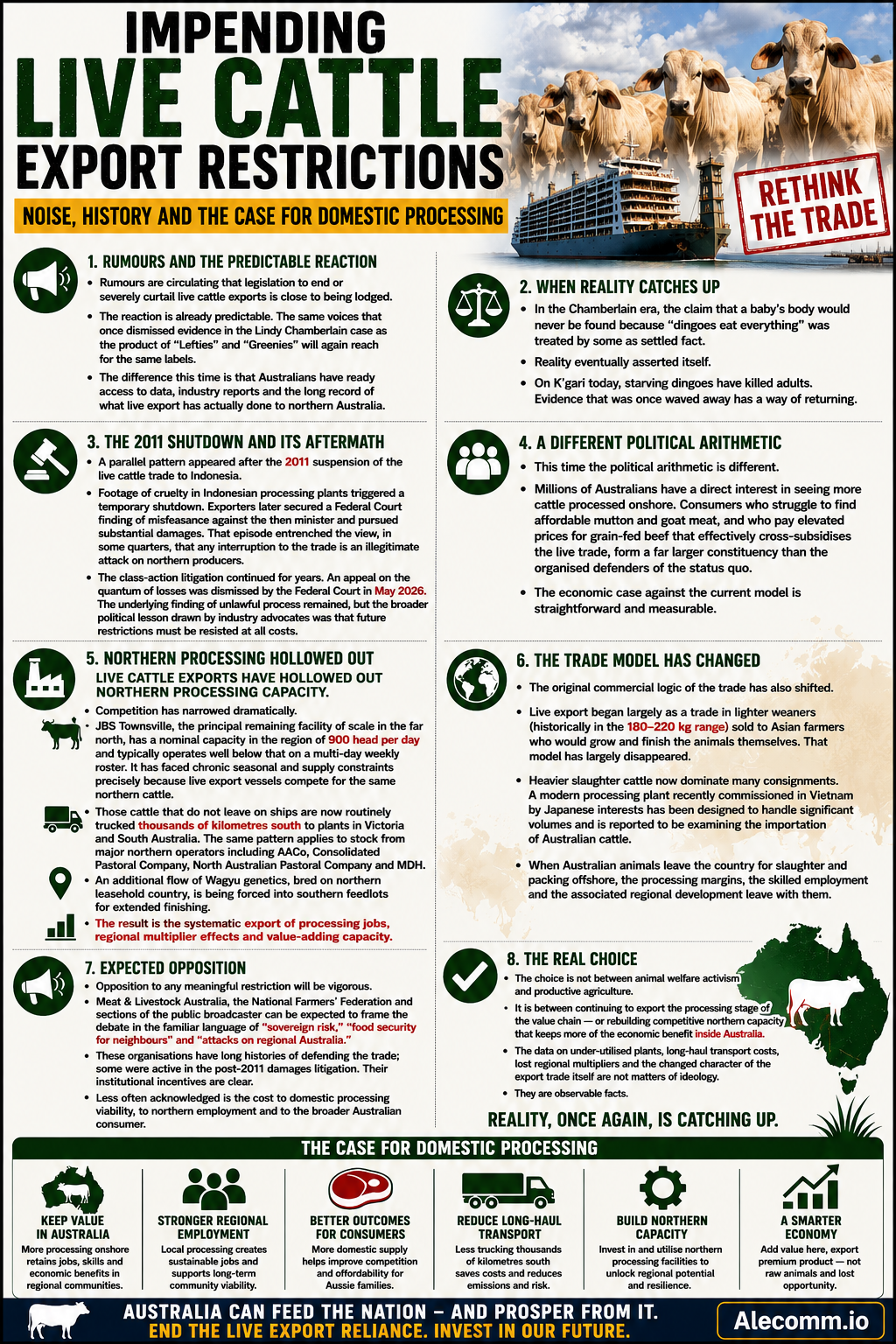
Rumours And The Predictable Reaction
Rumours are circulating that legislation to end or severely curtail live cattle exports is close to being lodged.
The reaction is already predictable. The same voices that once dismissed evidence in the Lindy Chamberlain case as the product of “Lefties” and “Greenies” will again reach for the same labels.
The difference this time is that Australians have ready access to data, industry reports and the long record of what live export has actually done to northern Australia.
When Reality Catches Up
In the Chamberlain era, the claim that a baby’s body would never be found because “dingoes eat everything” was treated by some as settled fact.
Reality eventually asserted itself.
On K’gari today, starving dingoes have killed adults. Evidence that was once waved away has a way of returning.
The 2011 Shutdown And Its Aftermath
A parallel pattern appeared after the 2011 suspension of the live cattle trade to Indonesia.
Footage of cruelty in Indonesian processing plants triggered a temporary shutdown. Exporters later secured a Federal Court finding of misfeasance against the then minister and pursued substantial damages. That episode entrenched the view, in some quarters, that any interruption to the trade is an illegitimate attack on northern producers.
The class-action litigation continued for years. An appeal on the quantum of losses was dismissed by the Federal Court in May 2026. The underlying finding of unlawful process remained, but the broader political lesson drawn by industry advocates was that future restrictions must be resisted at all costs.
A Different Political Arithmetic
This time the political arithmetic is different.
Millions of Australians have a direct interest in seeing more cattle processed onshore. Consumers who struggle to find affordable mutton and goat meat, and who pay elevated prices for grain-fed beef that effectively cross-subsidises the live trade, form a far larger constituency than the organised defenders of the status quo.
The economic case against the current model is straightforward and measurable.
Northern Processing Hollowed Out
Live cattle exports have hollowed out northern processing capacity.
Competition has narrowed dramatically.
JBS Townsville, the principal remaining facility of scale in the far north, has a nominal capacity in the region of 900 head per day and typically operates well below that on a multi-day weekly roster. It has faced chronic seasonal and supply constraints precisely because live export vessels compete for the same northern cattle.
Those cattle that do not leave on ships are now routinely trucked thousands of kilometres south to plants in Victoria and South Australia. The same pattern applies to stock from major northern operators including AACo, Consolidated Pastoral Company, North Australian Pastoral Company and MDH.
An additional flow of Wagyu genetics, bred on northern leasehold country, is being forced into southern feedlots for extended finishing.
The result is the systematic export of processing jobs, regional multiplier effects and value-adding capacity.
The Trade Model Has Changed
The original commercial logic of the trade has also shifted.
Live export began largely as a trade in lighter weaners (historically in the 180–220 kg range) sold to Asian farmers who would grow and finish the animals themselves. That model has largely disappeared.
Heavier slaughter cattle now dominate many consignments. A modern processing plant recently commissioned in Vietnam by Japanese interests has been designed to handle significant volumes and is reported to be examining the importation of Australian cattle.
When Australian animals leave the country for slaughter and packing offshore, the processing margins, the skilled employment and the associated regional development leave with them.
Expected Opposition
Opposition to any meaningful restriction will be vigorous.
Meat & Livestock Australia, the National Farmers’ Federation and sections of the public broadcaster can be expected to frame the debate in the familiar language of “sovereign risk,” “food security for neighbours” and “attacks on regional Australia.”
These organisations have long histories of defending the trade; some were active in the post-2011 damages litigation. Their institutional incentives are clear.
Less often acknowledged is the cost to domestic processing viability, to northern employment and to the broader Australian consumer.
The Real Choice
The choice is not between animal welfare activism and productive agriculture.
It is between continuing to export the processing stage of the value chain — or rebuilding competitive northern capacity that keeps more of the economic benefit inside Australia.
The data on under-utilised plants, long-haul transport costs, lost regional multipliers and the changed character of the export trade itself are not matters of ideology.
They are observable facts.
Reality, once again, is catching up.
References
References
Federal Court of Australia. Brett Cattle Company Pty Ltd v Minister for Agriculture (appeal dismissal). May 2026. Reported in ABC News (“Federal Court rejects northern cattle industry’s appeal over impact of live export ban,” 15 May 2026); Farm Online; and Beef Central.
JBS Australia. Public statements and recruitment materials on the Townsville plant (approximately 900 head per day capacity, typically operating four days per week). 2024–2026.
Sojitz Corporation / Japan Vietnam Livestock Co., Ltd. Official announcements on the Tam Dao (Vinh Phuc Province) beef processing plant. December 2024 onward. Capacity approximately 30,000 head per year; reported interest in Australian cattle supply. Covered in Beef Central (February 2025) and Sojitz corporate releases.
Countryman / The West Australian. “Northern WA cattle industry under threat from petition calling for Australia to end all live exports.” 4 August 2026.
Queensland Country Life / related reporting. Coverage of the re-heated petition against live animal exports scheduled for presentation in Canberra, September 2026 (August 2026).
Parliament of Australia. Export Control Amendment (Ending Live Sheep Exports by Sea) Bill 2024 – Bills Digest and related Hansard. Government statements confirming no planned ban on live cattle exports while noting industry concerns about precedent.
Meat & Livestock Australia and National Farmers’ Federation. Public positions and submissions opposing live sheep phase-out and raising concerns about flow-on effects for the cattle trade (2024–2026).
Leave a Reply