
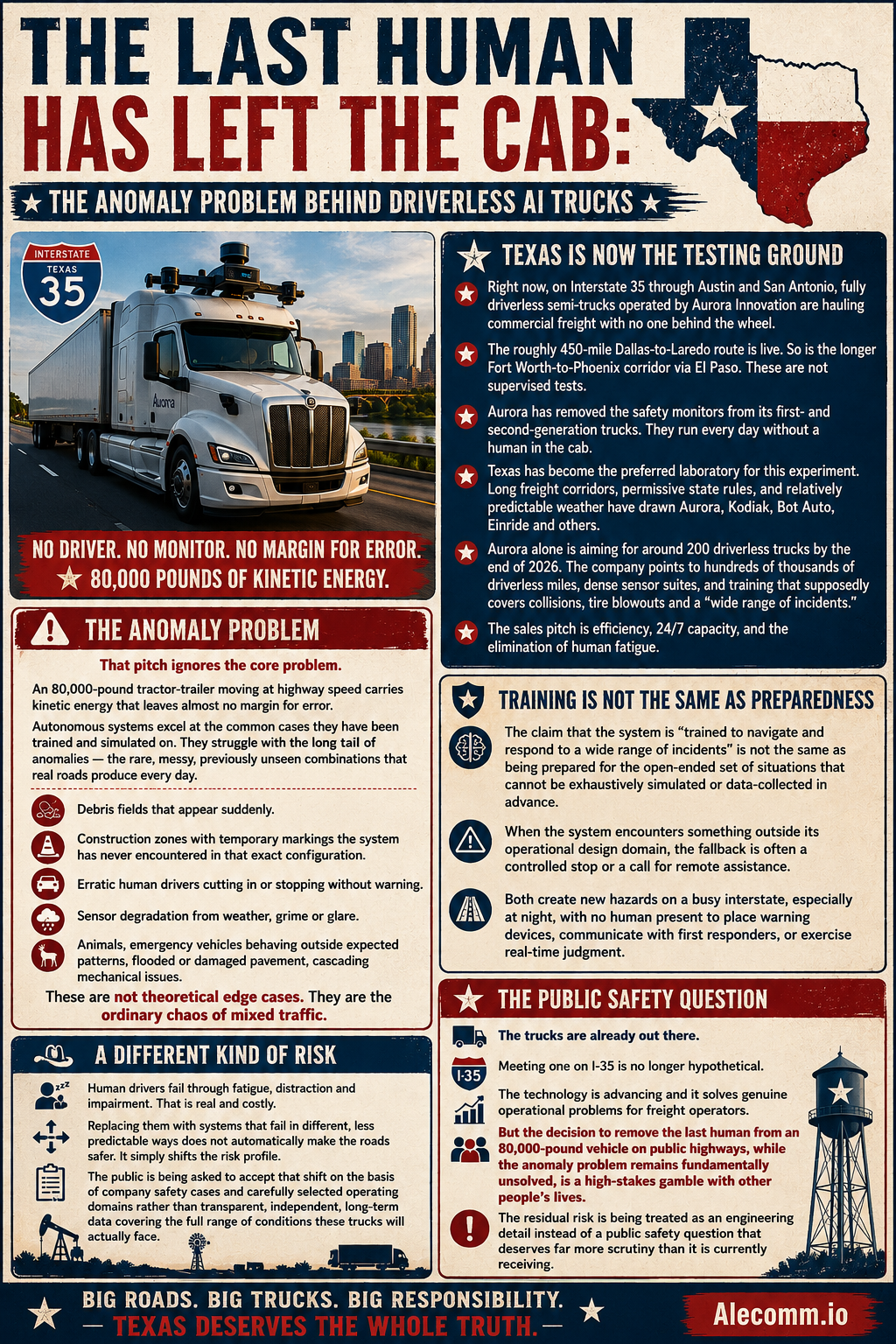
Texas Is Now the Testing Ground
Right now, on Interstate 35 through Austin and San Antonio, fully driverless semi-trucks operated by Aurora Innovation are hauling commercial freight with no one behind the wheel.
The roughly 450-mile Dallas-to-Laredo route is live. So is the longer Fort Worth-to-Phoenix corridor via El Paso. These are not supervised tests.
Aurora has removed the safety monitors from its first- and second-generation trucks. They run every day without a human in the cab.
Texas has become the preferred laboratory for this experiment. Long freight corridors, permissive state rules, and relatively predictable weather have drawn Aurora, Kodiak, Bot Auto, Einride and others.
Aurora alone is aiming for around 200 driverless trucks by the end of 2026. The company points to hundreds of thousands of driverless miles, dense sensor suites, and training that supposedly covers collisions, tire blowouts and a “wide range of incidents.”
The sales pitch is efficiency, 24/7 capacity, and the elimination of human fatigue.
The Anomaly Problem
That pitch ignores the core problem.
An 80,000-pound tractor-trailer moving at highway speed carries kinetic energy that leaves almost no margin for error.
Autonomous systems excel at the common cases they have been trained and simulated on. They struggle with the long tail of anomalies — the rare, messy, previously unseen combinations that real roads produce every day.
Debris fields that appear suddenly. Construction zones with temporary markings the system has never encountered in that exact configuration. Erratic human drivers cutting in or stopping without warning. Sensor degradation from weather, grime or glare. Animals, emergency vehicles behaving outside expected patterns, flooded or damaged pavement, cascading mechanical issues.
These are not theoretical edge cases. They are the ordinary chaos of mixed traffic.
Training Is Not the Same as Preparedness
The claim that the system is “trained to navigate and respond to a wide range of incidents” is not the same as being prepared for the open-ended set of situations that cannot be exhaustively simulated or data-collected in advance.
When the system encounters something outside its operational design domain, the fallback is often a controlled stop or a call for remote assistance.
Both create new hazards on a busy interstate, especially at night, with no human present to place warning devices, communicate with first responders, or exercise real-time judgment.
A Different Kind of Risk
Human drivers fail through fatigue, distraction and impairment. That is real and costly.
Replacing them with systems that fail in different, less predictable ways does not automatically make the roads safer. It simply shifts the risk profile.
The public is being asked to accept that shift on the basis of company safety cases and carefully selected operating domains rather than transparent, independent, long-term data covering the full range of conditions these trucks will actually face.
The Public Safety Question
The trucks are already out there.
Meeting one on I-35 is no longer hypothetical.
The technology is advancing and it solves genuine operational problems for freight operators.
But the decision to remove the last human from an 80,000-pound vehicle on public highways, while the anomaly problem remains fundamentally unsolved, is a high-stakes gamble with other people’s lives.
The residual risk is being treated as an engineering detail instead of a public safety question that deserves far more scrutiny than it is currently receiving.
Leave a Reply