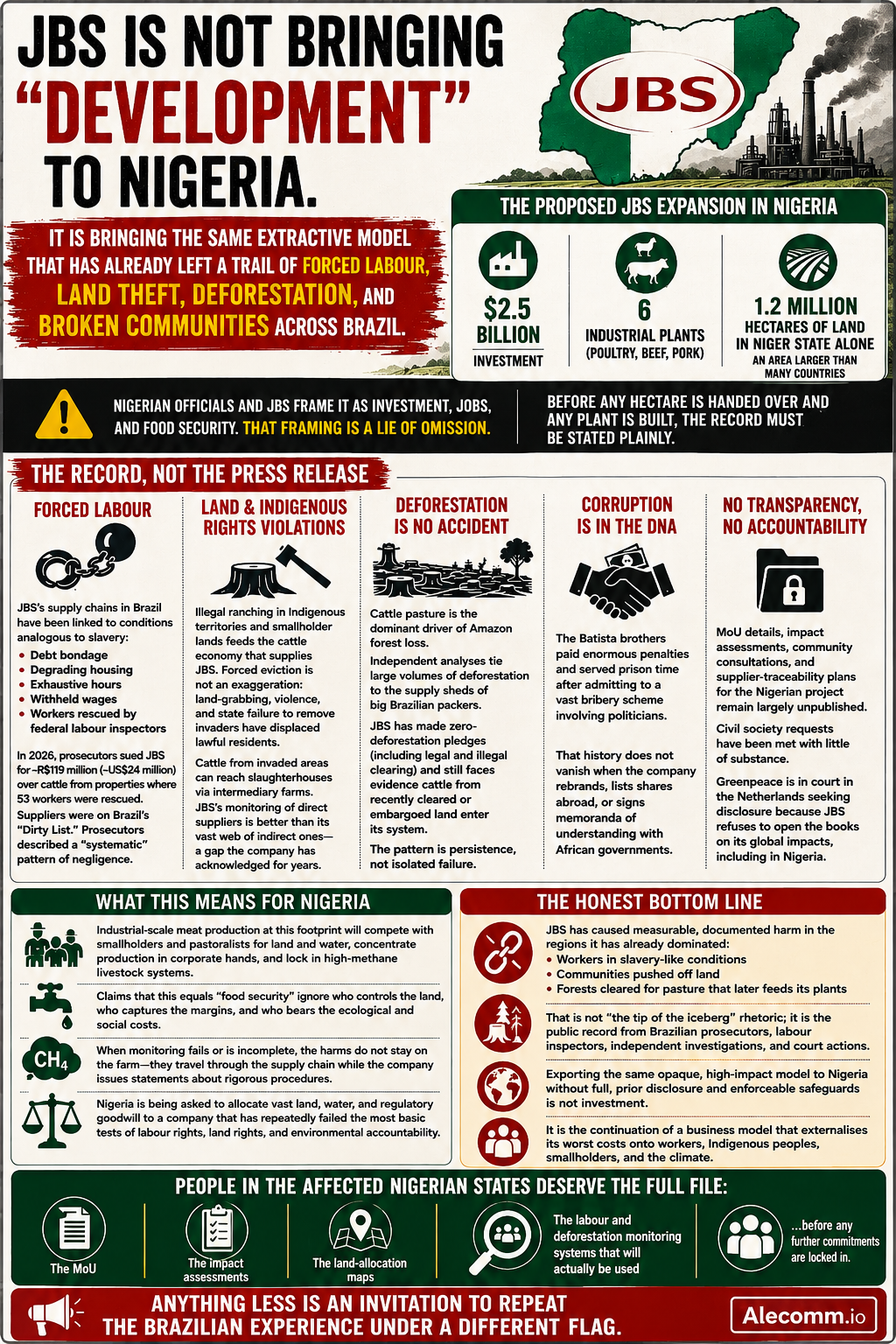
The world’s largest meat company is preparing a $2.5 billion push into Nigeria — six industrial plants (poultry, beef, pork) and a reported 1.2 million hectares of land in Niger State alone, an area larger than many countries.
Nigerian officials and JBS frame it as investment, jobs, and food security.
That framing is a lie of omission.
Before any hectare is handed over and any plant is built, the record must be stated plainly.
The Record, Not The Press Release
JBS’s supply chains in Brazil have repeatedly been linked to conditions Brazilian authorities themselves define as analogous to slavery:
- Debt bondage
- Degrading housing
- Exhaustive hours
- Withheld wages
- Workers rescued by federal labour inspectors
In 2026, Brazilian labour prosecutors filed a civil action seeking roughly R$119 million (~US$24 million) from JBS over cattle purchases from properties where 53 workers were rescued between 2014 and 2025.
Those suppliers appeared on Brazil’s official “Dirty List.”
Prosecutors described a “systematic pattern of negligence.”
Separate cases have involved JBS Aves (poultry) contractors, with workers subjected to:
- 16-hour shifts
- No clean water
- Unlawful wage deductions
A judge ordered a JBS subsidiary onto the Dirty List.
Investigations by Repórter Brasil, Climate Rights International, and others continue to document cattle from Dirty List ranches and embargoed deforestation sites moving into JBS’s chain via indirect suppliers that the company has long claimed it cannot fully monitor.
Land and Indigenous rights violations follow the same pattern.
Illegal ranching inside or on the edges of Indigenous territories and smallholder settlements has been documented feeding into the wider cattle economy that supplies major packers, including JBS.
Forced eviction is not an exaggeration: land-grabbing, violence, and state failure to remove invaders have displaced lawful residents.
Human Rights Watch and others have shown how cattle from invaded areas can reach slaughterhouses after being moved through intermediary farms.
JBS’s monitoring covers direct suppliers more effectively than the vast web of indirect ones — a gap the company has acknowledged for years while continuing to expand.
Deforestation is not incidental.
Cattle pasture remains the dominant driver of Amazon forest loss.
Independent analyses have repeatedly tied large volumes of deforestation to the supply sheds of the big Brazilian packers.
JBS has made successive zero-deforestation pledges (including legal and illegal clearing) and still faces evidence that cattle from recently cleared or embargoed land enter its system.
The company has been fined, sued, and publicly embarrassed over these issues for more than a decade.
The pattern is persistence, not isolated failure.
Corruption is part of the founding story.
The Batista brothers paid enormous penalties and served prison time after admitting to a vast bribery scheme involving politicians.
That history does not vanish when the company rebrands, lists shares abroad, or signs memoranda of understanding with African governments.
What This Means For Nigeria
Nigeria is being asked to allocate vast land, water, and regulatory goodwill to a company whose Brazilian operations have repeatedly failed the most basic tests of:
- Labour rights
- Land rights
- Environmental accountability
The MoU details, environmental and social impact assessments, community consultation records, and supplier-traceability plans for the Nigerian project remain largely unpublished.
Nigerian civil society groups have sought information through formal channels and received little of substance.
Greenpeace has gone to court in the Netherlands seeking disclosure precisely because the company will not voluntarily open the books on climate, nature, and human rights impacts of its global expansion, including Nigeria.
Industrial-scale meat production at this footprint will compete with smallholders and pastoralists for land and water, concentrate production in corporate hands, and lock in high-methane livestock systems.
Claims that this equals “food security” ignore:
- Who controls the land
- Who captures the margins
- Who bears the ecological and social costs
JBS’s history shows that when monitoring fails or is incomplete, the harms do not stay on the farm — they travel through the supply chain while the company issues statements about rigorous procedures.
The Honest Bottom Line
JBS has caused measurable, documented harm in the regions it has already dominated:
- Workers in slavery-like conditions
- Communities pushed off land
- Forests cleared for pasture that later feeds its plants
That is not “the tip of the iceberg” rhetoric; it is the public record from Brazilian prosecutors, labour inspectors, independent investigations, and court actions.
Exporting the same opaque, high-impact model to Nigeria without full, prior disclosure and enforceable safeguards is not investment.
It is the continuation of a business model that externalises its worst costs onto:
- Workers
- Indigenous peoples
- Smallholders
- The climate
People in the affected Nigerian states deserve the full file:
- The MoU
- The impact assessments
- The land-allocation maps
- The labour and deforestation monitoring systems that will actually be used
…before any further commitments are locked in.
Anything less is an invitation to repeat the Brazilian experience under a different flag.
Leave a Reply