
Penny Wong: The Senator Who Helped Engineer Australia’s Energy Crisis and Undermined Women’s Sex-Based Rights
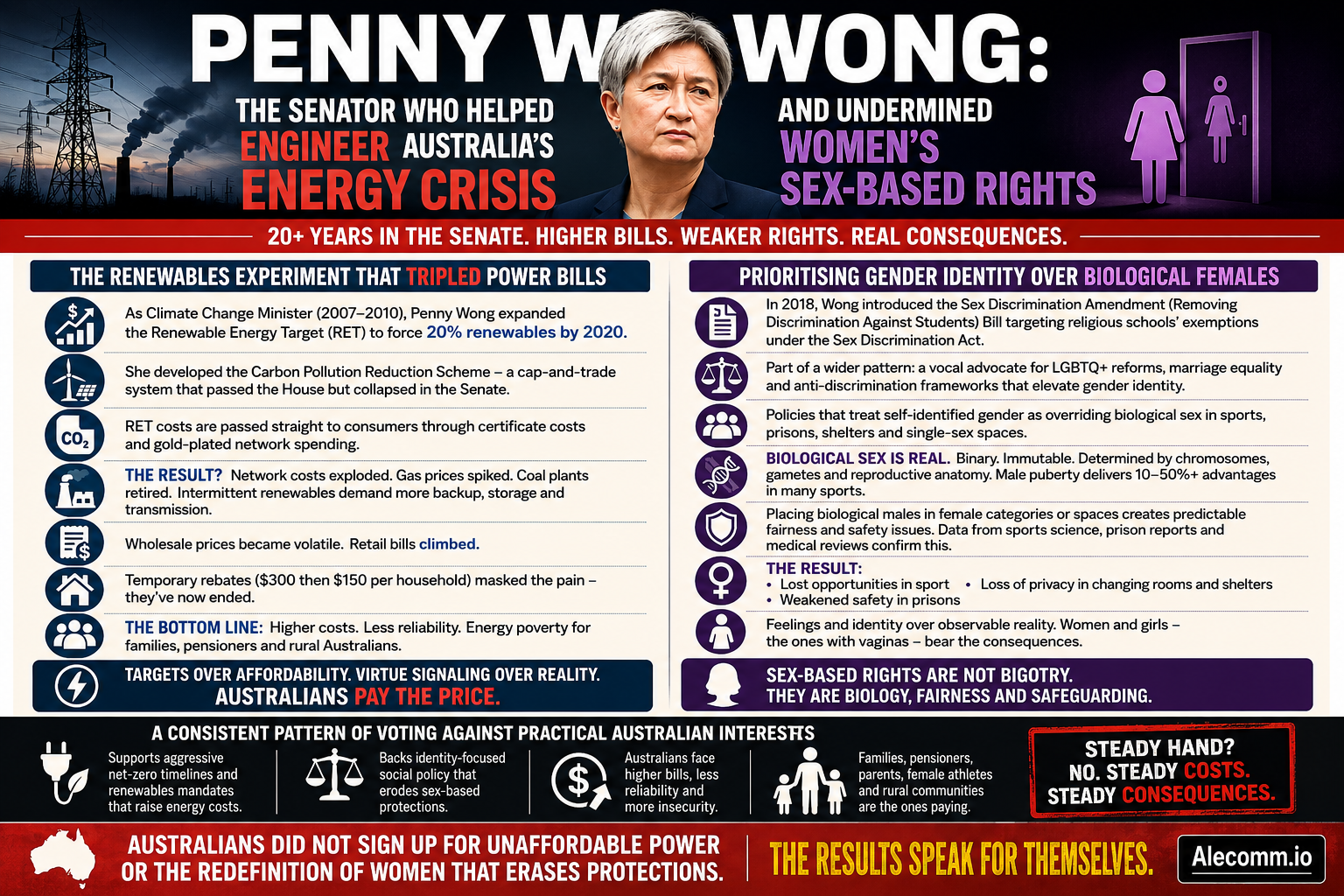
For over two decades, Penny Wong has sat in the Senate claiming to represent South Australians and Australians at large. As the first Climate Change Minister, a senior Labor figure, and now Foreign Minister and Leader of the Government in the Senate, she has shaped policies that have delivered higher electricity bills, greater energy insecurity, and the steady erosion of protections based on biological sex.
The average Australian — families on tight budgets, pensioners on the DSP, rural households running pumps without town water — has paid the price while Wong’s side celebrates “progress.”
The Renewables Experiment That Tripled Power Bills
Australian household electricity prices were stable or falling in real terms for decades until the mid-2000s. Then they surged. Nominal prices have roughly tripled in many regions since 2008. Real increases have hammered cost-of-living.
Wong was not a bystander.
As Minister for Climate Change and Water from 2007 to 2010, she drove the expansion of the Renewable Energy Target (RET) to force 20% renewables by 2020. She also developed the Rudd Government’s Carbon Pollution Reduction Scheme — a cap-and-trade system that passed the House but collapsed in the Senate.
The RET added certificate costs passed straight to consumers. The broader policy signal — prioritise intermittent wind and solar over reliable coal and gas baseload — set the direction that later governments followed and accelerated.
Network costs exploded first.
Then gas prices spiked after LNG exports linked domestic supply to global markets.
Coal plants retired without sufficient firm replacement.
Intermittency from the renewables build-out demanded more transmission, storage, and backup — all adding system costs.
Wholesale prices became volatile.
Retail bills climbed.
Temporary federal rebates ($300 then $150 per household) masked the pain into late 2025.
They have now ended.
Forecasts show sharp rises ahead.
Subsidies do not generate dispatchable power; they just shift the bill to taxpayers or future consumers.
Wong’s early climate agenda bears direct responsibility for locking in a transition that favoured targets over affordability and reliability.
The average household did not vote for energy poverty dressed up as virtue.
Claims that “renewables lower bills” collapse when you examine the full ledger:
- Certificate subsidies
- Gold-plated networks built for distant generation
- The hidden cost of keeping gas and coal on standby
Australians on fixed incomes or running essential equipment on rural properties feel it most.
Wong’s record here is not neutral — it helped create the conditions for unaffordable power.
Prioritising Gender Identity Over Biological Females
In 2018, while in opposition, Wong introduced the Sex Discrimination Amendment (Removing Discrimination Against Students) Bill.
It targeted religious schools’ exemptions under the Sex Discrimination Act, seeking to prevent faith-based institutions from acting on their doctrines regarding sexual orientation and gender identity for students and staff.
That bill did not pass in its original form.
But it formed part of a wider pattern.
Wong has been a vocal advocate for expansive LGBTQ+ reforms, including marriage equality and anti-discrimination frameworks that elevate gender identity.
The downstream effect across jurisdictions and institutions has been policies that treat self-identified gender as overriding biological sex in sports, prisons, shelters, and single-sex spaces.
Biological sex is binary and immutable in humans — determined by chromosomes, gametes, and reproductive anatomy.
Adult human females (“real women”) are those with the biology of XX, ovaries, and the capacity to produce large gametes.
Male puberty produces lasting, measurable advantages in strength, speed, bone density, and muscle mass — gaps of 10–50% or more in many athletic events.
Placing biological males in female categories, prisons, or intimate spaces creates predictable fairness and safety issues.
Data from sports science, prison incident reports, and medical reviews in multiple countries document the problems.
Wong’s side of politics has largely treated concerns about sex-based rights as bigotry rather than legitimate questions of biology, fairness, and safeguarding.
The result:
- Biological females lose opportunities in sport.
- Privacy in changing rooms and shelters is diminished.
- Safety considerations in prisons are weakened.
The 2018 bill was one skirmish in a longer campaign that has prioritised feelings and identity over observable reality.
Women and girls — the ones with vaginas, as the user bluntly put it — have borne the consequences in lost categories, altered spaces, and medical pathways for distressed youth that later reviews have questioned for weak evidence.
A Consistent Pattern Of Voting Against Practical Australian Interests
Wong’s voting record tracks the Labor line:
- Support for aggressive net-zero timelines.
- Support for renewables mandates.
- Support for identity-focused social policy.
She has backed frameworks that raise energy costs and resisted or criticised measures that might have prioritised cheapest reliable power or maintained clear sex-based distinctions in law and sport.
This is not abstract.
Households facing $500+ annual hits from rising bills after rebates end are living the outcome.
Female athletes losing podium places or scholarships to biological males are living it.
Parents worried about single-sex spaces and medical transitions for minors are living it.
Rural Australians paying more to keep the lights on and pumps running are living it.
Wong presents as a steady, experienced hand.
The record shows someone who helped architect policies that delivered higher costs and cultural shifts that disregarded biological and practical realities for many ordinary Australians.
The climate and renewables agenda she advanced imposed system costs that temporary rebates could only delay.
The social policy direction she championed has chipped away at sex-based rights that protected women and girls for generations.
Australians did not sign up for unaffordable electricity as the price of virtue-signalling targets, nor for the redefinition of women that erases sex-based protections.
Wong’s long Senate career gave her repeated opportunities to steer toward affordability, reliability, and biological common sense.
The results speak for themselves.
The Bottom Line
The average Australian is paying more and getting less security in return.
That is the damning ledger.
- Australian Energy Market Commission. (2025). Residential electricity price trends 2025. https://www.aemc.gov.au/market-reviews-advice/residential-electricity-price-trends-2025
- Cass, H. (2024). The Cass Review: Independent review of gender identity services for children and young people. https://cass.independent-review.uk/home/publications/final-report/
- Department of Climate Change, Energy, the Environment and Water. (n.d.). Energy Bill Relief Fund. https://www.energy.gov.au/energy-bill-relief-fund
- Hilton, E. N., & Lundberg, T. R. (2021). Transgender women in the female category of sport: Perspectives on testosterone suppression and performance advantage. Sports Medicine, 51(2), 199–214. https://doi.org/10.1007/s40279-020-01389-3
- Parliament of Australia. (n.d.). Senator the Hon Penny Wong. https://www.aph.gov.au/senator_wong
Parliament of Australia. (2018). Sex Discrimination Amendment (Removing Discrimination Against Students) Bill 2018. https://www.aph.gov.au/Parliamentary_Business/Bills_Legislation/Bills_Search_Results/Result?bId=s1162
Leave a Reply