
Ivermectin: A Truly Remarkable, Multi-Benefit Medicine
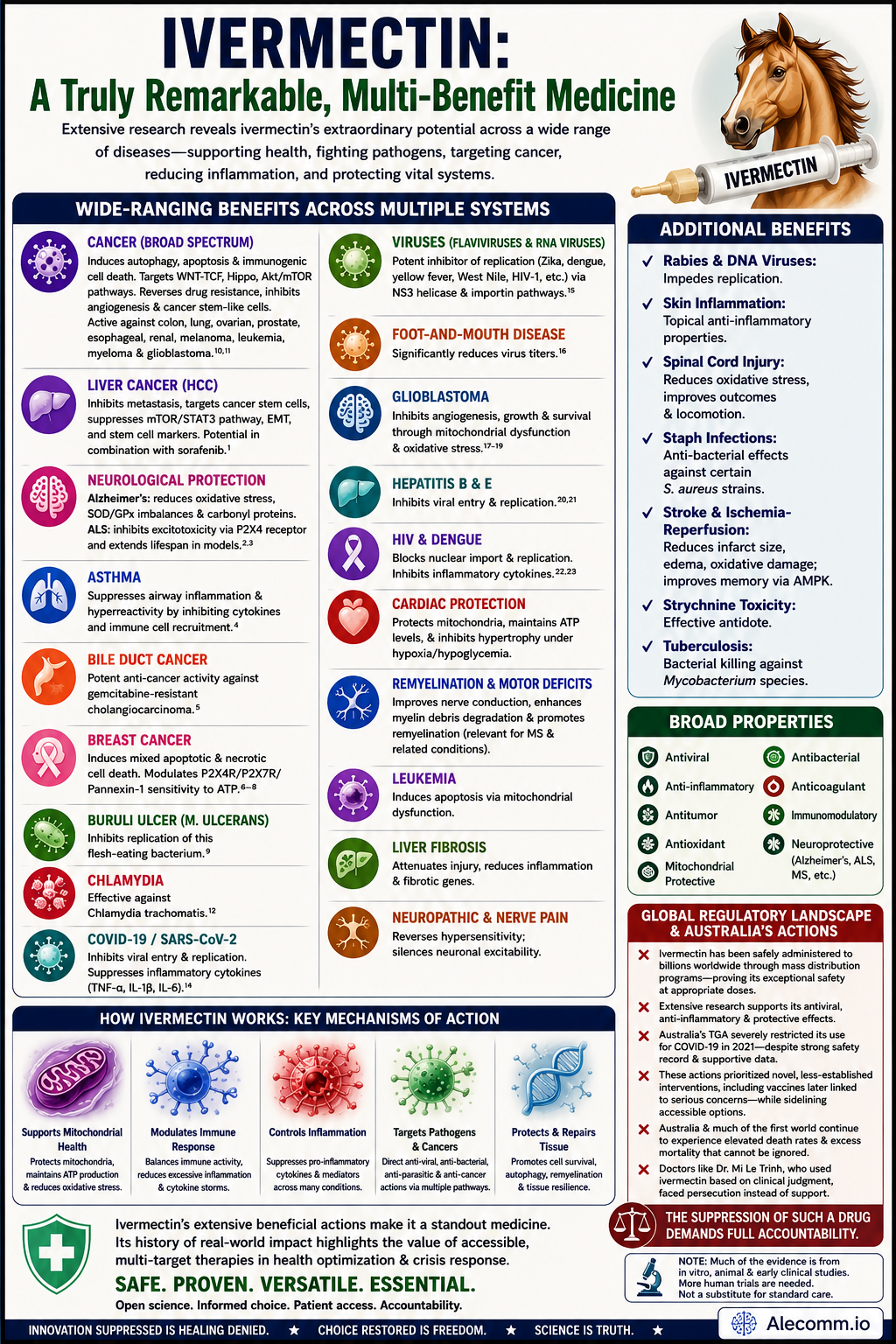
Ivermectin stands as an extraordinary drug with an impressive track record of supporting health across a wide range of conditions. Here is a comprehensive overview drawn from detailed compilations:
• Advanced Hepatocellular Carcinoma (Liver Cancer): Inhibits metastasis, targets cancer stem cells, suppresses the mTOR/STAT3 pathway, epithelial-mesenchymal transition (EMT), and stem cell markers. Shows strong potential in combination with sorafenib.
• Alzheimer’s Disease: Protects against oxidative stress and reduces SOD/GPx imbalances and carbonyl protein elevation.
• Amyotrophic Lateral Sclerosis (ALS): Inhibits excitotoxicity in motor neurons and extends lifespan in transgenic models via P2X4 receptor effects.
• Asthma: Suppresses airway inflammation and hyperreactivity by inhibiting cytokine production and immune cell recruitment.
• Bile Duct Cancer: Exhibits potent anti-cancer activity against gemcitabine-resistant cholangiocarcinoma.
• Breast Cancer: Induces mixed apoptotic and necrotic cell death while modulating P2X4R/P2X7R/Pannexin-1 sensitivity to ATP.
• Buruli Ulcer (Mycobacterium ulcerans): Inhibits replication of this flesh-eating bacterium.
• Broad Cancer Effects: Induces PAK1-mediated autophagy, caspase-dependent apoptosis, and immunogenic cell death. Modulates the WNT-TCF, Hippo, and Akt/mTOR pathways, reverses multidrug resistance, enhances chemotherapy sensitivity, targets angiogenesis, and inhibits cancer stem-like cells. Experimental activity has been reported against colon, lung, ovarian, prostate, oesophageal, renal, melanoma, leukaemia, myeloma, and glioblastoma.
• Chlamydia: Demonstrates effectiveness against Chlamydia trachomatis.
• COVID-19 / SARS-CoV-2: Inhibits viral entry and replication while suppressing inflammatory cytokines including TNF-α, IL-1β, and IL-6.
• Flaviviruses And RNA Viruses: Potent inhibitor of viral replication (including Zika, dengue, yellow fever, West Nile virus, HIV-1, and others) through NS3 helicase and importin α/β pathways.
• Foot-And-Mouth Disease: Significantly reduces viral titres.
• Glioblastoma: Inhibits angiogenesis, tumour growth, and survival through mitochondrial dysfunction and oxidative stress.
• Hepatitis B And E: Inhibits viral entry and replication.
• HIV And Dengue: Blocks nuclear import and viral replication.
• Hypoxia, Hypoglycaemia And Cardiac Protection: Protects mitochondria, maintains ATP production, and inhibits cardiac hypertrophy.
• Motor Deficits And Remyelination: Improves nerve conduction, enhances myelin debris degradation, and promotes remyelination, making it highly relevant to multiple sclerosis and related demyelinating disorders.
• Leukaemia: Induces apoptosis through mitochondrial dysfunction.
• Liver Fibrosis: Attenuates liver injury while reducing inflammation and fibrotic gene expression.
• Multiple Sclerosis: Reduces central nervous system inflammation, improves clinical symptoms in EAE models, and induces autophagy.
• Neuropathic And Nerve Pain: Reverses hypersensitivity and silences neuronal excitability.
• Ovarian, Prostate, Melanoma, Renal And Other Cancers: Demonstrates strong suppression of tumour growth together with induction of apoptosis.
• Rabies And DNA Viruses: Impedes viral replication.
• Skin Inflammation: Demonstrates topical anti-inflammatory properties.
• Spinal Cord Injury: Reduces oxidative stress while improving neurological outcomes and locomotion.
• Staphylococcal Infections: Exhibits antibacterial effects against selected Staphylococcus aureus strains.
• Stroke And Ischaemia-Reperfusion Injury: Reduces infarct size, cerebral oedema, oxidative damage, and improves memory through AMPK activation.
• Strychnine Toxicity: Demonstrates effectiveness as an antidote.
• Tuberculosis: Exhibits bactericidal activity against Mycobacterium species.
• Additional Properties: Antiviral, antibacterial, anti-inflammatory, antitumour, anticoagulant, antioxidant, immunomodulatory, mitochondrial protective, and neuroprotective, including protection against oxidative stress associated with Alzheimer’s disease, ALS, multiple sclerosis, and related neurological disorders.
These actions demonstrate ivermectin’s remarkable versatility as a powerful tool for mitochondrial support, immune modulation, inflammation control, and direct pathogen and cancer targeting, making it highly relevant to chronic disease management, neurological support, and resilience-focused health protocols.
Global Regulatory Landscape And Australia’s Actions
Ivermectin has been safely administered to billions of people worldwide through mass drug administration programs targeting parasitic diseases, underscoring its exceptional safety profile when used at appropriate doses. Extensive research has documented its antiviral, anti-inflammatory, immunomodulatory, mitochondrial protective, and tissue-protective effects, providing substantial grounds for investigation in early treatment and chronic disease management.
Despite this, Australia’s Therapeutic Goods Administration (TGA) moved to severely restrict its use for COVID-19. The temporary prescribing limits introduced during 2021 were viewed by many clinicians and researchers as lacking sufficient justification in light of ivermectin’s established safety profile and the body of supportive experimental and clinical evidence available at the time.
Many regard these actions as part of a broader strategy that prioritised novel, less-established interventions, including vaccines that later became the subject of significant ongoing safety investigations and public debate, while limiting access to inexpensive, widely available therapeutic options.
The results speak for themselves. Australia, along with many other developed nations, continues to experience persistent excess mortality and elevated death rates, trends that warrant continued independent investigation and transparent scientific scrutiny.
This approach effectively denied many patients and clinicians access to a medicine with an extensive safety record and broad biological activity during a critical period. Doctors such as Dr. Mi Le Trinh, who exercised their clinical judgement and prescribed ivermectin based on their assessment of individual patients, subsequently faced investigation and professional sanctions rather than support.
Ivermectin’s extensive range of documented biological actions makes it one of the most versatile medicines ever discovered. Its history of real-world impact continues to highlight the potential value of accessible, low-cost, multi-target therapies in health optimisation, infectious disease, chronic illness, neurological disorders, and oncology research.
The suppression of such a medicine deserves ongoing scientific scrutiny, transparent public accountability, and an honest re-evaluation of the evidence.
Leave a Reply