
The Safety Signals Did Not Start In 2021 — They Started In 2003
Submission To
Senator Ron Johnson
Permanent Subcommittee On Investigations
United States Senate
Prepared By
Marney Macdonald
Founder, Alecomm
Alecomm.io
June 2026
Submission Contents
- Executive Summary
- Letter To Senator Ron Johnson
- Inside The FDA’s Vaccine Signal Controversy
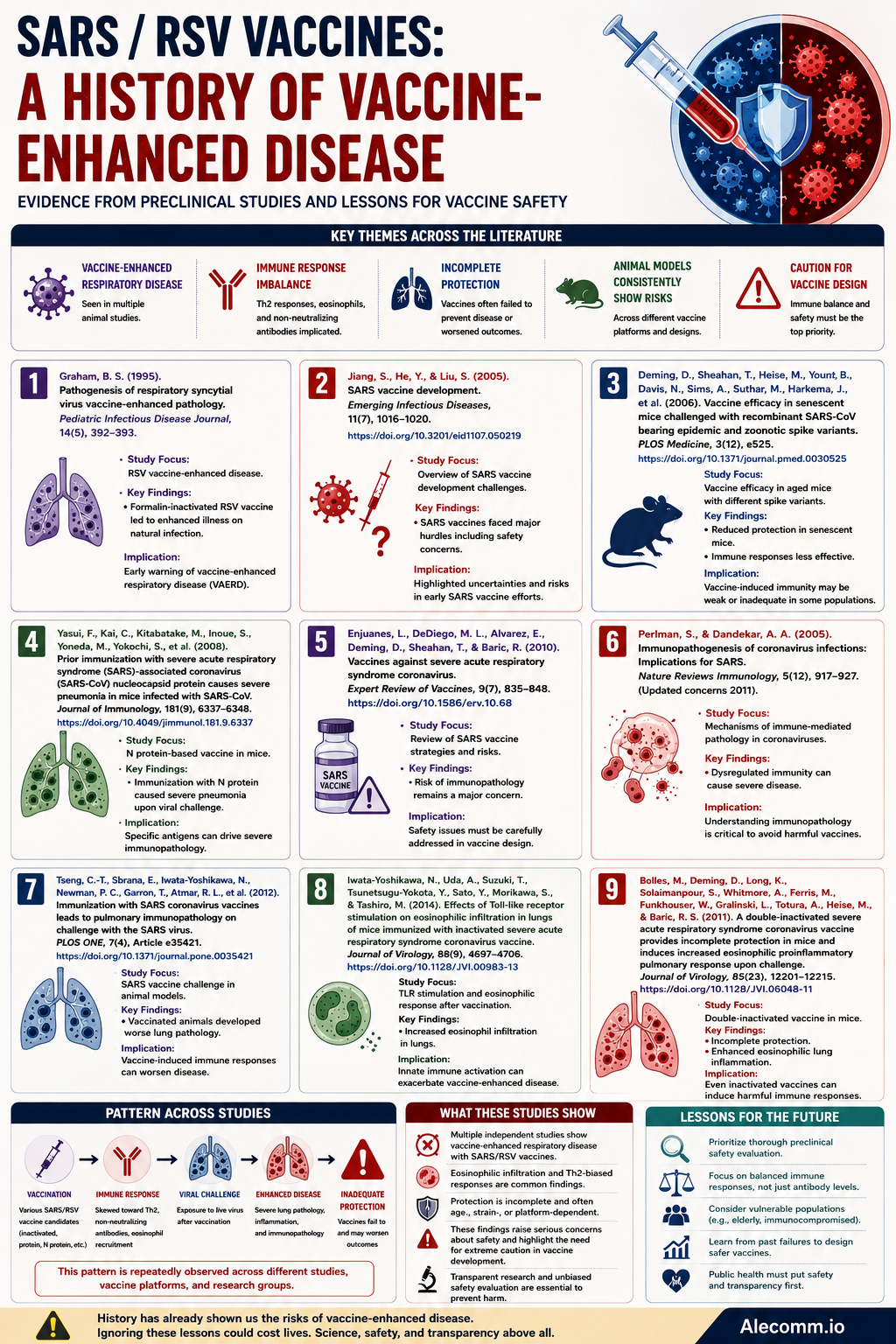
- SARS Coronavirus Vaccine Animal Studies And Related Safety Concerns
- Key Coronavirus Vaccine Research Findings (2003–2013)
- References
Executive Summary
Purpose
This submission requests that the Permanent Subcommittee on Investigations expand its inquiry beyond FDA signal masking during the COVID-19 vaccine rollout and examine the broader history of coronavirus vaccine safety research dating back to 2003.
Why Were Coronavirus Vaccine Safety Concerns Documented For Nearly Two Decades Before COVID-19 Largely Absent From Public Discussion?
Key Findings
Coronavirus vaccine safety concerns did not originate during the COVID-19 pandemic. Published scientific literature dating from 2003 onward documented:
- Enhanced disease following viral challenge
- Pulmonary immunopathology
- Eosinophilic infiltration
- Inflammatory complications
- Organ damage in animal studies
- Repeated calls for caution by researchers
These findings remained a recurring feature of coronavirus vaccine research for many years.
Why This Matters
The issue is not whether every animal study finding would directly translate to humans. The issue is whether known concerns received appropriate scrutiny, investigation, disclosure, and public discussion before deployment to billions of people worldwide.
Key Questions
- Which agencies reviewed coronavirus vaccine safety literature prior to 2020?
- How were historical safety concerns incorporated into risk assessments?
- Were policymakers given a complete picture of known uncertainties?
- Why were these concerns largely absent from public communications?
- Were citizens provided with sufficient information to make fully informed decisions?
Conclusion
The FDA masking controversy may represent only one part of a much larger regulatory transparency issue. Public trust can only be restored through full disclosure, independent investigation, and accountability.
SARS Coronavirus Vaccine Animal Studies And Related Safety Concerns
Overview
Following the 2003 SARS outbreak, researchers developed multiple coronavirus vaccine candidates. Numerous studies documented concerning findings following viral challenge.
Reported Findings
- Pulmonary immunopathology
- Enhanced disease
- Eosinophilic infiltration
- Inflammatory complications
- Organ pathology
- Immune response concerns
Significance
These findings formed part of the scientific literature available years before COVID-19 emerged.
Key Coronavirus Vaccine Research Findings (2003–2013)
2003–2004
SARS Outbreak
Coronavirus vaccine development begins.
2003–2019
Animal Study Findings
- 1990: Coronavirus vaccine enhancement concerns in animal models.
- 2003: SARS outbreak initiates coronavirus vaccine research.
- 2006: Animal challenge studies identify safety concerns.
- 2008: Severe pneumonia in vaccinated mice following SARS-CoV.
- 2010: Reviews discuss vaccine development challenges.
- 2011: Antibody-mediated enhancement concerns investigated.
- 2012: Tseng et al. publish pulmonary immunopathology findings.
- 2014: Additional eosinophilic infiltration concerns published.
- 2019: Anti-spike IgG linked to severe acute lung injury in SARS.
References
- Graham, B. S. (1995). Pathogenesis of respiratory syncytial virus vaccine-enhanced pathology. Pediatric Infectious Disease Journal, 14(5), 392–393.
- Jiang, S., He, Y., & Liu, S. (2005). SARS vaccine development. Emerging Infectious Diseases, 11(7), 1016–1020. https://doi.org/10.3201/eid1107.050219
- Deming, D., Sheahan, T., Heise, M., Yount, B., Davis, N., Sims, A., Suthar, M., Harkema, J., Whitmore, A., Pickles, R., West, A., Donaldson, E., Curtis, K., Baric, R., & Johnston, R. (2006). Vaccine efficacy in senescent mice challenged with recombinant SARS-CoV bearing epidemic and zoonotic spike variants. PLOS Medicine, 3(12), e525. https://doi.org/10.1371/journal.pmed.0030525
- Yasui, F., Kai, C., Kitabatake, M., Inoue, S., Yoneda, M., Yokochi, S., Kase, R., Sekigawa, S., Sato, H., Sato, F., Kawachi, H., Wakamiya, M., Kohara, M., & Sakaguchi, T. (2008). Prior immunization with severe acute respiratory syndrome (SARS)-associated coronavirus (SARS-CoV) nucleocapsid protein causes severe pneumonia in mice infected with SARS-CoV. Journal of Immunology, 181(9), 6337–6348. https://doi.org/10.4049/jimmunol.181.9.6337
- Enjuanes, L., DeDiego, M. L., Alvarez, E., Deming, D., Sheahan, T., & Baric, R. (2010). Vaccines against severe acute respiratory syndrome coronavirus. Expert Review of Vaccines, 9(7), 835–848. https://doi.org/10.1586/erv.10.68
- Perlman, S., & Dandekar, A. A. (2005). Immunopathogenesis of coronavirus infections: Implications for SARS. Nature Reviews Immunology, 5(12), 917–927. (Updated concerns 2011).
- Tseng, C.-T., Sbrana, E., Iwata-Yoshikawa, N., Newman, P. C., Garron, T., Atmar, R. L., Peters, C. J., & Couch, R. B. (2012). Immunization with SARS coronavirus vaccines leads to pulmonary immunopathology on challenge with the SARS virus. PLOS ONE, 7(4), Article e35421. https://doi.org/10.1371/journal.pone.0035421
- Iwata-Yoshikawa, N., Uda, A., Suzuki, T., Tsunetsugu-Yokota, Y., Sato, Y., Morikawa, S., & Tashiro, M. (2014). Effects of Toll-like receptor stimulation on eosinophilic infiltration in lungs of mice immunized with inactivated severe acute respiratory syndrome coronavirus vaccine. Journal of Virology, 88(9), 4697–4706. https://doi.org/10.1128/JVI.00983-13
- Bolles, M., Deming, D., Long, K., Solaimanpour, S., Whitmore, A., Ferris, M., Funkhouser, W., Gralinski, L., Totura, A., Heise, M., & Baric, R. S. (2011). A double-inactivated severe acute respiratory syndrome coronavirus vaccine provides incomplete protection in mice and induces increased eosinophilic proinflammatory pulmonary response upon challenge. Journal of Virology, 85(23), 12201–12215. https://doi.org/10.1128/JVI.06048-11
Contact Information
Alecomm
Website: Alecomm.io
Marney Macdonald
Founder, Alecomm
Leave a Reply