The Prioritisation Of Gender Identity Rights Over Cultural Competence In Victorian Schools: A Policy Tension In Multicultural Victoria
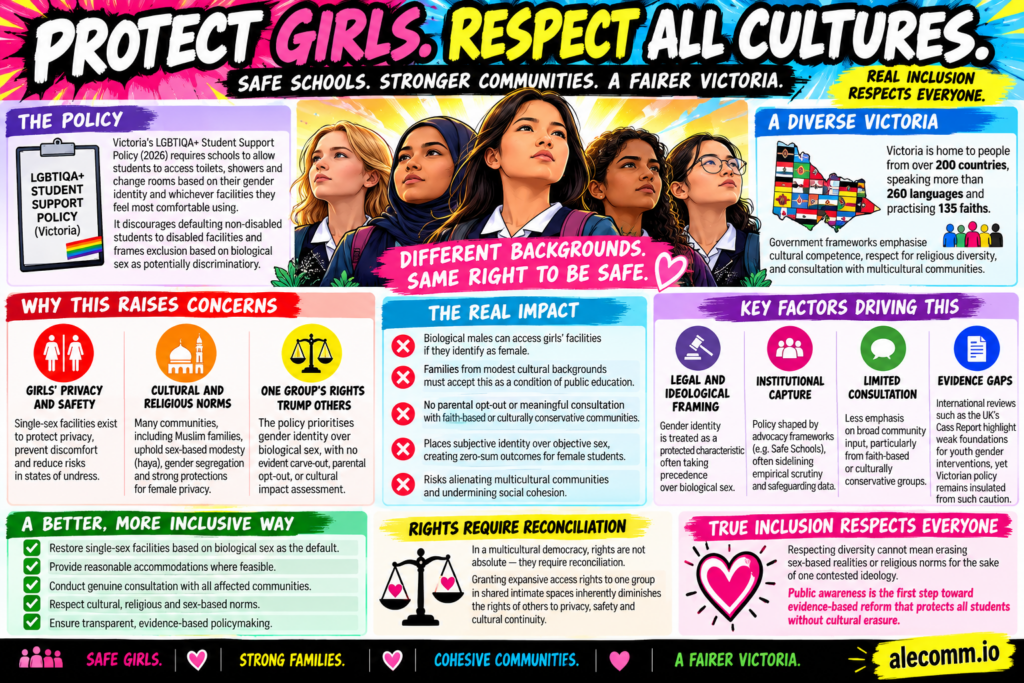
The Victorian Department of Education’s LGBTIQA+ Student Support Policy (current as of 2026) mandates that government schools support students affirming a gender identity through, among other measures, access to toilets, showers, and change rooms “based on the student’s gender identity and whichever facilities they will feel most comfortable using.”
This directive explicitly discourages defaulting non-disabled students to disabled facilities and frames exclusion based on biological sex as potentially discriminatory.
This approach raises profound questions about policy coherence in one of Australia’s most culturally diverse states.
Victoria prides itself on multiculturalism, with residents from over 200 countries, speaking more than 260 languages, and practising 135 faiths.
Government frameworks routinely emphasise cultural competence, respect for religious diversity, and consultation with multicultural communities.
Yet, in the sensitive domain of single-sex intimate spaces, the rights of one group—those affirming a transgender or gender-diverse identity—appear to supersede broader considerations of cultural, religious, and sex-based norms held by large segments of the population.
The Policy Framework And Its Implications
Under the policy, a biological male student identifying as female gains access to girls’ facilities if that aligns with their affirmed identity.
This is operationalised via individual Gender Affirmation Student Support Plans, developed in consultation primarily with the student, with limited mandatory involvement of families in some cases.
The Equal Opportunity Act 2010 reinforces this by protecting “gender identity” as a distinct attribute, often taking precedence over biological sex in access disputes.
From A Biological And Safeguarding Perspective, This Is Problematic
Males and females exhibit average differences in physical development, anatomy, and patterns of sexual offending.
Single-sex facilities were designed precisely to mitigate:
- Privacy intrusions
- Discomfort
- Risks in states of undress
Prioritising subjective identity over objective sex creates zero-sum outcomes for female students’ dignity and security—outcomes documented in jurisdictions with similar self-ID approaches.
Cultural Competence And Multicultural Realities
The inconsistency becomes stark in high-multiculturalism contexts across Melbourne’s suburbs and regional areas like Greater Shepparton.
Many communities, particularly Muslim families, maintain strong religious and cultural expectations of:
- Sex-based modesty (haya)
- Gender segregation in intimate spaces
- Protection of female privacy
These norms are not marginal.
They reflect deeply held beliefs integral to identity and child-rearing for significant portions of Victoria’s diverse population.
Victorian multicultural policy and education guidelines stress:
- Affirming cultural and linguistic diversity
- Combating Islamophobia
- Fostering inclusion through consultation
Yet the LGBTIQA+ policy imposes a uniform, ideologically driven standard with minimal apparent accommodation for these perspectives.
No Evident Carve-Out. No Parental Opt-Out. No Cultural Impact Assessment.
There is no evident carve-out, parental opt-out mechanism, or cultural impact assessment for facilities access that would respect religious sensitivities.
This effectively requires families from modest cultural backgrounds to accept biological males in their daughters’ private spaces as a condition of public education.
Such prioritisation inverts core principles of cultural competence.
Multiculturalism, properly understood, involves balancing competing rights and avoiding the imposition of one subcultural worldview—here, a specific interpretation of gender ideology—onto others.
When policy elevates gender identity affirmation above sex-based protections and religious freedoms, it risks alienating communities whose support is essential for social cohesion.
Parents in diverse schools may reasonably question why their cultural expectations of safety, privacy, and modesty are subordinated without robust public debate or evidence of superior outcomes.
Why Does One Group’s Rights Trump Others?
This hierarchy appears rooted in several intersecting factors:
Legal And Ideological Framing
Gender identity is treated as an immutable, protected characteristic akin to (or overriding) sex, influenced by human rights interpretations that emphasise self-identification.
Institutional Capture
Education policy has been shaped by advocacy frameworks (e.g., Safe Schools) that prioritise minority affirmation, often sidelining empirical scrutiny of:
- Developmental psychology
- Desistance rates
- Safeguarding data
Limited Consultation
Unlike multicultural or Indigenous policies, gender-related directives show less emphasis on broad community input, particularly from faith-based or culturally conservative groups.
Evidence Gaps
International reviews, such as the UK’s Cass Report, highlight weak foundations for youth gender interventions, yet Victorian policy remains largely insulated from such caution.
Rights Require Reconciliation
In a multicultural democracy, rights are not absolute; they require reconciliation.
Granting expansive access rights to one group in shared intimate spaces inherently diminishes the rights of others to:
- Privacy
- Safety
- Cultural continuity
This Is Not Sustainable Inclusion — It Is Selective Imposition
Victorian authorities, including the Department of Education, should urgently review this policy.
A balanced approach would:
- Restore single-sex facilities based on biological sex as the default
- Provide reasonable accommodations where feasible
- Engage in genuine consultation with all affected communities
True Cultural Competence Demands Consistency
Respecting diversity cannot mean erasing sex-based realities or religious norms for the sake of one contested ideology.
Parents and educators across Victoria deserve transparency, accountability, and evidence-based policymaking.
Public Awareness Is The First Step
Public awareness of these policy details is the first step toward evidence-based reform that protects all students without cultural erasure.
Leave a Reply