The chart doesn’t lie.
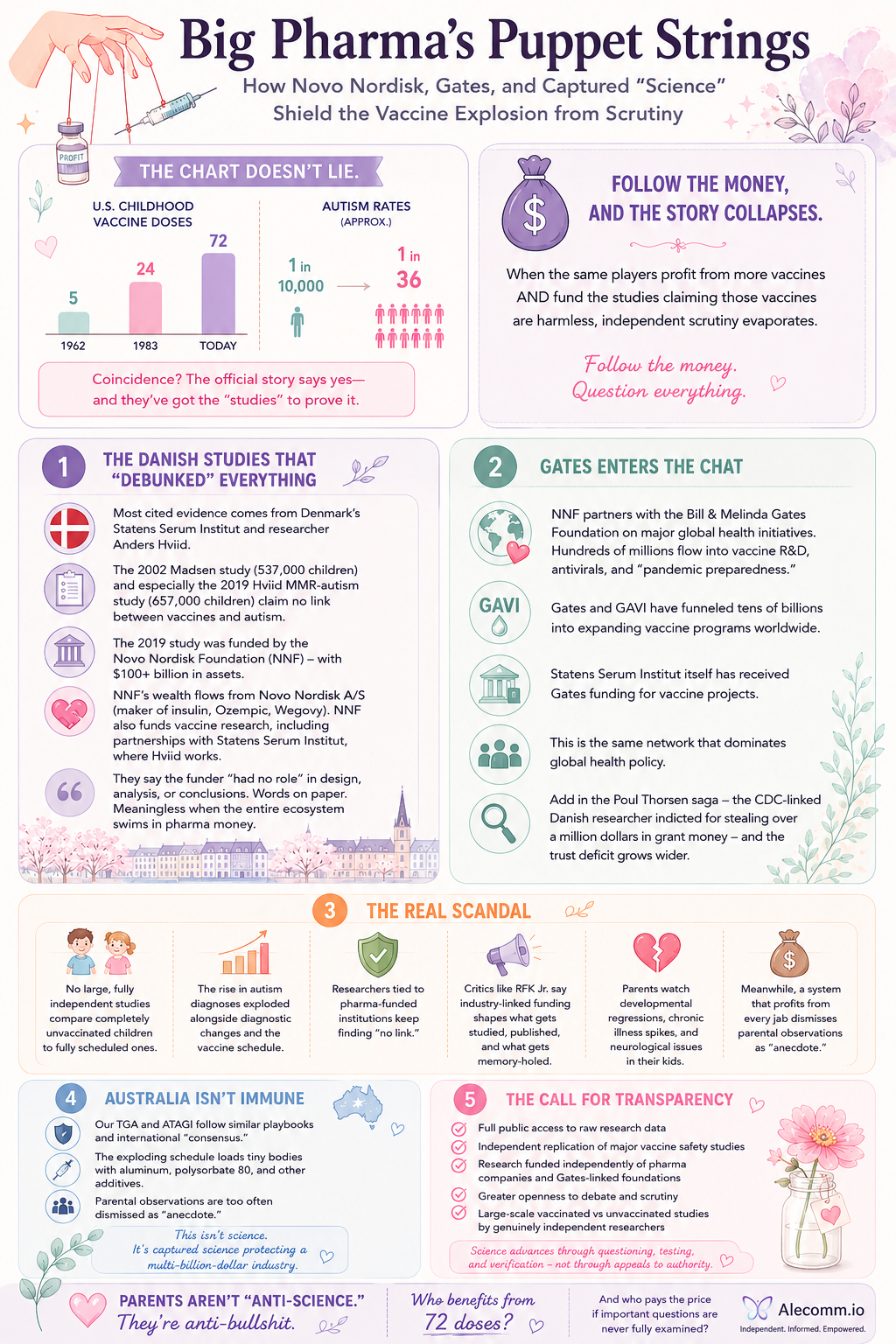
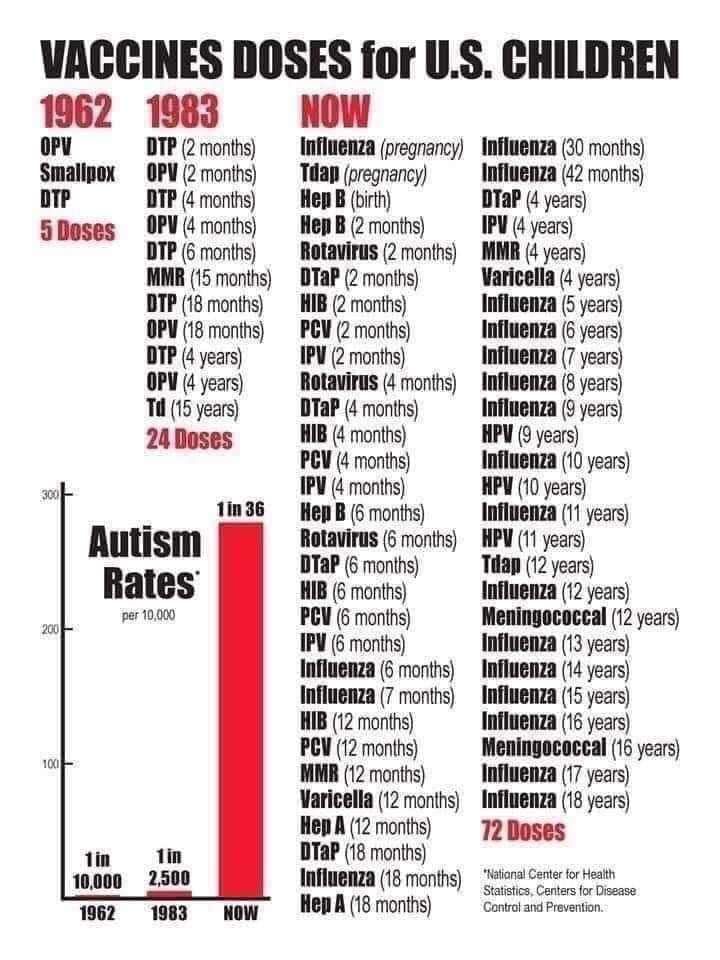
U.S. children went from 5 vaccine doses in 1962 to 24 doses in 1983, to a staggering 72 doses today.
At the same time, autism rates reportedly increased from roughly 1 in 10,000 to approximately 1 in 36.
Coincidence?
The official story says yes — and they’ve got the studies to prove it.
But follow the money, and the story begins to look very different.
The Danish Studies That “Debunked” Everything
The most frequently cited evidence comes from Denmark’s Statens Serum Institut and researcher Anders Hviid.
The 2002 Madsen study, involving approximately 537,000 children, and especially the 2019 Hviid MMR-autism study, involving approximately 657,000 children, are repeatedly referenced as evidence that vaccines do not cause autism.
Who funded the 2019 study?
The Novo Nordisk Foundation (NNF), an organisation with assets exceeding $100 billion.
Its wealth originates from ownership interests in Novo Nordisk A/S, the pharmaceutical giant generating billions from products such as insulin, Ozempic, and Wegovy.
NNF also funds vaccine research, including collaborations with Statens Serum Institut, where Hviid is employed.
Supporters point out that the foundation states it had “no role” in the design, analysis, or conclusions of the study.
Critics argue that such assurances are insufficient when an entire research ecosystem is heavily supported by pharmaceutical funding and when the same organisations actively promote vaccine development.
Gates Enters The Chat
NNF does not operate in isolation.
It has partnered with the Bill & Melinda Gates Foundation on major global health initiatives, including significant investments in vaccine research and development, antiviral programs, and pandemic preparedness projects.
The Gates Foundation and GAVI have directed tens of billions of dollars toward expanding vaccine programs globally.
Statens Serum Institut has also participated in projects that received Gates Foundation support.
Critics contend that when organisations funding vaccine development also support research evaluating vaccine safety, genuine independence becomes difficult to demonstrate.
Adding to concerns is the case of Poul Thorsen, a Danish researcher previously associated with CDC-funded autism research who was later charged in the United States with alleged grant-related financial offences.
For many observers, incidents such as these contribute to a growing trust deficit.
The Real Scandal
Critics argue that no large-scale, fully independent studies have compared completely unvaccinated children with children who received the full recommended vaccine schedule.
At the same time, autism diagnoses have risen dramatically over recent decades.
Mainstream researchers attribute much of this increase to broader diagnostic criteria, increased awareness, improved identification, and changes in reporting practices.
Sceptics remain unconvinced and argue that institutions receiving pharmaceutical or vaccine-related funding repeatedly arrive at the same conclusion: “No link.”
Public figures such as RFK Jr. have argued that industry-linked funding influences which questions are asked, which studies receive funding, and which findings receive public attention.
In this view, conflict-of-interest disclosures and statements that funders had “no role” function more as public-relations safeguards than as evidence of true independence.
Meanwhile, many parents report developmental regressions, chronic illnesses, and neurological concerns in their children and feel their observations are dismissed rather than investigated.
Australia Isn’t Immune
Australia’s regulatory framework, including bodies such as the Therapeutic Goods Administration (TGA) and Australian Technical Advisory Group on Immunisation (ATAGI), often aligns with international scientific consensus and recommendations.
Critics argue that this can lead to an overreliance on overseas guidance and insufficient consideration of dissenting perspectives.
Questions are frequently raised about vaccine ingredients such as aluminum-based adjuvants, polysorbate 80, and other excipients, along with the cumulative impact of expanding immunisation schedules.
Parents who express concerns often feel that their experiences are dismissed as anecdotal rather than explored through further research.
The Call For Greater Transparency
The central argument is not that questions should be prohibited.
Rather, it is that more transparency should be encouraged.
Calls include:
- Full public access to raw research data.
- Independent replication of major vaccine safety studies.
- Research funded independently of pharmaceutical companies and philanthropic organisations with vaccine investments.
- Greater openness to debate and scrutiny.
- Large-scale vaccinated versus unvaccinated studies conducted by genuinely independent researchers.
Supporters of this position argue that science advances through questioning, testing, and verification — not through appeals to authority.
Until greater transparency exists, they contend that many parents will continue to ask difficult questions about expanding vaccine schedules, rising chronic illness rates, and who ultimately benefits from current policies.
Parents are not necessarily anti-science.
Many would argue they are simply demanding better science, greater transparency, and fewer conflicts of interest.
The question remains:
Who benefits from 72 doses?
And who bears the risk if important questions are never fully examined?
Leave a Reply