
The Silencing Of Clare And Poppy: Coincidence Or Something Far Darker?
Some stories refuse to stay buried.
Not because the media keeps them alive. Not because politicians demand answers. Not because authorities continue to investigate.
They refuse to disappear because the questions never go away.
The deaths of Clare and her daughter Poppy sit among those stories.
Officially, both deaths were treated as suicides.
For many who have examined the circumstances, that explanation raises more questions than it answers.
What are the chances that a mother and daughter, separated by years, would allegedly die by the same method?
What are the chances that one of them had reportedly spoken of abuse, expressed fears she was being targeted, and was allegedly preparing to discuss sensitive matters with investigators, only to be found dead the following day?
And what are the chances that, years later, her daughter would also die under circumstances that left so many people unconvinced?
Perhaps it is all coincidence.
Or perhaps it is not.
Clare Knew Too Much?
Supporters of further investigation point to what they believe is the most troubling aspect of the entire story.
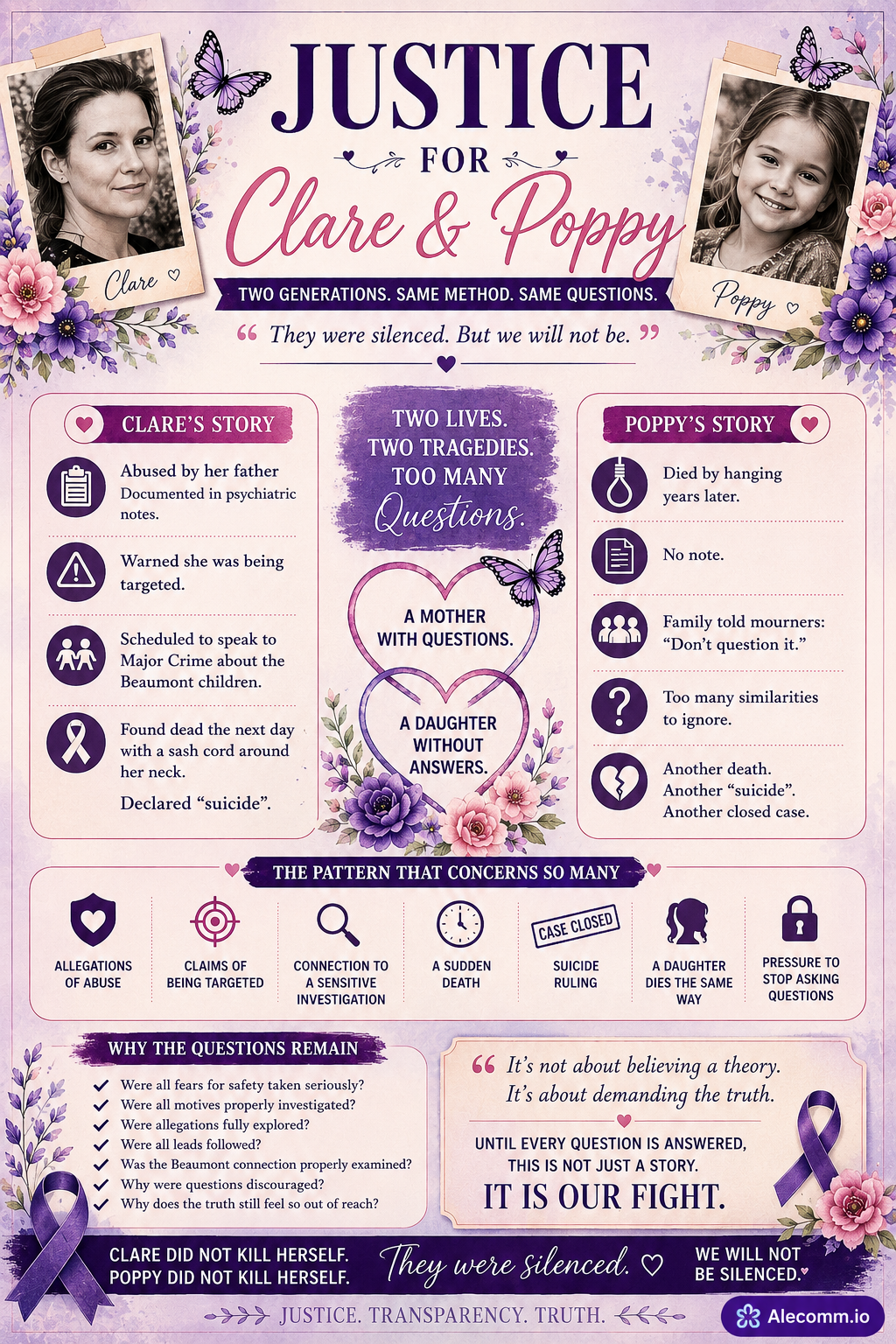
Before her death, Clare had reportedly spoken about abuse involving her father.
Those allegations were not whispered rumours circulating decades later. According to those familiar with the case, concerns were documented in psychiatric records.
More significantly, Clare was reportedly due to speak with Major Crime investigators regarding information connected to the Beaumont children mystery.
The Beaumont disappearance remains one of Australia’s most infamous unsolved cases.
Generations have grown up asking what happened.
Many people have theories.
Few claim to have answers.
Yet supporters argue that Clare may have possessed information investigators considered important enough to hear.
Then came the event that transformed concern into suspicion.
According to accounts from those questioning the official narrative, Clare had warned that she was being targeted.
The next day she was dead.
Authorities ruled suicide.
Case closed.
Or was it?
A Convenient Conclusion?
Throughout history, controversial deaths have often followed a familiar pattern.
A troubling allegation emerges.
A witness comes forward.
Sensitive information appears ready to surface.
Then, suddenly, the key person is gone.
Sometimes that really is suicide.
Sometimes it is not.
The problem is that when investigators move too quickly toward a conclusion, public trust evaporates.
Many people examining Clare’s case believe exactly that happened.
They argue that the broader circumstances surrounding her death were never given the scrutiny they deserved.
If someone had expressed fears for their safety, why were those concerns not treated more seriously?
If someone was preparing to speak with investigators, were all possible motives explored?
If someone had made allegations involving powerful or influential individuals, were those allegations fully investigated?
Supporters say those questions remain unanswered.
Then Came Poppy
Years later, tragedy struck again.
Clare’s daughter, Poppy, also died by hanging.
No note.
No explanation that satisfied those closest to her.
And once again, the official conclusion was accepted.
For sceptics, the similarities were impossible to ignore.
The same family.
The same method.
The same lingering doubts.
The same pressure to stop asking questions.
According to those who attended memorial gatherings and spoke with mourners, questioning the official narrative was strongly discouraged.
Whether that was motivated by grief, privacy, or something else remains a matter of interpretation.
But to those already suspicious, it appeared to be part of a familiar pattern.
Silence.
Acceptance.
Move on.
Do not ask questions.
The Pattern
Conspiracies are often dismissed because some theories are absurd.
But history also teaches another lesson.
Real conspiracies do exist.
Governments have hidden information.
Police forces have protected reputations.
Institutions have buried scandals.
Intelligence agencies have lied.
Courts have made mistakes.
Media organisations have ignored stories that later proved true.
The question is not whether conspiracies happen.
The question is whether one happened here.
Supporters of renewed scrutiny point to a pattern they believe is impossible to ignore:
• Allegations of abuse
• Claims of targeting
• Connections to one of Australia’s most sensitive criminal mysteries
• A sudden death
• A suicide ruling
• A daughter who later dies in the same way
• Continued demands for silence
Individually, each element may be explainable.
Together, they paint a picture many find deeply unsettling.
What If They Were Trying To Tell Us Something?
The most disturbing possibility is also the simplest.
What if Clare was telling the truth?
What if she genuinely feared for her safety?
What if the people around her underestimated the danger?
What if investigators never asked the right questions?
What if Poppy spent years carrying burdens nobody understood?
And what if the official explanations have prevented the public from looking deeper?
These questions do not prove murder.
They do not prove a cover-up.
They do not prove a conspiracy.
But they are questions that refuse to disappear.
Justice Requires Questions
The demand for justice is not necessarily a demand for certainty.
It is a demand for transparency.
A demand for evidence.
A demand for accountability.
A demand to know whether every lead was followed and every possibility examined.
For supporters of Clare and Poppy, the issue is not whether authorities reached a conclusion.
The issue is whether they reached the right one.
Until every question is answered, many believe the story of Clare and Poppy will remain what it has always been:
Not a closed case.
But an open wound.
And perhaps one of the most troubling unresolved mysteries many Australians have never heard about.
The Question That Remains
If Clare was about to speak…
If Clare believed she was being targeted…
If Poppy later died in the same manner…
If concerns were dismissed…
If questions were discouraged…
Then perhaps the most important question is not:
“Why won’t people let this story go?”
Perhaps it is:
“Why were so many people so eager for it to be forgotten?”
Leave a Reply