Did You Know?
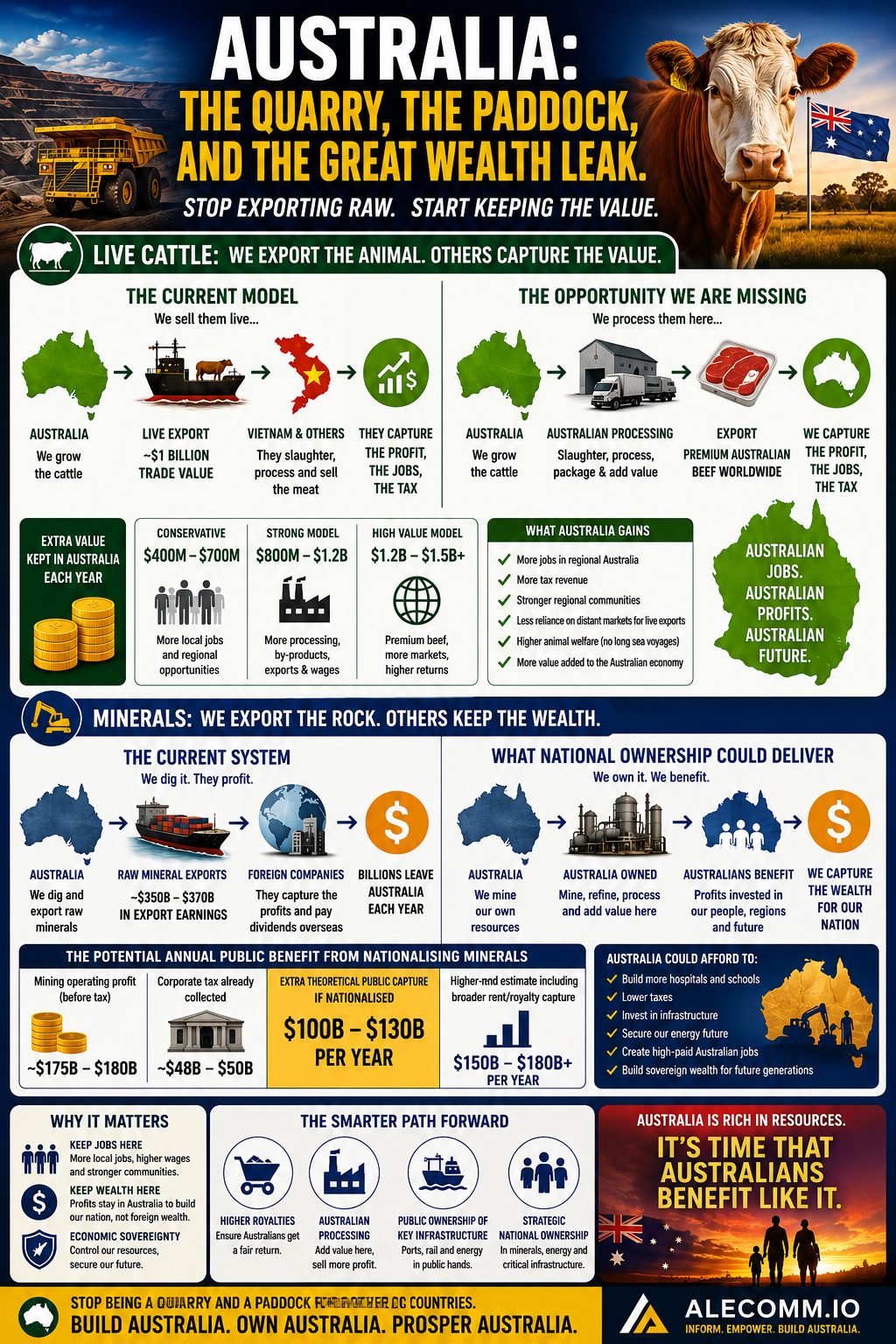
Australia could probably gain about $400 million to $1.5 billion per year in extra domestic economic activity by processing live-export cattle here instead of sending them offshore.
Nationalising the minerals sector is a much bigger beast. Depending on what you include, Australia could theoretically capture $100 billion to $180 billion+ per year in extra public revenue/profit, but only if the government ran the sector well and did not destroy investment, productivity, export contracts, or production. Big “if”. Very big. Elephant-in-a-high-vis-vest big.
Live Cattle Processing Estimate
Australia’s live cattle export trade is roughly around $1 billion per year.
If those cattle were processed in Australia instead, the extra value would come from:
- Slaughtering
- Boning
- Packaging
- Cold storage
- Hides, offal, tallow and by-products
- Exporting boxed beef instead of live animals
- More regional wages and tax receipts
A realistic added-value estimate would be:
| Scenario | Extra Value Kept In Australia |
|---|---|
| Conservative | $400 million–$700 million/year |
| Strong domestic processing model | $800 million–$1.2 billion/year |
| High-value boxed beef/by-product model | $1.2 billion–$1.5 billion+/year |
So yes, your argument is sound: Vietnam and others are capturing processing margin Australia could keep.
But Australia would need northern abattoirs, cold-chain infrastructure, reliable labour, cheaper power, and export-market access. Otherwise cattle just become stranded in the north and processors get a cheap-cattle bonanza.
Nationalising Minerals Estimate
Australia’s resources and energy export earnings are roughly in the $350 billion–$370 billion per year range recently/forecast.
Mining operating profit before tax in 2023–24 was roughly around $177 billion, based on ABS figures showing mining profit fell by $66.7 billion, or 27.4%.
Large miners already pay tax. One recent figure reported mining paid about $48.5 billion in corporate tax.
So the rough maths is:
| Item | Approximate Amount |
|---|---|
| Mining/resource export earnings | $350b–$370b/year |
| Mining operating profit before tax | About $175b–$180b/year |
| Corporate tax already collected from mining | About $48b–$50b/year |
| Extra theoretical public capture if nationalised | About $100b–$130b/year |
| Higher-end estimate including broader rent/royalty capture | $150b–$180b+/year |
The Big Catch
Nationalisation does not mean Australia magically gets the full export value. Revenue is not profit.
You still have to pay for:
- Wages
- Machinery
- Fuel
- Rail
- Ports
- Exploration
- Environmental rehab
- Capital replacement
- Global marketing
- Insurance
- Debt
- Technical management
The realistic prize is not the whole $350b+. The realistic prize is the profit/rent currently captured by private and foreign shareholders after costs.
Better Policy Than Full Nationalisation
The smarter model may be:
- Higher sovereign royalties
- Mandatory Australian equity stakes in strategic minerals
- State-owned processing/refining companies
- Domestic reservation for gas and critical minerals
- Public ownership of rail, ports and key infrastructure
- Ban raw export of selected minerals unless value-added locally
That gives Australia more control without blowing up the whole sector overnight.
Bottom Line
On cattle, Australia may be leaking hundreds of millions to over $1 billion a year by exporting live animals instead of processed beef.
On minerals, Australia may be leaking $100 billion+ a year in sovereign wealth by letting private and foreign corporations capture the downstream profit from public resources.
Australia is acting like a quarry and a paddock for other countries’ value chains. That is the core problem.
Sources
Australian Livestock Exporters’ Council — Economic Impact
https://auslivestockexport.com/about-alec/economic-impact
Meat & Livestock Australia — Red Meat Economic Impact 2023–24
https://www.mla.com.au/news-and-events/industry-news/what-role-does-red-meat-play-in-australias-economy/
Australian Bureau Of Statistics — Livestock Products, March 2026
https://www.abs.gov.au/statistics/industry/agriculture/livestock-products/latest-release
Australian Bureau Of Statistics — Australian Industry 2023–24
https://www.abs.gov.au/statistics/industry/industry-overview/australian-industry/latest-release
Department Of Industry — Resources And Energy Quarterly, December 2025
https://www.industry.gov.au/publications/resources-and-energy-quarterly-december-2025
ATO/Corporate Tax Reporting Figure Via News.com.au
https://www.news.com.au/finance/money/tax/tax-avoiders-drop-below-30-per-cent-as-corporate-australia-pays-100bn/news-story/53d49dac2121508a19a9408fc33bc5e0
Leave a Reply