
Live Cattle Exports: The Ultimate Hypocrisy Against “Footprint Reduction” Mandates
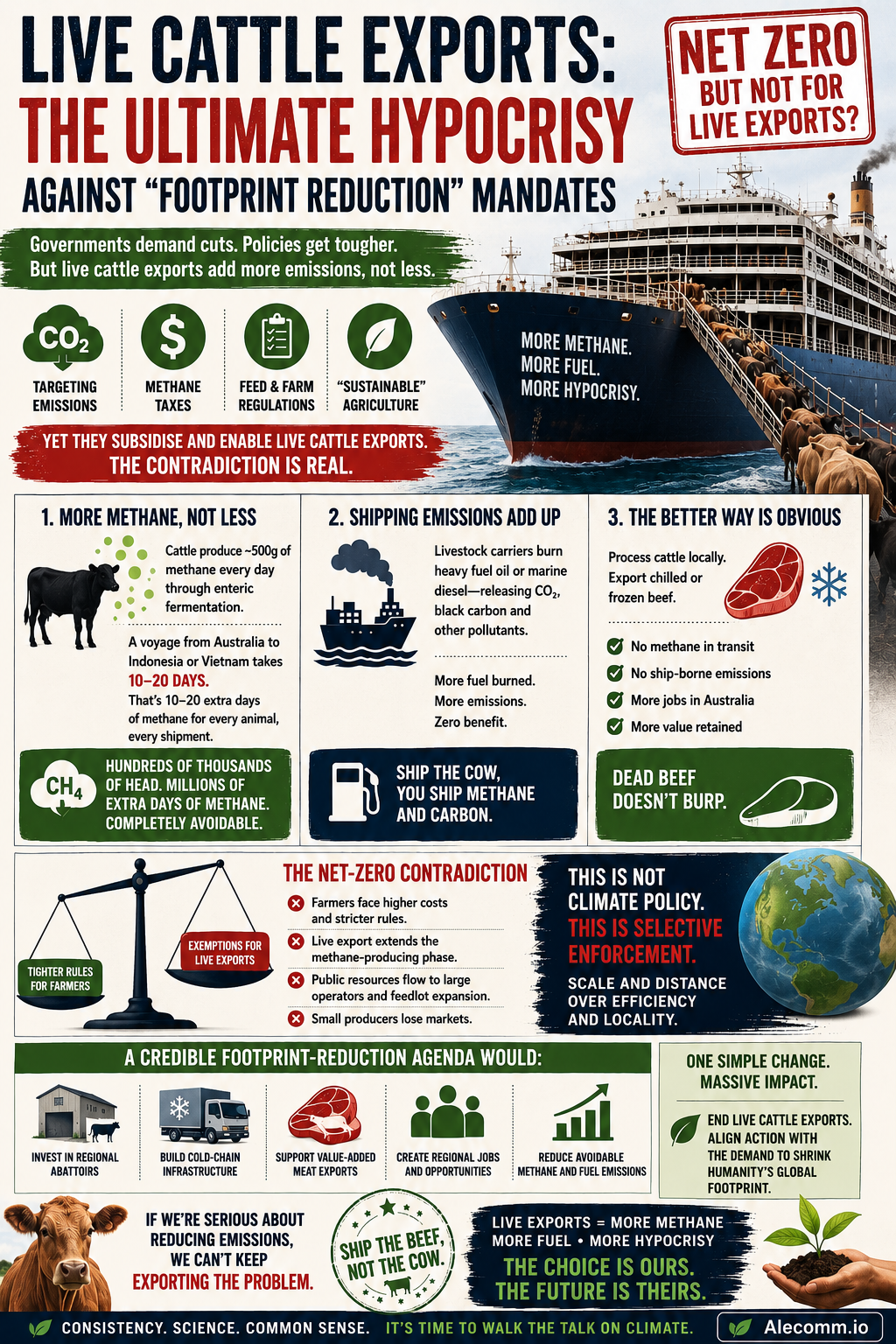
Governments and global bodies demand drastic cuts to humanity’s carbon and methane footprint. They impose net-zero targets, methane taxes, feed regulations, and so-called “sustainable” agriculture rules. Yet at the same time, they actively enable and subsidise live cattle exports — a practice that directly increases emissions through unnecessary long-distance transport of methane-producing animals.
Methane Doesn’t Stop At The Port
Cattle produce methane through enteric fermentation every day they live and eat. Whether they are on a farm, in a feedlot, or aboard a ship, methane production continues.
While these emissions are already counted within agricultural inventories, live export extends the methane-producing phase of the supply chain by days or even weeks. A voyage from northern Australia to Indonesia or Vietnam can keep cattle in transit for 10–20 days, during which methane production continues uninterrupted.
When multiplied across hundreds of thousands of exported cattle each year, the additional emissions become substantial. More importantly, they are entirely avoidable.
The Shipping Emissions Nobody Wants To Talk About
Methane is only part of the story.
Large livestock carriers burn significant quantities of heavy fuel oil or marine diesel. These fuels generate carbon dioxide, black carbon, sulphur compounds, and other pollutants throughout the voyage.
Unlike refrigerated containers carrying boxed beef, live-export vessels transport animals that continue consuming feed, producing manure, and emitting methane for the entire journey.
If those same cattle were processed locally and exported as chilled or frozen beef, the methane-producing phase would end before shipment.
Carcasses do not belch methane across oceans.
A Direct Contradiction To Net-Zero Rhetoric
This is where the contradiction becomes impossible to ignore.
Governments repeatedly tell farmers, businesses, and consumers that emissions must be reduced at every opportunity. Livestock producers face increasing pressure through methane targets, sustainability reporting requirements, and emissions-reduction programs.
Yet one of the most obvious opportunities to reduce avoidable emissions remains protected.
If reducing methane is genuinely the objective, why support a system that:
- Extends the methane-producing lifespan of cattle.
- Requires long-distance fossil-fuel transport.
- Exports jobs and economic activity offshore.
- Delays processing that could occur domestically.
The policy simply does not align with the stated objective.
The Economic Cost To Australia
The issue is not solely environmental.
Processing cattle within Australia creates regional employment, supports local abattoirs, strengthens cold-chain infrastructure, and generates greater value from every animal produced.
Live export transfers much of that economic activity overseas.
Meanwhile, family-owned and grass-fed producers increasingly face compliance costs associated with climate policies, while large vertically integrated operators continue benefiting from export systems that add both transport emissions and supply-chain inefficiencies.
The result is a policy framework that often appears to favour scale, distance, and corporate concentration over local production and regional economic development.
Selective Enforcement Or Genuine Climate Policy?
Critics argue that net-zero policies are being applied unevenly.
Small producers are expected to reduce emissions, improve reporting, and absorb additional regulatory burdens. Yet the live-export trade — a supply chain that adds both methane and shipping emissions — remains largely untouched.
Whether this reflects policy inconsistency, political influence, or simple inertia, the contradiction remains.
A climate policy cannot credibly demand emissions reductions while simultaneously protecting avoidable sources of emissions.
The Logical Alternative
A genuine footprint-reduction strategy would prioritise:
- Regional abattoirs.
- Expanded meat-processing capacity.
- Modern cold-chain logistics.
- Value-added beef exports.
- Greater domestic economic retention.
Such an approach would:
- Reduce avoidable methane emissions.
- Eliminate unnecessary ship-borne livestock emissions.
- Keep more jobs in regional Australia.
- Increase value captured from every animal produced.
Most importantly, it would align policy with rhetoric.
Conclusion
If governments are serious about reducing humanity’s carbon and methane footprint, then live cattle exports deserve the same scrutiny applied to every other sector.
Continuing to support long-distance transport of methane-producing animals while demanding emissions reductions elsewhere exposes a fundamental inconsistency at the heart of current policy.
Either footprint reduction matters, or it doesn’t.
If it does, live cattle exports remain one of the most obvious contradictions in the entire emissions debate.
References
1. Meat & Livestock Australia (MLA) – LiveLink Reports
https://www.mla.com.au/prices-markets/Trends-analysis/livelink/
2. Australian Government Department of Agriculture – Live Animal Export Statistics
https://www.agriculture.gov.au/biosecurity-trade/export/controlled-goods/live-animals/live-animal-export-statistics
3. Elmallah et al. (2024)
Reducing Methane Emissions on Livestock Ships.
4. Ridoutt et al. (2021)
Short Communication: Climate Impact of Australian Livestock Supply Chains.
5. Black et al. (2021)
Methane Emissions from Ruminants in Australia.
6. PETA Asia (Updated)
Live Export’s Huge Carbon Footprint.
7. Climate Council of Australia
Farming Down Under: Agriculture’s Role in Australia’s Emissions.
8. Department of Climate Change, Energy, the Environment and Water (DCCEEW)
https://www.dcceew.gov.au/climate-change/emissions-reduction/agricultural-land-sectors/livestock
9. Cattle Australia And Industry Submissions
10. Comparative Life-Cycle Assessment Studies Comparing Live Export And Boxed Beef Export Supply Chains
Leave a Reply