
Taxpayers Robbed Blind: Albanese’s Cabinet Blows Nearly $5 Million In Three Months On What, Exactly?
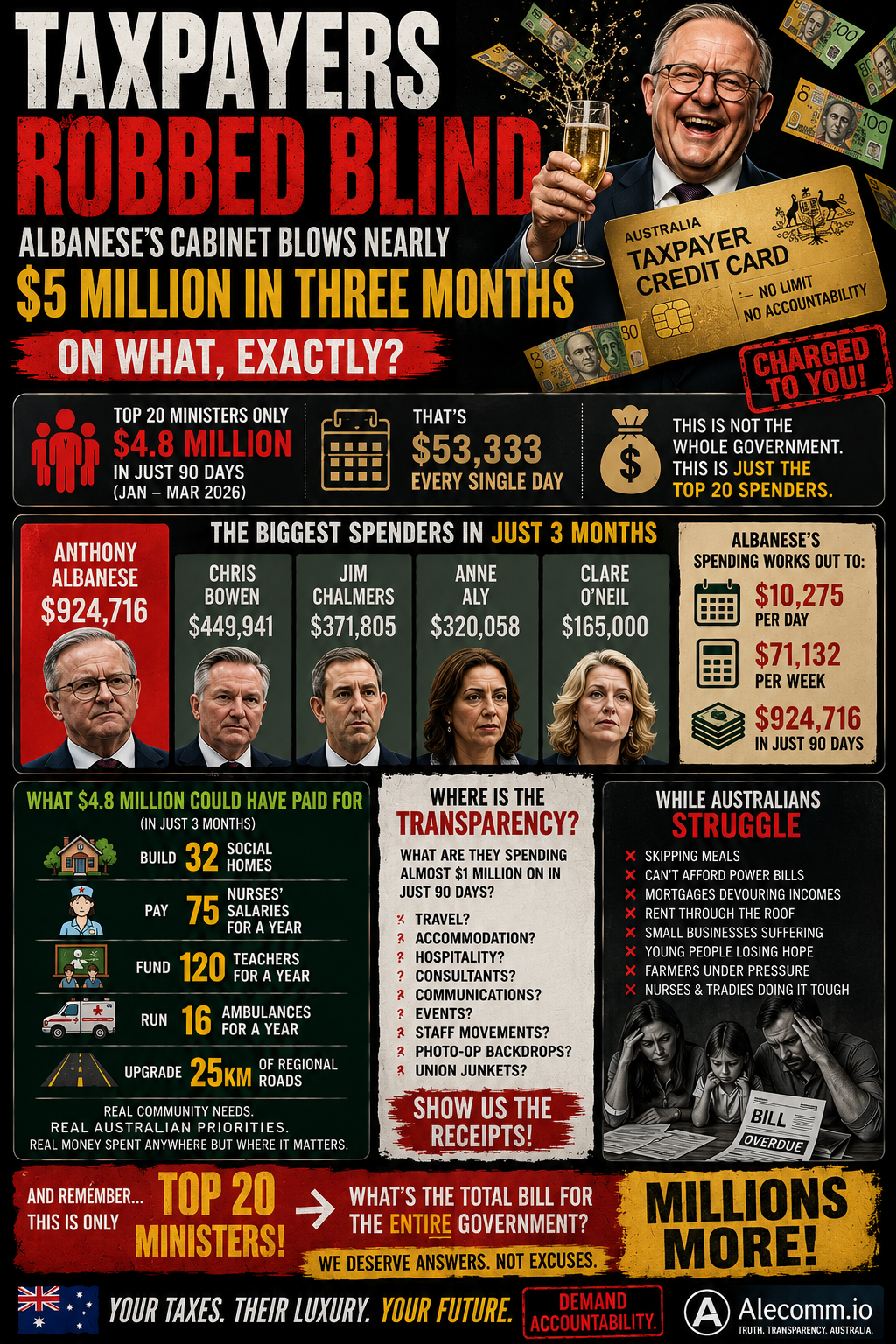
While everyday Australians are skipping meals, juggling power bills, and watching mortgage repayments swallow larger chunks of their income, Prime Minister Anthony Albanese and his ministerial colleagues appear to be operating in a completely different financial universe.
According to the latest IPEA figures for Q1 2026, the Top 20 Ministerial Spenders Alone recorded a combined $4.8 million in ministerial expenditure between January and March.
Let that sink in.
These figures do not represent the entire government.
They do not include every minister.
They do not include all parliamentarians.
They are simply the 20 biggest spenders.
If the highest-spending twenty ministers can collectively spend almost $5 million in just three months, Australians are entitled to ask a very simple question:
What Is The Total Bill Across The Entire Federal Government?
At the top of the spending table sits Anthony Albanese, the man who regularly speaks about cost-of-living relief while recording $924,716 in expenditure during a single quarter.
That equates to:
• $10,275 per day
• $71,132 per week
• Nearly $1 million in just 90 days
The average Australian worker would need years to earn what is being spent in a matter of weeks.
What exactly requires this level of expenditure?
Australians are constantly told there is not enough money for affordable housing, struggling regional communities, health services, aged care, or meaningful cost-of-living relief.
Yet somehow there always appears to be funding available for travel, offices, conferences, consultants, stakeholder engagement events, and the endless machinery of government.
Not to be outdone, several senior ministers also posted extraordinary figures:
Chris Bowen — $449,941
Jim Chalmers — $371,805
Anne Aly — $320,058
Even ministers lower down the Top 20 list are spending at rates that would shock ordinary taxpayers.
Clare O’Neil’s $165,000 quarterly expenditure still works out to approximately $1,833 every single day.
These are not numbers that suggest restraint.
These are numbers that suggest a political culture increasingly detached from the financial realities facing the people paying the bills.
The Bigger Question Nobody Is Asking
The media focus tends to stop at the individual totals.
But the more important question is what these numbers reveal about government spending as a whole.
If the Top 20 spenders alone accumulated nearly $5 million in three months, what happens when Australians add:
• The remaining ministers
• Assistant ministers
• Parliamentary secretaries
• Political advisers
• Government staff
• Consultants
• Departmental travel
• Conferences and events
• External contractors
• Communications and media operations
The final figure is likely many multiples higher.
Yet Australians are repeatedly told there is no money available for the issues that directly affect their daily lives.
Somehow, however, there always seems to be money available inside the Canberra bubble.
The Contradiction Is Impossible To Ignore
This is the same political class that:
• Talks about “shared sacrifice” during economic hardship
• Benefits from bracket creep that quietly increases the tax burden on workers
• Lectures Australians about reducing consumption and lowering emissions
• Tells young families there is no quick solution to housing affordability
• Warns households to prepare for ongoing economic pressures
Meanwhile, expenditure figures continue to climb.
For many Australians, the disconnect between what politicians say and how politicians spend has become impossible to ignore.
Where Is The Transparency?
Australians deserve more than broad expenditure categories.
They deserve detailed explanations.
What specific costs contributed to almost $925,000 in expenditure from the Prime Minister’s office in a single quarter?
How much was spent on travel?
How much on accommodation?
How much on hospitality?
How much on consultants?
How much on communications?
How much on events?
How much on staff movements?
Taxpayers should not be expected to simply accept large totals without meaningful scrutiny.
Public money requires public accountability.
A Political Class Living Beyond The Experience Of Its Citizens
The real issue is not merely the dollars.
It is what those dollars reveal.
While households cut spending, postpone holidays, delay medical treatments, and abandon dreams of home ownership, many Australians see a political class operating under an entirely different set of financial rules.
That perception damages trust.
It fuels resentment.
And it raises a legitimate question:
Has Canberra become so insulated from everyday life that it no longer understands the people funding it?
The Bottom Line
The IPEA Q1 2026 figures reveal that the 20 highest-spending ministers alone accounted for nearly $5 million in expenditure in just three months.
Not the whole government.
Not all ministers.
Not all parliamentarians.
Just the Top 20 spenders.
If that does not prompt serious questions about priorities, accountability, and transparency, what will?
Because every dollar spent by government began as a dollar earned by an Australian taxpayer.
And many of those taxpayers are finding it harder than ever to make ends meet while watching government spending continue to rise.
Your wallet funds the system.
The least you deserve is to know where the money went.
Leave a Reply