
How To Push Back: Holding Powerful Institutions Accountable On Biotech, Ticks, And Food Policy
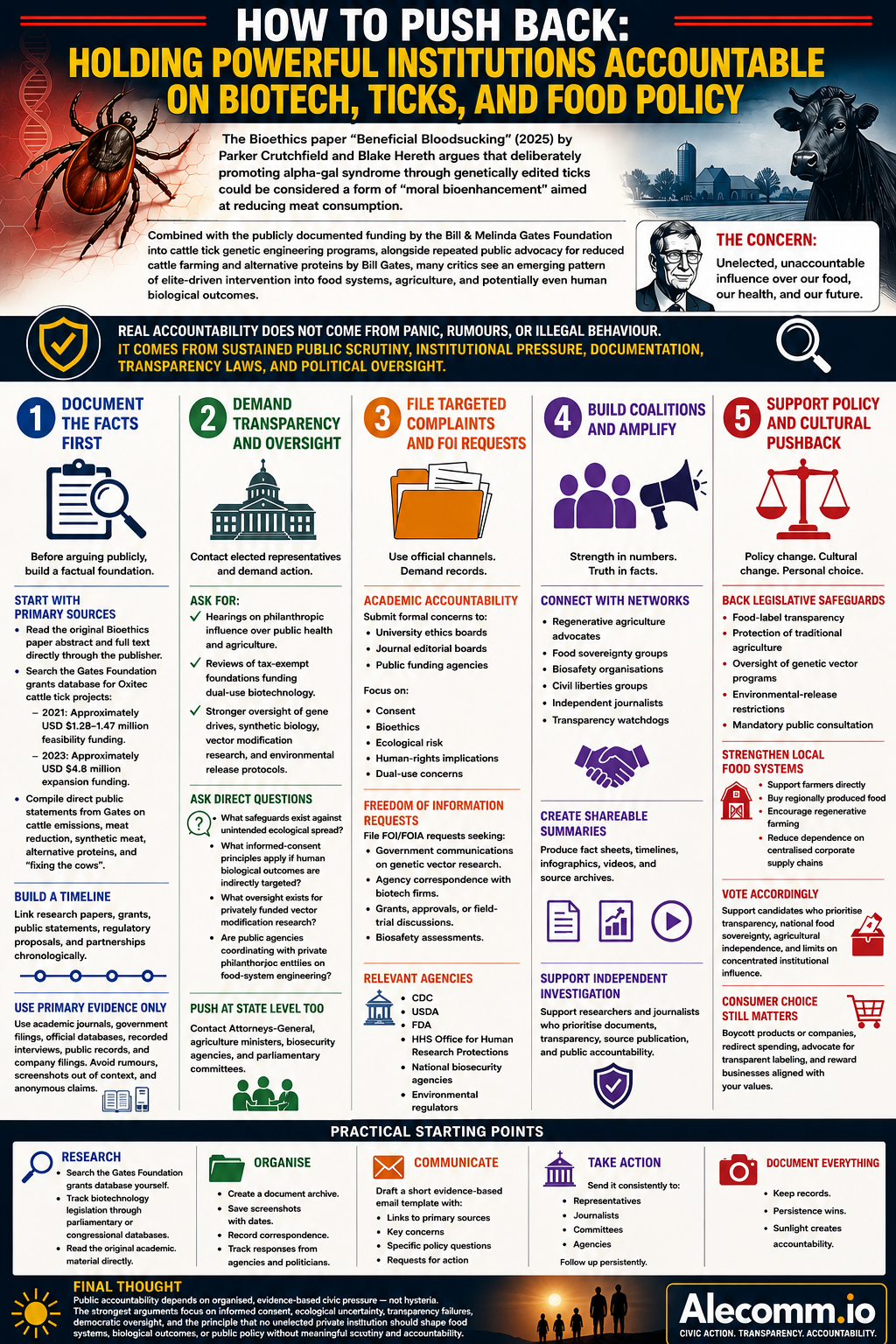
The Bioethics paper “Beneficial Bloodsucking” (2025) by Parker Crutchfield and Blake Hereth argues that deliberately promoting alpha-gal syndrome through genetically edited ticks could be considered a form of “moral bioenhancement” aimed at reducing meat consumption.
Combined with the publicly documented funding by the Bill & Melinda Gates Foundation into cattle tick genetic engineering programs, alongside repeated public advocacy for reduced cattle farming and alternative proteins by Bill Gates, many critics see an emerging pattern of elite-driven intervention into food systems, agriculture, and potentially even human biological outcomes.
Real accountability does not come from panic, rumours, or illegal behaviour. It comes from sustained public scrutiny, institutional pressure, documentation, transparency laws, and political oversight.
1. Document The Facts First
Before arguing publicly, build a factual foundation.
Start With Primary Sources
- Read the original Bioethics paper abstract and full text directly through the publisher.
- Search the Gates Foundation grants database for Oxitec cattle tick projects:
- 2021: Approximately USD $1.28–1.47 million feasibility funding.
- 2023: Approximately USD $4.8 million expansion funding.
- Compile direct public statements from Gates discussing:
- Methane emissions from cattle.
- Reducing meat consumption.
- Synthetic meat and alternative proteins.
- “Fixing the cows” through biotechnology.
Build A Timeline
Create a chronological timeline linking:
- Research papers.
- Grant announcements.
- Public speeches/interviews.
- Regulatory proposals.
- Biotech company partnerships.
Accuracy matters. One bad claim can destroy credibility faster than a politician deleting text messages during an inquiry.
Use Primary Evidence Only
Avoid recycled screenshots, memes, anonymous posts, or “my mate reckons” internet archaeology.
Use:
- Academic journals.
- Government filings.
- Official grant databases.
- SEC/company filings.
- Recorded interviews.
- Public parliamentary records.
2. Demand Transparency And Oversight
Contact Elected Representatives
Write to your federal and state representatives requesting:
- Hearings into philanthropic influence over public health and agriculture.
- Reviews of tax-exempt foundations funding dual-use biotechnology.
- Stronger oversight of:
- Gene drives.
- Synthetic biology.
- Vector modification research.
- Environmental release protocols.
Keep correspondence concise, factual, and evidence-linked.
Ask Direct Questions
Examples:
- What safeguards exist against unintended ecological spread?
- What informed-consent principles apply if human biological outcomes are indirectly targeted?
- What oversight exists for privately funded vector modification research?
- Are public agencies coordinating with private philanthropic entities on food-system engineering?
Push At State Level Too
State governments often control:
- Agricultural regulation.
- Biosecurity responses.
- Land management.
- Food labeling frameworks.
Contact:
- Attorneys-General.
- Agriculture ministers.
- Biosecurity agencies.
- Parliamentary committees.
3. File Targeted Complaints And FOI Requests
Academic Accountability
If you believe ethical boundaries are being crossed:
- Submit formal concerns to:
- University ethics boards.
- Journal editorial boards.
- Public funding agencies.
Focus specifically on:
- Consent.
- Bioethics.
- Ecological risk.
- Human-rights implications.
- Dual-use concerns.
Freedom Of Information Requests
File FOI/FOIA requests seeking:
- Government communications on genetic vector research.
- Agency correspondence with biotech firms.
- Grants, approvals, or field-trial discussions.
- Biosafety assessments.
Persistence matters. Bureaucracies often respond like a possum caught in headlights: freeze first, move later.
Relevant Agencies
Depending on jurisdiction:
- CDC
- USDA
- FDA
- HHS Office for Human Research Protections
- National biosecurity agencies
- Environmental regulators
4. Build Coalitions And Amplify
Connect With Existing Networks
Reach out to:
- Regenerative agriculture advocates.
- Food sovereignty groups.
- Biosafety organisations.
- Civil liberties groups.
- Independent journalists.
- Transparency watchdogs.
Broad coalitions carry more influence than isolated outrage.
Create Shareable Summaries
Produce:
- Fact sheets.
- Timelines.
- Infographics.
- Short-form videos.
- Source archives.
Keep messaging:
- Verifiable.
- Calm.
- Evidence-based.
- Easy to understand.
Support Independent Investigation
Independent researchers and journalists often investigate issues mainstream institutions ignore until the political weather changes.
Support work that prioritises:
- Documents.
- Transparency.
- Source publication.
- Public accountability.
5. Support Policy And Cultural Pushback
Back Legislative Safeguards
Support policies involving:
- Food-label transparency.
- Protection of traditional agriculture.
- Oversight of genetic vector programs.
- Environmental-release restrictions.
- Mandatory public consultation.
Strengthen Local Food Systems
Practical resistance often begins locally:
- Support farmers directly.
- Buy regionally produced food.
- Encourage regenerative farming.
- Reduce dependence on centralised corporate supply chains.
Vote Accordingly
Support candidates prioritising:
- Transparency.
- National food sovereignty.
- Agricultural independence.
- Limits on concentrated institutional influence.
Consumer Choice Still Matters
Consumers can:
- Boycott products or companies.
- Redirect spending toward local producers.
- Publicly advocate for transparent labeling.
- Reward businesses aligned with their values.
Markets notice when wallets start voting louder than hashtags.
Practical Starting Points
Research
- Search the Gates Foundation grants database yourself.
- Track biotechnology legislation through parliamentary or congressional databases.
- Read the original academic material directly.
Organise
- Create a document archive.
- Save screenshots with dates.
- Record correspondence.
- Track responses from agencies and politicians.
Communicate
Draft a short evidence-based email template containing:
- Links to primary sources.
- Key concerns.
- Specific policy questions.
- Requests for action.
Then send it consistently to:
- Representatives.
- Journalists.
- Committees.
- Agencies.
Follow up persistently.
Final Thought
Public accountability depends on organised, evidence-based civic pressure — not hysteria.
The strongest arguments focus on:
- Informed consent.
- Ecological uncertainty.
- Transparency failures.
- Democratic oversight.
- The principle that no unelected private institution should shape food systems, biological outcomes, or public policy without meaningful scrutiny and accountability.
Sunlight remains one of the few disinfectants governments, corporations, foundations, and academic institutions still genuinely fear.
Leave a Reply