A Revolving Door Of Violence: The System That Failed Kumanjayi Little Baby
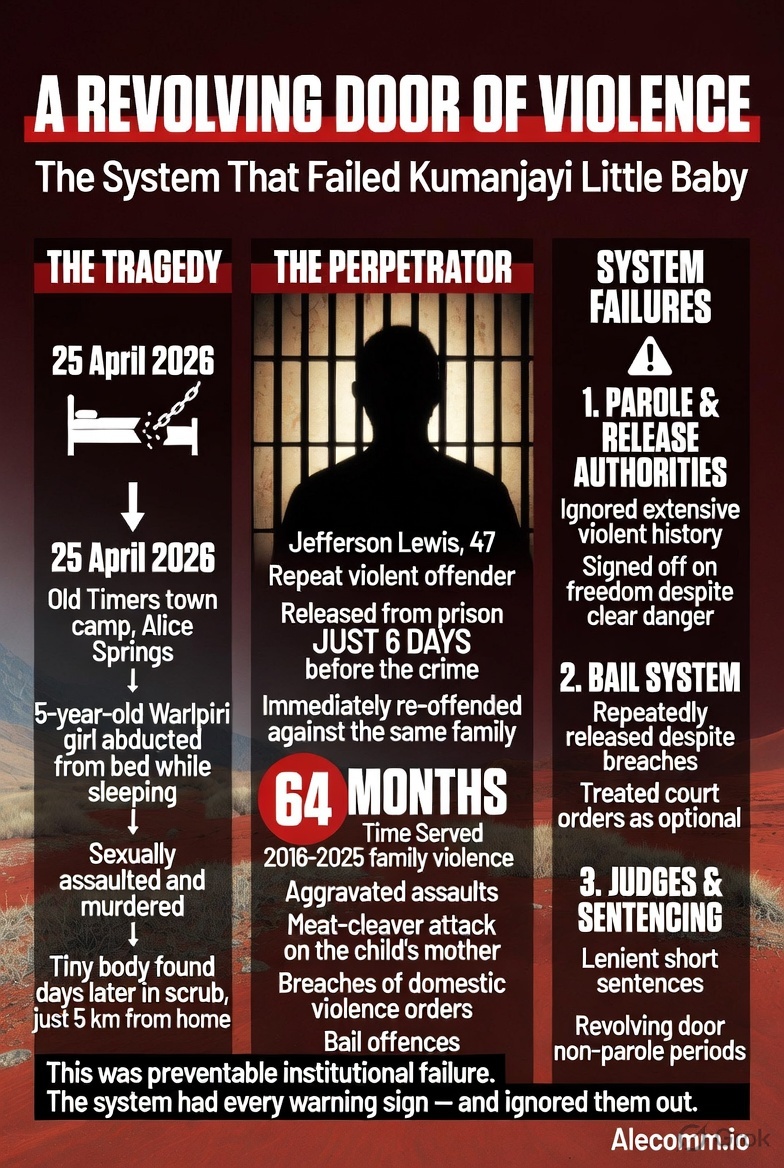
A five-year-old Warlpiri girl — known now as Kumanjayi Little Baby in line with her family’s cultural protocols — was tucked into bed at the Old Timers town camp near Alice Springs on the night of 25 April 2026. She never woke up. She was abducted, sexually assaulted, and murdered. Her tiny body was found days later in the scrub just five kilometres from the home where she should have been safe. The man charged with her murder and two counts of sexual assault is 47-year-old Jefferson Lewis — a repeat violent offender with a lengthy history of domestic violence, including a vicious meat-cleaver attack on the child’s own mother.
This was no random tragedy. This was a foreseeable, preventable horror enabled by the very institutions meant to protect the vulnerable: the parole and release authorities who signed off on his freedom, the bail system that kept giving him chances, and the judges who repeatedly failed to keep a dangerous man locked up.
Jefferson Lewis had just walked out of prison six days before the girl disappeared. He had served his full 18-month sentence for the meat-cleaver assault on his long-term partner — the child’s mother — plus extra time inside for breaches while locked up. Court records show he pleaded guilty to striking the woman in the right side of her head with the cleaver while their teenage son tried to intervene. That was no isolated incident. Lewis had racked up dozens of offences over the years, including aggravated assaults, breaches of domestic violence orders, bail offences, and resisting police. Between 2016 and 2025 alone he spent 64 months behind bars for violence that targeted the very family he is now accused of destroying.
Yet the system that released him looked at that record and decided he was fit to re-enter the community. He was not welcome back in Yuendumu because of his offending, so authorities directed him elsewhere. He turned up in Alice Springs anyway — within striking distance of the family he had already terrorised. The parole and release decision-makers had every warning sign they needed: a documented pattern of ignoring court orders, escalating domestic violence, and fresh offending while supposedly under supervision. They ignored it all and set him free.
The bail system bears equal blame. Lewis had a well-established habit of treating bail conditions and domestic violence orders as optional. Magistrates and bail sureties repeatedly let him out, accepting promises that he would stay away and keep the peace. How many times must a man breach court orders and commit fresh acts of violence before the people responsible for bail stop rolling the dice with other people’s lives? This was not a minor offender who missed a court date. This was a man with a clear, escalating history of targeted brutality against the mother of the child he is now accused of murdering.
And the judges who handed down those sentences? They failed Kumanjayi Little Baby long before she was taken from her bed. Time after time they looked at a rap sheet packed with aggravated assaults and domestic terror and decided that incremental prison terms — 18 months here, 19 months there — were sufficient. Non-parole periods became little more than a revolving door. Every lenient decision sent the same message: the system did not regard Lewis as a serious ongoing threat. It told his victims their safety was negotiable.
The child was never safe because Jefferson Lewis had already proven, in the most graphic terms possible, that he was capable of extreme violence against her own mother. He had an extensive, documented history of ignoring court orders, breaching bail, and committing fresh violence. He had only just been released after serving time for attacking that same mother with a meat cleaver. The authorities who approved his release into the community had every piece of evidence required to know he was not rehabilitated, not safe, and should never have been allowed anywhere near that family or that town camp.
This is not a case of “complex social issues.” This is institutional failure with blood on its hands. The parole and release authorities, the bail decision-makers, and the judges who kept extending chance after chance to a violent repeat offender now have questions to answer — loud, public, unforgiving questions. Kumanjayi Little Baby deserved better than to become the latest statistic proving that being soft on violent crime is not compassion. It is complicity.
The family has called for calm while the justice system does its work. That is their right. The rest of us do not have to stay silent. The system that failed this little girl must be dragged into the light, exposed for what it is, and forced to change — before the next child pays the price.
Leave a Reply