
High-Risk Wagyu Takeover
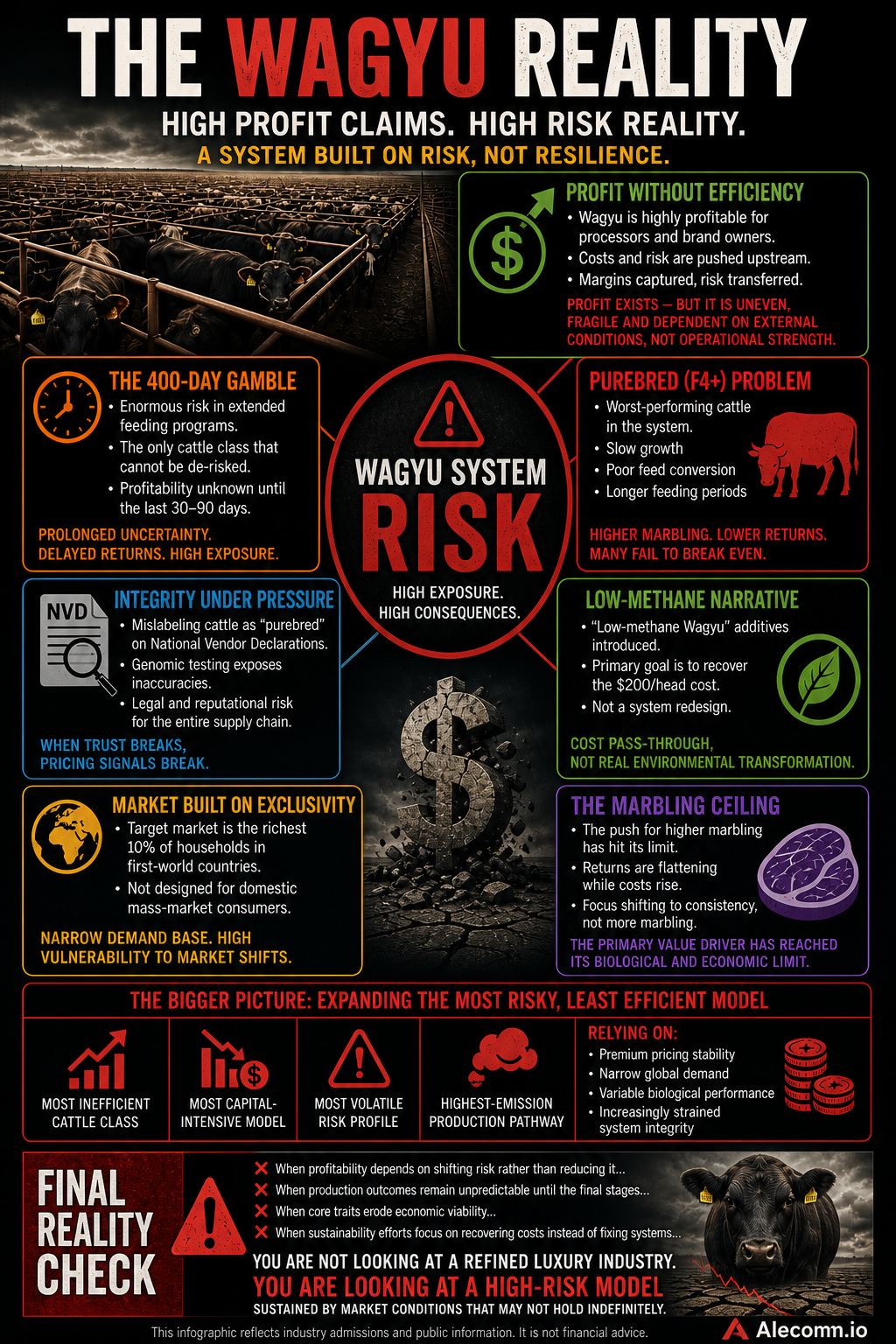
Most Australians still cling to the fantasy that Wagyu is a rare, pampered delicacy — a handful of spoiled cattle indulged with beer and daily massages. The reality is far less romantic and far more structural.
Wagyu genetics have expanded rapidly across northern Australia on a scale that remains poorly understood outside industry circles. While official figures attempt to quantify the shift, they consistently fail to capture what is visible on the ground across the Gulf, Cape York, Barkly Tableland, the Kimberley, and the Northern Territory.
In these regions, Wagyu bloodlines are no longer peripheral. They are becoming embedded across large portions of the northern herd.
The pitch has always been simple: improved calving and weaning performance compared to traditional Brahman systems. But the trade-off is significant. These animals are typically slower growing, less suited to extensive rangeland conditions, and heavily dependent on controlled finishing systems to realise their market value.
That dependency is not a flaw in the model. It is the model.
And it is exactly what the major players are positioning for.
The Wagyu Barons Orchestrating The Shift
A relatively small group of large corporate operators is driving the expansion of Wagyu genetics and long-fed production systems across Australia.
Key players include:
• JBS — operating some of the largest feedlot and Wagyu programs in the country
• Australian Agricultural Company (AACo) — one of the oldest and largest pastoral landholders, heavily invested in Wagyu systems
• Stanbroke — vertically integrated Wagyu breeder, feeder, and processor
• Hancock Agriculture (Gina Rinehart) — expanding Wagyu programs across northern holdings
• NH Foods (Oakey Beef) — major processor and exporter of Wagyu and Wagyu-cross cattle
• Rangers Valley — one of the largest long-fed Wagyu operators
• Kilcoy Global Foods — rapidly scaling Wagyu production capacity
These are not boutique producers. They are vertically integrated, capital-heavy operations with the ability to influence breeding decisions, supply chains, and market direction across the entire sector.
Their strategy is clear: control genetics upstream, control feeding systems midstream, and capture premium pricing downstream.
The Feedlot System At Scale
The scale of Wagyu finishing in Australia is often underestimated.
• Large feedlots can hold tens of thousands of cattle at any given time
• Long-fed Wagyu programs typically run 300 to 400+ days on feed
• Processing chains operating weekly throughput can translate into tens of thousands of animals annually per facility
When multiplied across multiple operators, this creates a highly industrialised production system — one that is structurally different from traditional pasture-based northern beef.
This is no longer a niche luxury segment.
It is a system-level shift.
The Efficiency And Sustainability Trade-Off
Long-fed Wagyu production delivers high marbling and premium pricing. That is the upside.
The trade-offs are harder to ignore:
• Extended feeding periods significantly increase total resource use per animal
• Grain-heavy diets shift cattle away from natural grazing systems
• Feedlot confinement introduces welfare and management challenges
• Emissions intensity per kilogram of beef is generally higher in long-fed systems compared to shorter, pasture-based production
At the same time, the broader industry continues to promote sustainability targets, including ambitions around carbon neutrality.
This creates a growing tension between market-driven production choices and public-facing environmental commitments.
The Structural Reality
Wagyu expansion is not an accident. It is the result of coordinated economic incentives:
• Premium export demand
• Strong pricing for marbled beef
• Vertical integration by large corporations
• Genetic programs aligned to feedlot finishing
The outcome is a gradual but undeniable shift in how northern cattle systems are designed and operated.
The Wake-Up Call
This is not simply about taste, branding, or luxury beef.
It is about:
• Land use transformation across northern Australia
• Increased dependence on feedlot finishing systems
• Changing herd genetics at scale
• Concentration of market power among a small number of major operators
If the full scale of this shift were widely understood, it would force a far more serious national conversation about sustainability, resilience, and the long-term direction of Australia’s beef industry.
This is not a fringe development.
This is a structural transition already underway.
Leave a Reply