
Francisco Partners (FP): Surveillance Tech and Massive Conflicts of Interest.
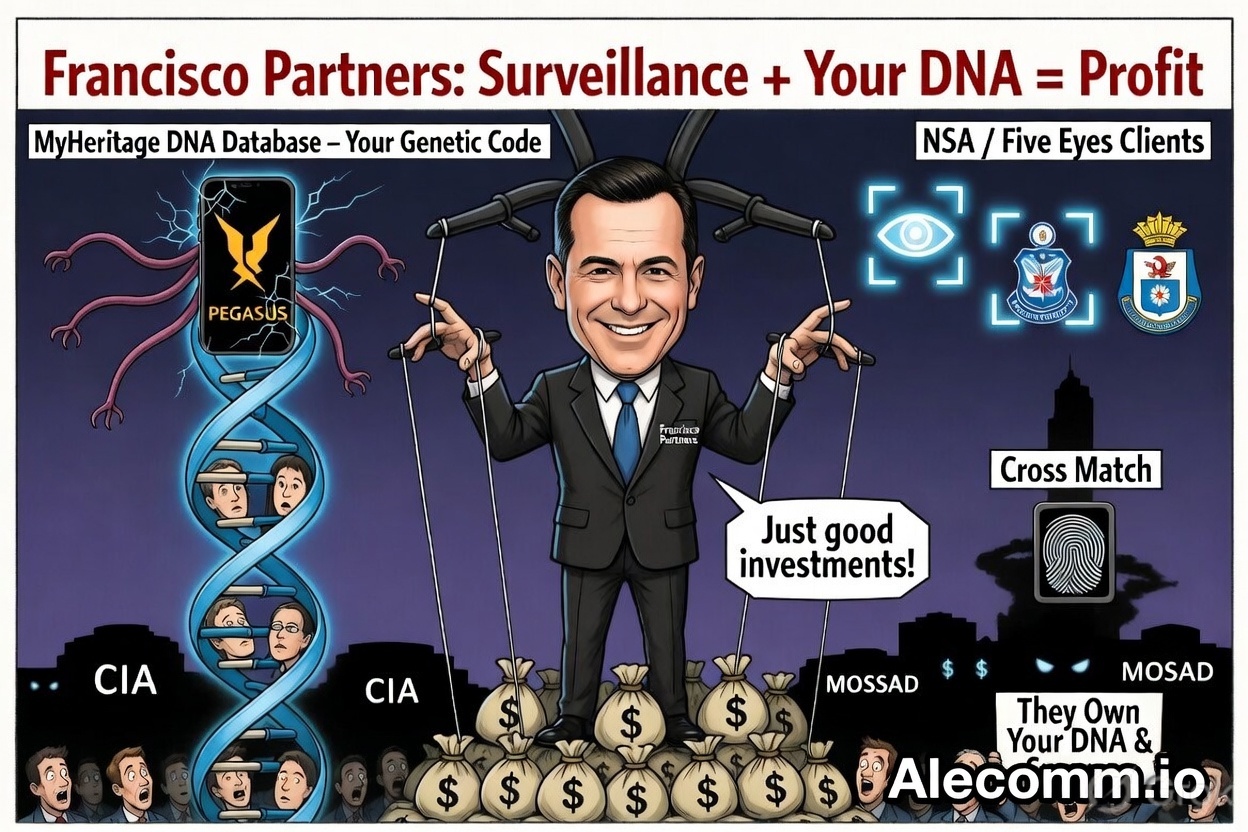
Francisco Partners (FP), a leading U.S. technology-focused private equity firm with over $45–50 billion in assets under management, has long specialized in cybersecurity, communications, software, and government-facing tech investments.
Francisco Partners (FP) currently owns MyHeritage, the Israel-based genealogy and consumer DNA-testing company that maintains one of the world’s largest consumer DNA databases (tens of millions of profiles from at-home DNA kits, plus family trees).a6abc35cd387
The firm’s most notable connection to the intelligence and defense ecosystem stems from its portfolio companies—particularly those supplying advanced cyber tools, biometrics, and security platforms routinely acquired or used by governments, defense departments, and allied intelligence networks (including Five Eyes partners).
NSO Group: The flagship case
The standout example is NSO Group. In 2014, Francisco Partners acquired a controlling ~65–70% stake in the Israeli firm for approximately $130 million.
NSO’s flagship Pegasus spyware—capable of zero-click device compromise—has been deployed by numerous governments for targeted surveillance. During FP’s ownership (until the stake was sold back in 2019 at a roughly $1 billion valuation), the investment directly exposed the firm to the global spyware ecosystem.
FP also backed an NSO affiliate, Circles, focused on phone geolocation and tracking. The firm helped establish an internal ethics committee at NSO, yet the deal placed FP squarely in the supply chain of tools central to intelligence operations worldwide.
Broader security and government-linked portfolio
Beyond NSO, FP’s Communications, Security & Infrastructure vertical includes other holdings with documented or likely ties to government and intelligence clients:
- Forcepoint (acquired from Raytheon): Provided cybersecurity and cross-domain solutions to the U.S. Department of Defense and broader Intelligence Community before FP divested the government-focused unit.
- Cross Match: Delivered biometrics and identity-verification technology used by the U.S. Department of Defense, Department of Homeland Security, and State Department.
- Additional security platforms: Companies such as Barracuda Networks, SonicWall, BeyondTrust, and Sumo Logic provide security, analytics, and cloud infrastructure tools frequently procured by government and critical-infrastructure entities.
Consumer DNA and genetic data exposure
FP’s holdings also extend into consumer genetic data through its 2021 acquisition of MyHeritage, a major genealogy and DNA-testing platform with one of the world’s largest consumer DNA databases, comprising millions of profiles from at-home testing kits.
MyHeritage combines family-history records with genetic matching and is actively marketed for ancestry and health insights. As of late 2025, FP has been exploring a potential ~$1 billion sale of the business.
Why this matters—and why it should raise concern
These companies, through FP, effectively control or have controlled vast troves of highly sensitive personal data—including genetic information.
Genetic data is fundamentally different from other forms of data:
- It is permanent and cannot be changed
- It reveals ancestry, health predispositions, and familial relationships
- It can extend beyond the individual to entire family networks
When a single investment firm has exposure to both:
- Advanced surveillance tools (spyware, biometrics, cyber platforms)
- Mass-scale biological data (consumer DNA databases)
…the risk profile escalates significantly.
Potential pathways for access or misuse include:
- Legal mechanisms such as subpoenas
- Government or intelligence partnerships
- Data breaches or cyber compromise
- Future ownership transfers or acquisitions
Even where companies publicly commit to not selling or sharing genetic data, national security frameworks can override corporate policies, and commercial incentives to aggregate or monetise datasets remain.
Bottom line
In an era of expanding digital surveillance and cyber-espionage, the convergence of private equity, surveillance technology, and biological data represents a structural shift in power.
A relatively small group of investors can sit at the intersection of:
- Data collection
- Data analysis
- Operational surveillance capability
That concentration creates the potential for tracking, profiling, and long-term identity mapping at a scale that goes far beyond traditional biometrics—moving into the territory of permanent, biological-level data control.
Leave a Reply