
Title: The 2014 Unit 8200 Refusal — Israeli Intelligence Veterans Protest Abuses Against Palestinians
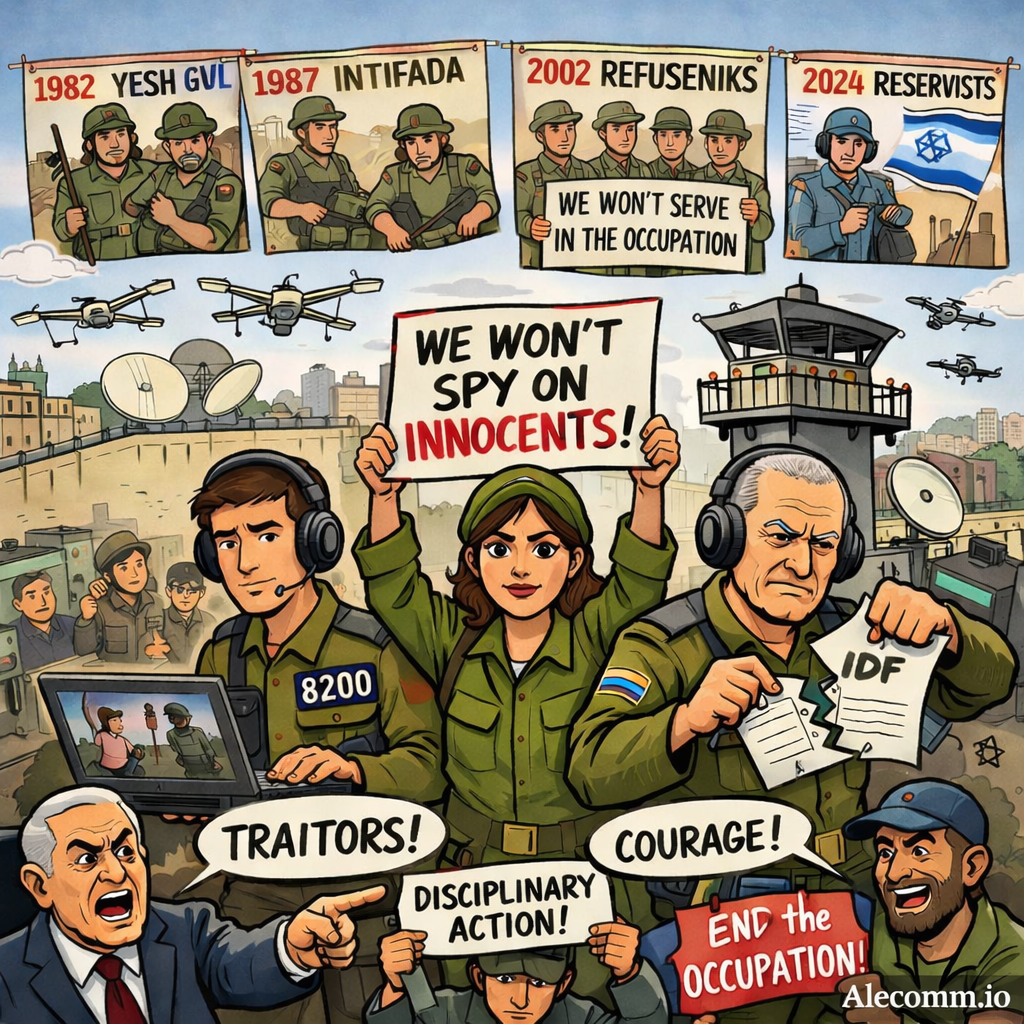
In September 2014, 43 veterans and reservists from Israel’s elite signals-intelligence Unit 8200 publicly refused to perform reserve duty, citing moral objections to surveillance practices targeting Palestinians. Their letter, addressed to Prime Minister Benjamin Netanyahu and senior military leadership, alleged systemic abuses connected to intelligence operations in the occupied territories.
Unit 8200, often compared to the U.S. National Security Agency (NSA), is responsible for electronic surveillance, cyber intelligence, and signals interception, and serves as a major pipeline into Israel’s high-technology sector. The signatories — including commissioned officers — argued that intelligence collection made “no distinction between Palestinians who are, and are not, involved in violence.”
According to the letter, gathered intelligence was allegedly used not only for security purposes but also for political pressure and coercion. The veterans claimed personal information — including medical conditions, financial hardship, or sexual orientation — could be exploited to recruit collaborators or exert influence, reinforcing military control over civilian populations.
“We refuse to take part in actions against Palestinians and refuse to continue serving as a tool for deepening military rule in the Occupied Territories,” the letter declared.
The refuseniks argued that large-scale surveillance eroded privacy, harmed uninvolved civilians, intensified tensions, and contributed to divisions within Palestinian society.
The Israel Defense Forces (IDF) rejected the accusations, describing the protest as politically motivated and warning of disciplinary consequences. Military officials maintained that intelligence operations function under strict oversight and ethical standards, disputing claims of systemic abuse. Political reactions were divided: some leaders condemned the refusal as insubordination, while others viewed the act as a rare expression of ethical dissent within an otherwise highly secretive intelligence establishment.
The incident echoed earlier acts of military refusal in Israel but stood out for focusing specifically on intelligence ethics and surveillance practices, igniting broader debate about the relationship between national security, occupation policy, and civil liberties.
These refusals also reflect a longer pattern of Israeli internal dissent connected to military operations and government policy, including:
• 1982 — Yesh Gvul Movement: Soldiers refuse service during the Lebanon War, challenging the legitimacy of extended military operations beyond Israel’s borders.
• 1987 — First Intifada: Selective refusals emerge among reservists assigned to policing and enforcement duties in occupied territories.
• 2002 — Combatants’ Letter: More than 51 reservists publicly refuse service in the West Bank and Gaza, citing opposition to occupation-related missions.
• 2003 — Pilots’ Refusal: 27 Israeli Air Force pilots decline participation in targeted strike missions in Palestinian territories; elite commandos also voice opposition to certain operational orders.
• 2014 — Gaza War Refusals: Approximately 50 reservists refuse participation in operations linked to the Gaza conflict.
• 2023–2024 — Post–October 7 Refusals: Reports indicate 365+ reservists declined or threatened refusal connected to Gaza operations, reflecting widening internal divisions over wartime policy.
Taken together, these episodes illustrate an enduring tension within Israeli society between security imperatives and moral objection, demonstrating that debate over military conduct and national strategy has persisted across decades — including within Israel’s own military and intelligence ranks.
Leave a Reply