This Was Not a Protest. It Was Felony Obstruction — And the Law Is Clear.
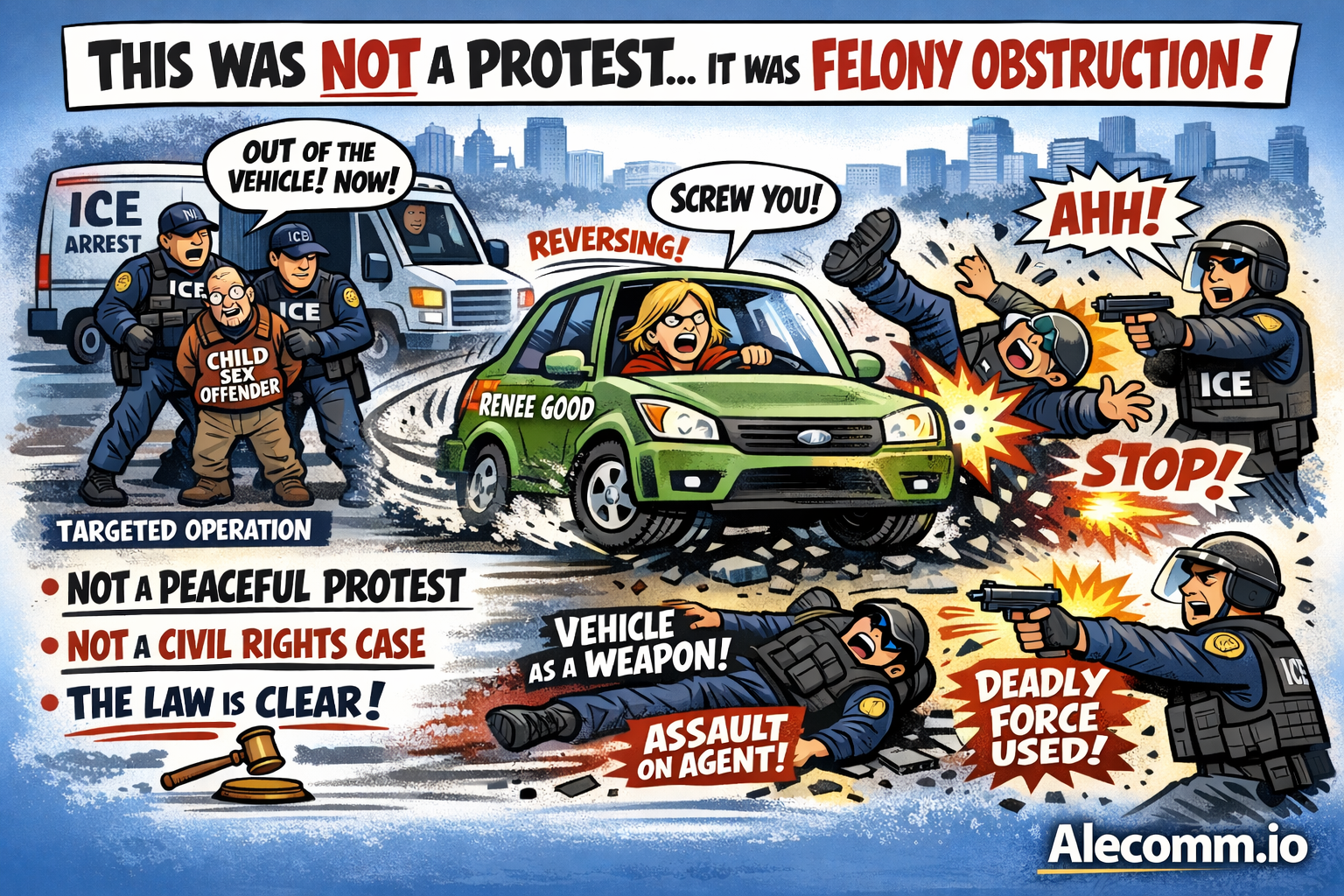
What happened in Minneapolis has been deliberately misframed. This was not a clash between ICE and “protesters.” It was criminal interference with a targeted federal immigration enforcement operation — and it ended exactly the way the law predicts when someone escalates with a vehicle.
The operation
Federal agents from Immigration and Customs Enforcement were conducting a targeted arrest to detain an illegal alien child sex offender. This was not a random sweep. It was not a traffic stop. It was a specific, lawful operation.
The obstruction
Renee Good did not stumble into this. She impeded the operation, blocked federal vehicles and public traffic, and ignored lawful commands. When agents moved to arrest her for obstruction, she refused to exit the vehicle.
Then she escalated.
She put the vehicle in reverse and accelerated, striking a federal agent. A vehicle used this way is deadly force under long-settled law. At that moment, the encounter crossed a bright legal line.
The use of force
Faced with imminent serious bodily harm, the agent fired. That is not politics. That is objective reasonableness under federal use-of-force standards. Officers are not required to be injured — or killed — before defending themselves. The law does not ask agents to gamble with their lives.
Why there is no civil-rights case
Calls for a civil-rights prosecution ignore the actual legal threshold. Criminal civil-rights charges require proof that an officer willfully violated a clearly established constitutional right — knowing the force used was unlawful at the time.
That standard is intentionally high. It exists to protect lawful enforcement and prevent hindsight prosecutions based on optics rather than facts. When a suspect uses a vehicle as a weapon and strikes an officer, that standard is not met.
This is why the Department of Justice declined to pursue a civil-rights prosecution. Not because of politics. Because the law does not support it.
The resignations — what they were, and weren’t
Several federal prosecutors resigned after DOJ leadership refused to green-light a civil-rights case. That disagreement was internal and professional — but disagreement does not transform an unjustified prosecution into a justified one. Prosecutors can resign; the law does not change to accommodate their preferences.
The rhetoric problem
Local political leaders, including Jacob Frey and Tim Walz, chose rhetoric over restraint. That rhetoric matters. It emboldens people to believe they are morally licensed to obstruct federal operations. When that belief meets a two-ton vehicle, the consequences are predictable — and tragic.
Call it what it is
This was not civil disobedience.
This was not a protest gone wrong.
This was felony obstruction followed by assault with a deadly weapon on a federal officer.
The agent did not create the danger. The escalation did.
The law is clear. Pretending otherwise is how we get more of this — and more people hurt.
References (for verification)
- 18 U.S.C. § 111 — Assaulting, Resisting, or Impeding Certain Officers
https://www.law.cornell.edu/uscode/text/18/111 - 18 U.S.C. § 242 — Deprivation of Rights Under Color of Law
https://www.law.cornell.edu/uscode/text/18/242 - Graham v. Connor, 490 U.S. 386 (1989) — Objective reasonableness standard
https://supreme.justia.com/cases/federal/us/490/386/ - Scott v. Harris, 550 U.S. 372 (2007) — Vehicle as deadly force context
https://supreme.justia.com/cases/federal/us/550/372/
Leave a Reply