This is What Obstruction of Federal Law Enforcement Looks Like
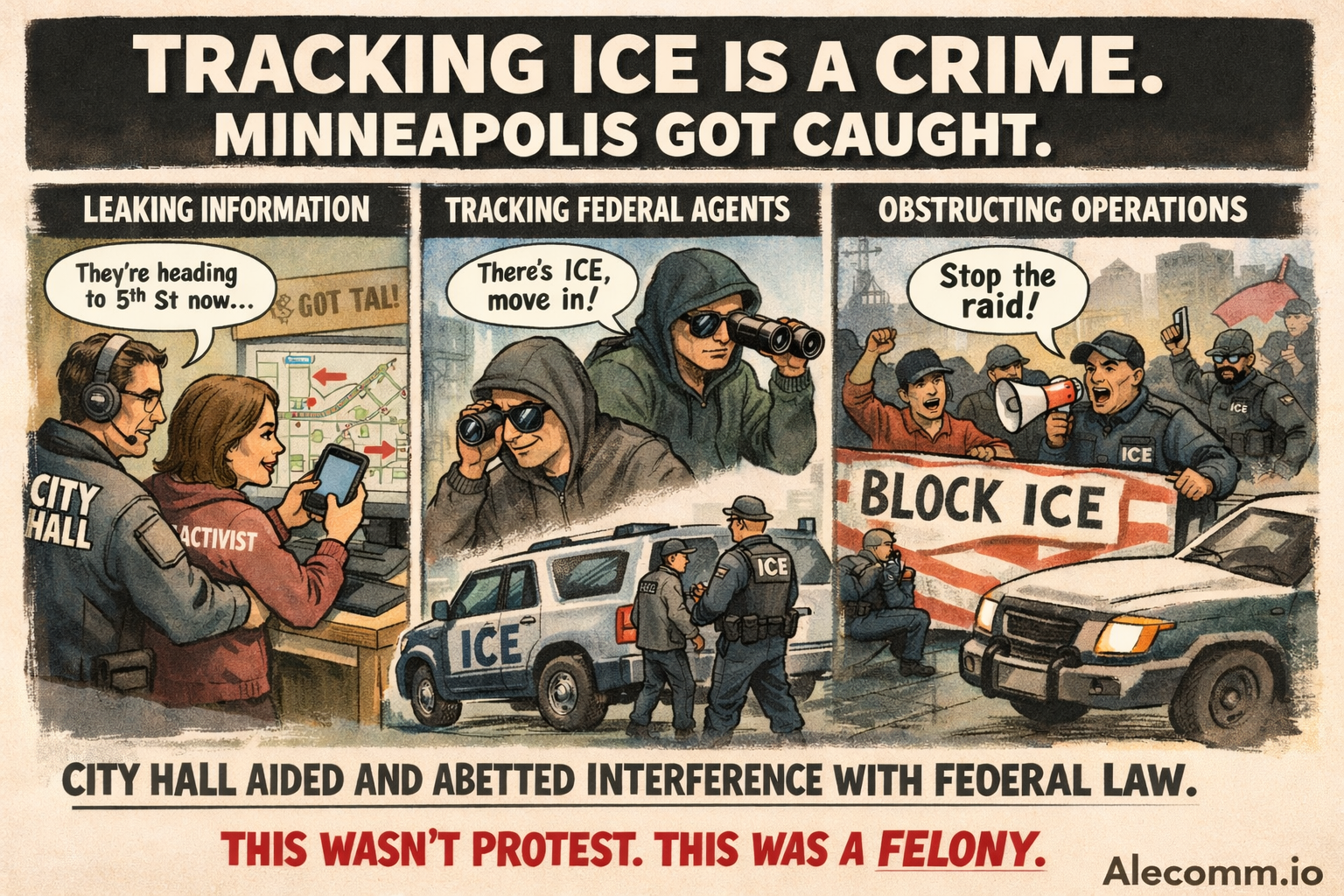
(Federal Immigration Enforcement Interference)
To: United States District Court for the District of Minnesota / United States Attorneys
Re: Enforcement Orders and Criminal Charges — Obstruction of ICE and CBP Operations
Operation: Metro Surge — Immigration Enforcement Actions, Minneapolis, Minnesota
1. APPLICANT
Name: __________________________
Address: _______________________
Telephone: _____________________
2. DEFENDANT(S)
Name: __________________________
Alias (if any): __________________
Address / Last Known Location: __________________________
3. BASIS FOR APPLICATION
This Application seeks the issuance of arrest warrants, protective orders, and felony criminal charges against individuals who have engaged in conduct that includes, but is not limited to:
- Obstructing or interfering with ICE and CBP operations;
- Assaulting, resisting, or impeding federal officers;
- Using motor vehicles to threaten, block, or endanger federal agents;
- Blocking, cordoning, or otherwise obstructing federal operational zones;
- Removing, damaging, or defeating security fencing and barriers erected by federal law enforcement;
- Participating in rioting or civil disorder resulting in federal criminal violations.
This Application is supported by the Injunction Order issued January 16, 2026, by the United States District Court for the District of Minnesota, which defines lawful and unlawful conduct during assemblies and activities occurring in connection with Operation Metro Surge.
4. STATEMENT OF FACTS
On or about January 7, 2026, large crowds assembled in the vicinity of active federal immigration enforcement operations in Minneapolis, Minnesota.
During these events, numerous individuals engaged in conduct including:
- Blocking ICE agents from carrying out lawful enforcement actions;
- Using motor vehicles to follow, impede, or attempt to strike federal officers;
- Blocking traffic and cordoning off operational zones;
- Removing or damaging security fencing installed to protect officers, vehicles, and federal installations;
- Forming human barricades to obstruct arrests and officer movement.
These actions are documented through video recordings, eyewitness accounts, and incident reports.
While peaceful observation or recording from a lawful distance remains constitutionally protected, the conduct described above escalated into violent and obstructive behavior, including the weaponization of vehicles against federal officers. Such conduct exceeds the scope of protected protest activity.
5. ADDITIONAL BASIS FOR CHARGES
Unlawful Tracking and Disclosure of Federal Operations
5.1 Statement of Conduct
Newly obtained evidence indicates that municipal employees of the City of Minneapolis, acting individually and/or in coordination with external “partners,” engaged in conduct including:
- Sharing or relaying real-time or near-real-time information concerning ICE and CBP officer locations, movements, and operational activity;
- Coordinating with third parties who actively tracked, followed, or mobilized against federal officers;
- Providing information that materially assisted individuals in positioning themselves to obstruct, confront, or interfere with federal immigration enforcement operations.
Such conduct occurred with knowledge, or at minimum reckless disregard, that the information would be used to interfere with lawful federal law enforcement activity.
5.2 Legal Relevance
The sharing of operational information that materially assists third parties in locating, confronting, or interfering with federal officers constitutes facilitation of obstruction, not protected speech.
This conduct is legally distinguishable from passive observation or public commentary because it:
- Transmits actionable, operational intelligence;
- Occurs in real or near real time;
- Enables physical interference, obstruction, or danger to officers;
- Is reasonably foreseeable to result in confrontation, disruption, or violence.
5.3 Applicable Federal Offenses (Illustrative)
Such conduct may support charges including, but not limited to:
- Obstructing and Impeding Federal Officers
Knowingly facilitating interference with officers engaged in official duties. - Aiding and Abetting Interference
Providing assistance that enables others to obstruct or impede federal law enforcement. - Civil Disorder–Related Interference
Where information sharing occurs in the context of riots or violent assemblies and materially assists obstruction. - Conspiracy
Where coordination exists between employees and external partners to track or disrupt federal operations.
Physical presence at the scene is not required where the defendant’s conduct materially facilitated the interference.
5.4 Relationship to Court Order
Any conduct violating the Court’s Protective Order—particularly provisions concerning:
- the five-metre moving safety zone;
- tracking or surveillance of federal officers;
- disclosure of operational or movement information;
constitutes independent grounds for arrest and prosecution, and may additionally support contempt of court proceedings.
6. APPLICABLE FEDERAL STATUTES AND GROUNDS
A. 18 U.S.C. § 111 — Assaulting, Resisting, or Impeding Certain Officers
Forcibly assaulting, resisting, opposing, impeding, intimidating, or interfering with a federal officer while engaged in official duties, including use of a vehicle as a weapon.
Charge Requested: Felony.
B. 18 U.S.C. § 231 — Civil Disorder
Willfully obstructing, impeding, or interfering with law enforcement officers by force or violence during a civil disorder.
Charge Requested: Felony.
C. 18 U.S.C. § 1752 — Restricted Federal Areas
Entering, remaining in, or interfering with restricted areas during federal operations.
Charge Requested: Misdemeanor or Felony (depending on conduct).
D. 18 U.S.C. § 373 — Solicitation / Aiding and Abetting
Encouraging or facilitating conduct intended to obstruct or interfere with lawful federal enforcement.
E. Related Federal Offenses
- 18 U.S.C. § 1361 — Destruction of Government Property;
- 18 U.S.C. § 831 — Use of Fireworks or Explosives Against Federal Property (where applicable).
7. MINNESOTA STATUTES (PARALLEL STATE CHARGES, IF APPLICABLE)
- Minn. Stat. § 609.50 — Obstructing Legal Process / Police Officer;
- Minn. Stat. § 609.66 — Riot;
- Minn. Stat. § 609.2231 — Dangerous Weapons (including vehicles used dangerously);
- Minn. Stat. § 609.605 — Interference with Public Safety.
State charges may be pursued where conduct also violates Minnesota law and federal supremacy principles permit concurrent enforcement.
8. LEGAL JUSTIFICATION
The federal injunction order makes clear that peaceful observation and recording are protected activities. However, conduct that escalates into violent obstruction, interference with ICE and CBP operations, tracking of officers, or assaultive behavior is not protected and constitutes prosecutable felony conduct under federal law.
The requested relief is necessary to ensure:
- Protection of federal officers and the public;
- Enforcement of federal statutes governing obstruction and assault;
- Deterrence of continued unlawful interference with federal operations.
9. REQUESTS FOR RELIEF
The Applicant respectfully requests:
- Issuance of arrest warrants for the named Defendant(s) for violations of 18 U.S.C. §§ 111, 231, 1752, and related statutes;
- Entry of protective and enforcement orders prohibiting further interference with federal operations;
- Direction that future violations of such orders be treated as felony obstruction;
- Notification of all relevant federal and state authorities.
Signature: ______________________________
Date: _________________________________
Leave a Reply