Application for Emergency Orders Protecting Federal Immigration Enforcement Operations
UNITED STATES DISTRICT COURT
DISTRICT OF MINNESOTA
In re: Protection of Federal Immigration Enforcement Operations
Civil Action No. __________
APPLICATION FOR EMERGENCY ORDERS
To Protect Federal Officers, Halt Violent Interference, and Reassert Federal Supremacy
INTRODUCTION — THIS IS NOT A THEORETICAL DISPUTE
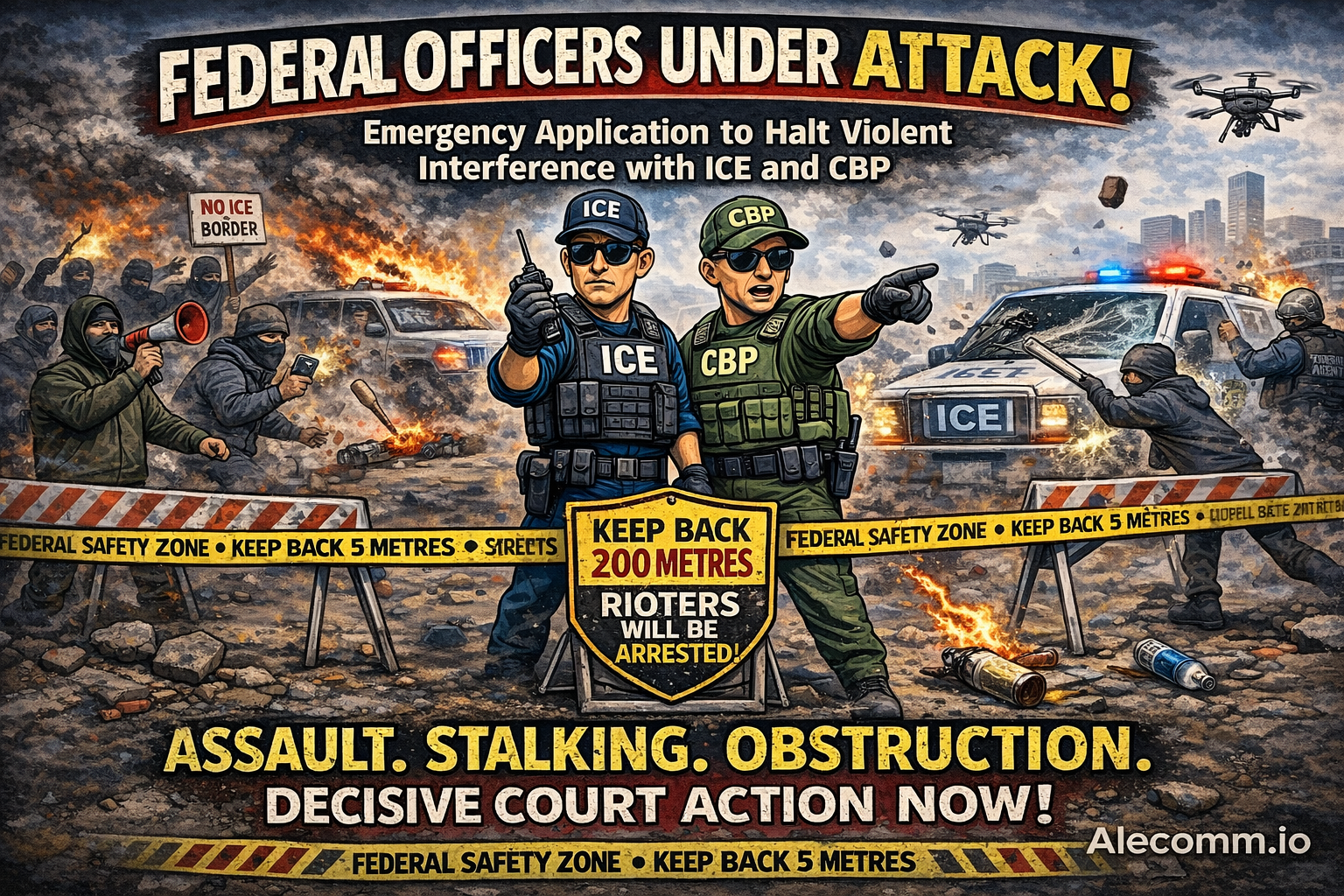
This Application is compelled by sustained, escalating, and extreme violence directed at federal immigration officers operating lawfully within the District of Minnesota.
Since January of last year, and intensifying dramatically following the current administration’s enforcement posture, ICE and CBP officers have been subjected to organized campaigns of violence, intimidation, stalking, and obstruction.
This conduct is not incidental.
It is not spontaneous.
It is not protest.
It is deliberate criminal interference with federal law enforcement.
Federal officers have:
• Been shot at during enforcement operations
• Been struck with vehicles used as weapons
• Been ambushed and beaten with improvised and blunt weapons
• Been surrounded and restrained by human barricades
• Been doxed, with personal and family information disseminated
• Had vehicles vandalized and destroyed
• Been urinated on and physically degraded
• Been tracked, shadowed, and stalked before, during, and after operations
• Had temporary accommodations identified and targeted
This Court is not being asked to referee speech.
It is being asked to stop violence before officers are killed.
JURISDICTION AND AUTHORITY
This Court has jurisdiction under:
• Article III of the United States Constitution
• 28 U.S.C. § 1331 (federal question)
• 28 U.S.C. § 1345 (United States as plaintiff)
• The Court’s inherent equitable authority to prevent irreparable harm to federal functions
This Court also has authority to restrain conduct violating federal criminal law, including but not limited to:
• 18 U.S.C. § 111 — Assaulting, resisting, or impeding federal officers
• 18 U.S.C. § 115 — Threats and retaliation against federal officers
• 18 U.S.C. § 1361 — Destruction of federal property
• 18 U.S.C. § 1505 — Obstruction of federal agency proceedings
• 18 U.S.C. § 1512 — Witness intimidation and harassment
• 18 U.S.C. § 1519 — Obstruction and concealment
• 18 U.S.C. § 2101 — Federal anti-riot statute
• 18 U.S.C. § 1951 — Interference by threats or violence
• 18 U.S.C. § 2383 — Rebellion or insurrection against federal authority
• The Supremacy Clause, U.S. Const. art. VI, cl. 2
STATEMENT OF FACTS — A CONTINUOUS PATTERN OF CRIMINAL CONDUCT
ICE and CBP officers are executing lawful federal immigration enforcement pursuant to congressional mandate.
For more than twelve months, those operations have been met with coordinated criminal behavior, including:
• Vehicular assaults designed to strike or trap officers
• Planned ambushes during arrests and transport
• Use of weapons and projectiles
• Human encirclement and barricade tactics
• Auditory attacks using whistles, horns, sirens, and amplification to mask commands
• Real-time tracking and shadowing of officers and convoys
• Targeting of officer lodging locations
• Doxing campaigns designed to intimidate officers and their families
This conduct squarely meets the legal definition of stalking, harassment, assault, obstruction, and intimidation.
State and municipal inaction — and in some cases facilitation — has emboldened this violence.
WHY DISTANCE IS LEGALLY NECESSARY
This Application seeks distance-based orders, not punishment.
Courts routinely impose exclusion zones where behavior constitutes:
• Stalking
• Targeted harassment
• Threat-based intimidation
• Operational interference
Here, distance is the only effective safety control.
REQUESTED ORDERS
I. DEFINITIONS
Federal Officers
ICE, CBP, and any assisting federal personnel.
Federal Operations
Any lawful arrest, transport, surveillance, staging, perimeter security, or enforcement activity.
Interference
Any act that obstructs, impedes, delays, hinders, tracks, stalks, harasses, intimidates, or disrupts federal officers.
II. TWO-HUNDRED (200) METRE FEDERAL EXCLUSION ZONE — STATIC
A. Establishment
A mandatory 200-metre exclusion zone is established around:
• Any active federal immigration enforcement operation
• Any federal staging or perimeter area
• Any location where federal officers are temporarily accommodated or housed during operations
B. Prohibited Presence
No protester, demonstrator, organizer, or member of a disruptive assembly may knowingly enter or remain within this zone.
C. Legal Basis
This exclusion is justified by:
• Documented stalking and tracking behavior
• Targeting of officer movements and lodging
• Repeated ambush and assault incidents
This zone is narrowly tailored to officer safety and operational integrity.
III. FIVE (5) METRE MOVING SAFETY ZONE — DYNAMIC
A. Establishment
A mandatory five (5) metre no-go zone exists at all times around:
• Any federal officer
• Any federal law-enforcement vehicle or convoy
• Any operational infrastructure
This zone moves continuously with officers and vehicles.
B. Absolute Prohibitions
No person may:
• Enter or remain within five (5) metres
• Follow, shadow, encircle, or pursue officers or vehicles
• Position vehicles within the zone
• Remove, damage, or reposition safety barriers
C. Per Se Obstruction
Any violation of the five-metre zone is conclusively deemed OBSTRUCTING AND IMPEDING FEDERAL LAW ENFORCEMENT.
No intent. No exceptions.
IV. VEHICLES AS AGGRAVATED CONDUCT
Use of a vehicle to approach, block, shadow, or penetrate either safety zone constitutes:
• Aggravated obstruction
• Assault under federal law
V. AUDITORY AND COMMUNICATION INTERFERENCE
The use of whistles, horns, sirens, amplification, or coordinated noise that:
• Masks commands
• Disrupts coordination
• Provides cover for assaults
is prohibited and constitutes obstruction.
VI. TRACKING, DOXING, AND INFORMATION SHARING
A. Tracking and Surveillance
Any monitoring, shadowing, or tracking of officers, vehicles, or lodging locations is prohibited.
B. Doxing
Dissemination of personal or operational information about officers constitutes unlawful intimidation.
C. Officials and “Partners”
Any state or municipal employee who facilitates such conduct is subject to enforcement.
VII. CONDUCT OF STATE AND MUNICIPAL OFFICIALS
Officials shall not:
• Encourage or legitimize interference
• Minimize criminal conduct
• Withhold cooperation necessary for officer safety
• Share operational information
Failure to deter or active facilitation may constitute obstruction under color of law.
VIII. ENFORCEMENT AUTHORITY
Federal officers are authorized to:
• Issue immediate dispersal orders
• Detain and arrest violators
• Remove persons from restricted zones
• Enforce this Order without delay
IX. CLARIFICATION OF NON-PROTECTED ACTIVITY
There is no constitutional right to:
• Stalk
• Surround
• Follow
• Harass
• Intimidate
• Obstruct
• Assault
federal officers.
X. DURATION
These Orders remain in effect for the duration of federal immigration enforcement operations in the District of Minnesota unless modified by this Court.
CONCLUSION
Federal officers are not expendable.
Federal law is not optional.
The violence described above demands decisive judicial action.
Applicants respectfully request that this Court enter these Orders immediately.
Leave a Reply