Refusal, Acceleration, Imminence: The Legal Threshold Met
LEGAL BRIEF
1. Issue Presented
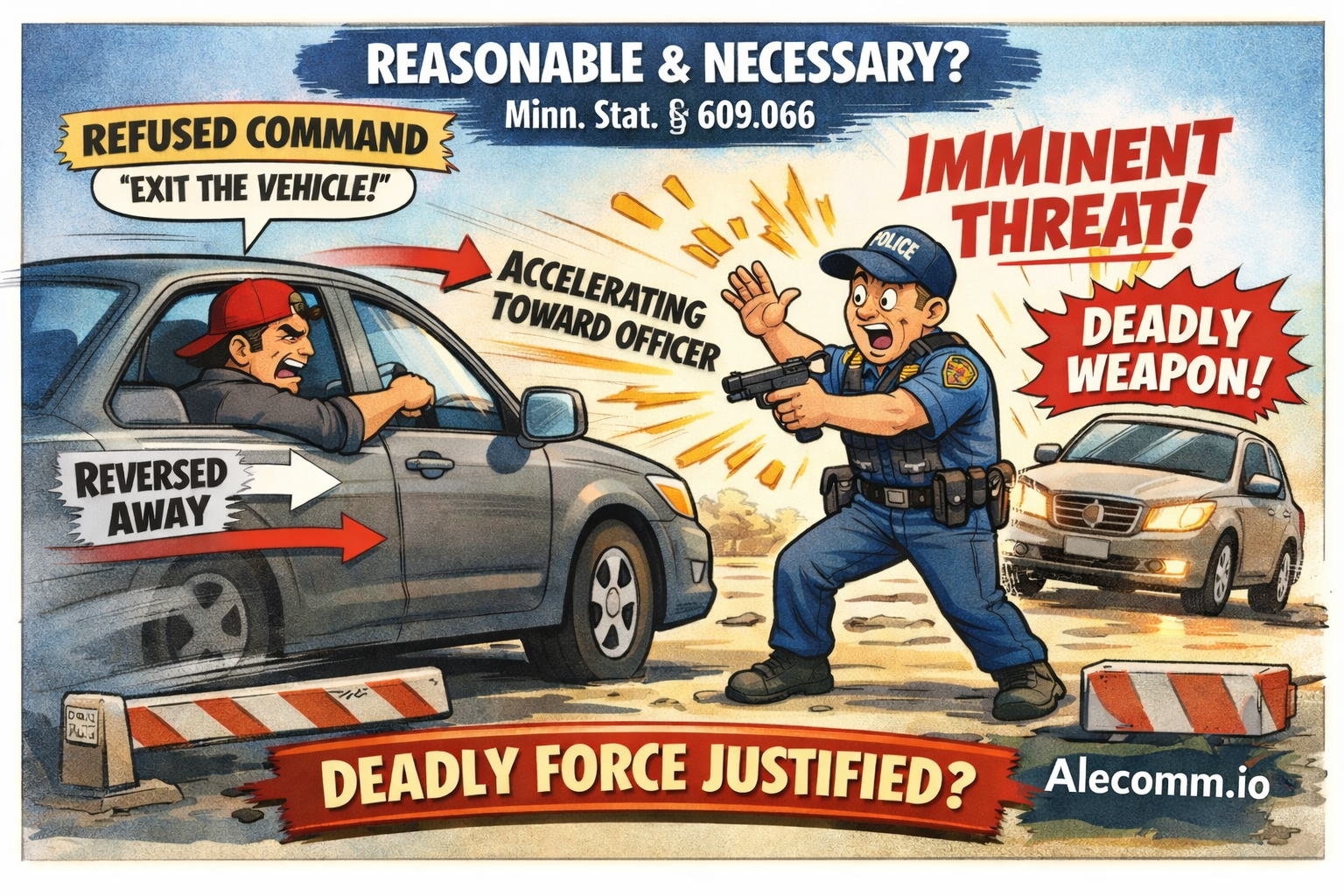
Whether a peace officer’s use of deadly force is legally justified under Minnesota Statute § 609.066 when a driver, after receiving lawful commands to exit a vehicle during a targeted law enforcement operation, reverses and then accelerates the vehicle toward an officer.
2. Relevant Law
2.1 Minnesota Statute § 609.066 authorizes a peace officer to use deadly force when the officer reasonably believes such force is necessary to:
- protect the officer or others from death or great bodily harm, or
- prevent the commission of a felony involving the use or threatened use of deadly force.
2.2 The determination is made based on:
- the totality of the circumstances,
- viewed from the perspective of a reasonable officer on the scene.
2.3 The statute does not require:
- physical contact,
- verbal threats, or
- actual injury
before deadly force may be used.
3. Facts Considered
3.1 Law enforcement officers are engaged in a lawful, targeted operation.
3.2 A driver actively impedes that operation using a motor vehicle.
3.3 The driver is given a lawful command to exit the vehicle.
3.4 The driver refuses to comply.
3.5 The driver:
- reverses the vehicle, then
- accelerates forward toward an officer positioned in front of or near the vehicle.
3.6 The officer has: - limited time to react, and
- limited avenues of escape.
4. Analysis
4.1 Courts consistently recognize a motor vehicle as a deadly weapon when used in a manner capable of causing death or great bodily harm.
4.2 Intent may be inferred from conduct, not verbal statements. Relevant factors include:
- acceleration,
- direction of travel,
- proximity to the officer,
- refusal to comply with lawful commands,
- the officer’s ability to retreat or evade the threat.
4.3 The reverse-then-forward maneuver demonstrates deliberate control of the vehicle rather than inadvertent movement.
4.4 Acceleration toward an officer creates an immediate and objectively lethal risk.
4.5 An officer is not required to wait for impact or injury to confirm intent.
4.6 Under these circumstances, a reasonable officer could conclude that:
- the vehicle is being used as a weapon, and
- the threat of death or great bodily harm is imminent.
4.7 The officer’s response must be assessed:
- in real time,
- without the benefit of hindsight.
4.8 Given the combination of:
- proximity,
- speed,
- noncompliance, and
- lack of safe alternatives,
the use of deadly force may be deemed necessary to prevent death or serious bodily injury.
5. Conclusion
5.1 Under Minnesota Statute § 609.066, the described conduct supports a finding that the use of deadly force is legally justified.
5.2 Provided that available evidence corroborates:
- the officer’s positioning,
- reaction time, and
- the driver’s vehicle movement and noncompliance,
the officer’s actions would likely be upheld as reasonable and lawful under the statute.
Leave a Reply